Design
How to Design an At-Home Library in a Tiny, Modular, or Container Home: The 2026 Design Reference
The at-home library trend has moved into small homes — and it works. Here's the 2026 design reference for building a real library into 480-1,200 sq ft modular, container, or tiny homes. Featured on Redfin.

On this page

The American at-home library has had a remarkable cultural moment since 2020. Redfin's editorial team has tracked the trend through multiple feature pieces, and the underlying buyer behavior has been consistent across markets — from Asheville, NC and Boise, ID to Madison, WI — homeowners who once treated dedicated reading rooms as a luxury for large houses are now designing them into 600, 800, and 1,200 square foot homes with the same intention as a primary bedroom. This guide is for the buyer building or owning a small modular, container, or tiny home who wants to design a real at-home library into the footprint — not a corner of bookshelves, but a designed space worth living in.
If you've been told a tiny or modular home can't accommodate a serious library, this guide is the reference that proves otherwise.
Why At-Home Libraries Matter More in Small Homes
The conventional wisdom is that a small home should be ruthlessly multi-functional — every square foot has to earn its keep, and dedicated single-use space is a luxury. The trend data points the other direction. Homeowners in small modular and tiny homes are reporting higher satisfaction when one room or zone is treated as single-purpose — a library, a music room, a writing studio — than when every space is forced into double duty.
The reason is psychological. In a large home, the kitchen is the kitchen and the library is the library because the rooms physically separate. In a small home, programming bleeds together unless the design explicitly resists it. A reading nook in the corner of a living room gets used as a phone-call space, a laundry-folding space, a guest sleeping space. A defined library zone — with its own door or its own sightline closure or its own ceiling treatment — stays a library.
This is the underlying lesson from the recent at-home library cultural moment: dedicated space, even in a small home, produces a quality of use that multi-purpose space cannot.
The Four Design Moves That Make a Small-Home Library Work
Move 1 — Define the Zone Architecturally

In a small modular or container home, the library zone needs to be architecturally defined so it doesn't drift into general living space. The four approaches that work:
Approach A — Wall-defined. A partition wall (full or half height) separates the library zone from adjacent space. Works in 600+ sq ft homes where one wall can be dedicated.
Approach B — Ceiling-defined. A different ceiling treatment — exposed beams, a coffered detail, a lower drop — signals zone boundary without a physical wall. Works in any size.
Approach C — Floor-defined. A different flooring material (wood transitioning to wood with a different stain, or wood transitioning to tile) marks the library zone. Works in any size.
Approach D — Built-in defined. Floor-to-ceiling built-in bookshelves on two adjacent walls create an L-shaped enclosure that functionally separates the library zone from the rest of the home. Works in 480+ sq ft homes.
Most successful small-home libraries combine two of these — most commonly a built-in enclosure plus a ceiling treatment.
Move 2 — Ceiling-Height Shelving With Real Structure

Bookshelves are heavy. A typical filled bookshelf carries 18-32 pounds of books per linear foot of shelf — significantly more than most decorative shelving is designed to support. In a small modular or container home, the structural attachment to the wall framing matters more than in a larger home because the wall thickness is often less, and because the visual prominence of any sag or failure is greater.
The structural rules that work:
- Direct anchorage to wall framing, not drywall anchors. Toggle bolts and butterfly anchors are not sufficient for floor-to-ceiling book storage.
- Continuous vertical supports from floor to ceiling, with cleats at top and bottom secured to floor framing and ceiling joists.
- Adjustable shelf supports (peg or pin systems) rather than fixed shelves — books vary in height and shelf spacing flexibility matters.
- Maximum shelf span of 36 inches for hardback books, 30 inches for paperbacks, between vertical supports. Longer spans sag.
Factory-built modular and container homes increasingly offer optional built-in library walls as a factory configuration. Buyers planning a serious library should specify this at order — adding floor-to-ceiling structural shelving after the home is built is significantly more expensive than including it in the factory build.
Move 3 — Layered Lighting That Supports Reading

A library is a working space, not a display space. The lighting has to support actual reading — books held at typical reading distance for typical reading durations — not just ambient mood. Most decorative library lighting fails this test.
The three lighting layers that work:
Layer 1 — Ambient. General room lighting at 3000K-3500K color temperature, dimmable. Provides baseline brightness when entering the room.
Layer 2 — Task. Reading light at each seat position. Adjustable arm lamps or wall-mounted task lights positioned over the shoulder of the reader. Task lights should produce 50-100 lumens of focused light onto the page without significant glare. The cheap fix is wrong here; quality task lights are typically $200-$500 per seat but last decades.
Layer 3 — Accent. Shelf-mounted strip lighting or sconce lighting that washes the bookshelf face, making the books findable when scanning and adding visual texture to the room. LED strip lighting at 2700K-3000K, dimmable independently of ambient.
The mistake most home library designs make is relying on ambient lighting alone, which produces glare on book pages and eye strain after 20-30 minutes of reading. Layered lighting with focused task lights at seats extends comfortable continuous reading time significantly.
Move 4 — One Real Reading Seat
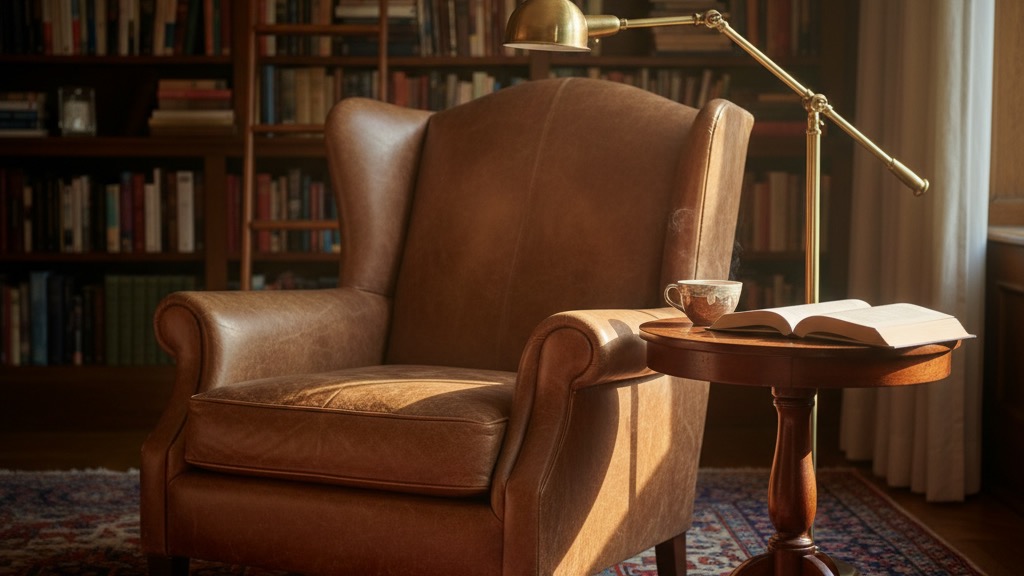
A library without a real reading seat is a book storage room. The seat is the test of whether the library actually gets used as a library.
The criteria for a real reading seat:
30+ minute comfort. The seat supports sustained continuous reading without producing the lower-back strain that drives the reader to stand up after 20 minutes.
Posture flexibility. Most readers shift position several times during a long reading session. A rigid seat that forces one position fails. The seat needs to support upright reading, slightly reclined reading, and feet-up reading.
Light alignment. The seat position is fixed; the task light is fixed. The two have to align so that the reader doesn't have to reposition for the light to work.
Table or surface for tea or coffee. The reader needs to set something down — a beverage, the second book, the reading glasses — without standing up.
In a small home where every piece of furniture has multiple cost considerations, the reading seat is the one piece worth spending more on. A good reading chair is $1,500-$3,500 and lasts 20-40 years. The savings of a $600 reading chair are immediately offset by the lower comfort and shorter useful life.
Configurations That Work by Home Size
The 480-650 Square Foot Home
A defined library zone in a home this size is roughly 60-90 square feet. The design that works:
- One L-shaped built-in shelf wall using two adjacent walls
- 200-280 linear feet of shelf capacity (roughly 600-900 books at typical density)
- One reading chair with a small side table
- One floor lamp positioned over the shoulder
- One pendant or sconce accent over the shelves
Total library zone cost (factory-built shelving + furniture + lighting): $4,800-$11,500. Library zone as a percentage of total home: roughly 12-15% of the home's square footage.
The 800-1,000 Square Foot Home
A defined library zone in a home this size can be 100-150 square feet. The design opens up:
- Three-wall library zone with built-in shelving
- 350-500 linear feet of shelf capacity (roughly 1,000-1,500 books)
- One primary reading chair, one secondary chair or chaise
- Two task lights, one accent
- Optional reading desk if work-from-home function shares the zone
Total library zone cost: $8,500-$18,000.
The 1,200+ Square Foot Home
A dedicated library room — with a door — becomes practical. The design moves into traditional at-home library territory while keeping the small-home efficiency:
- Full-room enclosure with door
- 500-800 linear feet of shelf capacity (roughly 1,500-2,400 books)
- Reading seat plus desk
- Layered lighting with separate switching
- Optional fireplace or stove for cold-climate placements
Total library room cost: $12,500-$32,000.
What Doesn't Work in Small-Home Library Design
Five common mistakes appear in unsuccessful small-home libraries:
Mistake 1 — Sharing the space with home office. Email is the enemy of reading. A library that doubles as a home office becomes a home office with bookshelves. Keep work and reading in different zones.
Mistake 2 — Open-plan integration. A library zone that flows directly into the kitchen, living, or sleeping area without architectural separation gets co-opted by adjacent functions. Define the zone.
Mistake 3 — Decorative shelving. Shallow decorative shelves can't hold real books. A "library" that's actually a display of objects with a few books mixed in isn't a library — it's decor. If the shelves are 8 inches deep or less, they're not library shelves.
Mistake 4 — Insufficient lighting. Reading by ambient room lighting produces eye strain after 20-30 minutes. The library either gets used in short sessions only, or it doesn't get used.
Mistake 5 — Uncomfortable seating. A library without a real reading seat is a book storage room. The seat is the test.
The Path Most Buyers Take
For most small-home buyers planning a library zone in 2026, the realistic path:
- Identify the library zone at the factory order stage, not after delivery
- Specify factory built-in shelving (significantly cheaper than retrofitting)
- Plan lighting circuits during electrical rough-in, not after drywall
- Invest in one quality reading seat rather than several cheap ones
- Test the zone for at least 30 days before adding decorative elements — let actual use patterns drive the final layout
PERCH was built to surface verified factories who handle custom built-in configurations (including library walls) at the factory rather than as expensive post-delivery retrofits. The honest builders charge a fraction of what retrofitting costs and deliver a structurally proper installation the first time.
Ready to design a real at-home library into a tiny or modular home? Join the PERCH waitlist → for verified inventory and factory-build concierge support.
Featured on Redfin
This guide builds on the at-home library trend Redfin's editorial team has tracked across multiple markets. PERCH was featured in Redfin's 4 Tips to Turn Your Spare Room Into Your Dream At Home Library — read the full Redfin article for additional tips that work across home sizes from spare bedrooms in Asheville, NC to apartments in Madison, WI.
Related guides
Frequently asked questions
How small can a home be and still have a real library?
How many books fit in a small-home library?
What's the cost of a library zone in a small home?
Can I add library shelves to a modular home after delivery?
Do I need a structural engineer for floor-to-ceiling bookshelves?
What's the right lighting for a small-home library?
Can a library zone work in a container home?
Keep reading
Join the conversation
Comments
Reader questions get answered. Real names and a working email — that's it.