Guides
Insurance for Modular, Manufactured, and Container Homes: The 2026 Reference
Modular, manufactured, and container homes follow different insurance pathways than site-built homes. Knowing which product applies to your specific configuration prevents the gap-coverage surprises that show up after the first storm.
On this page
Modular, manufactured, and container homes follow different insurance pathways than conventional site-built homes. The differences turn on the unit's legal classification, the foundation type, the installation jurisdiction, and the unit's wind, snow, and seismic rating relative to local hazard exposure. Buyers who assume their factory-built home will insure under the same products as a site-built home routinely discover gaps at the first significant weather event. This is the 2026 reference for what insurance product applies to which configuration.
Modular Home Insurance
Modular homes installed on permanent foundations and classified as real property qualify for standard homeowners insurance products in 2026. The most common product is the HO-3 (Special Form) homeowners policy that covers the dwelling against most perils, with specific exclusions for floods, earthquakes, and a defined list of other excluded perils.
Premium calculations for modular homes use the same factors as site-built — dwelling replacement cost, location risk factors, deductible selection, and policy limit selections. In most established US markets, modular and site-built homes of similar construction quality and location have indistinguishable premium calculations.
The carrier availability for modular insurance is broad. Most major national and regional insurance carriers write modular homes on the same products as site-built. The exception is the specific modular-home spec underwriting that some smaller specialty carriers offer for non-standard configurations.
Manufactured Home Insurance
Manufactured homes typically insure under the HO-7 (Mobile Homeowners) policy form or a manufactured-home-specific equivalent. The coverage structure is similar to HO-3 but with several manufactured-home-specific adjustments:
Coverage limits are typically based on the manufactured home's actual cash value or replacement cost specific to the manufactured-home market, which may differ from the conventional residential replacement-cost calculation.
Specific perils exclusions may differ from HO-3. Wind coverage in coastal jurisdictions often has separate deductibles or coverage caps for manufactured construction. Some carriers exclude certain perils for manufactured homes that they would cover for site-built.
Premium calculations factor in the manufactured-home-specific risk pool, the unit's age, the unit's foundation type (permanent versus chassis-only), and the unit's wind rating relative to local hazard.
The carrier availability for manufactured-home insurance is narrower than for conventional. Specialty manufactured-home insurers including Foremost Insurance, American Modern, and several others dominate the category. Some major national carriers do not write manufactured-home insurance at all.
Container Home Insurance
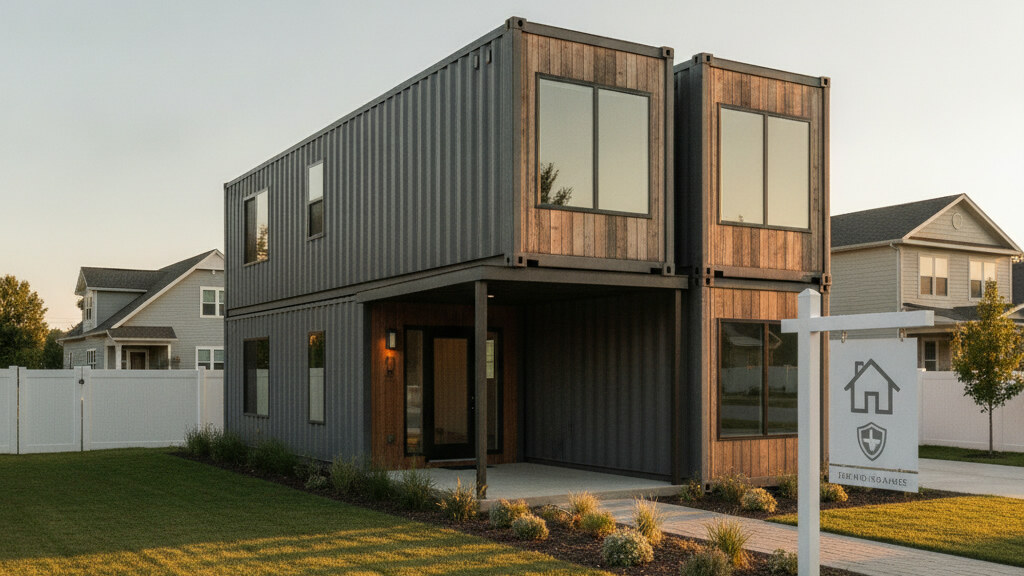
Container homes occupy a gap in the conventional insurance market in 2026. The category does not fit cleanly into the standard homeowners insurance product or the manufactured-home insurance product. The container-home configuration is typically too new for many carriers to have established underwriting guidelines.
Buyers of container homes typically face three insurance pathways:
Specialty carriers that have developed container-home-specific underwriting. The carrier availability is limited; some buyers find only one or two carriers willing to quote.
Standard homeowners insurance from carriers willing to underwrite the configuration with detailed manufacturer documentation. This typically requires the unit to have IBC or IRC structural certification and a permanent foundation; some carriers will then write standard products on the unit.
Custom-quoted commercial or specialty insurance for configurations that do not fit either of the above. This may be the only pathway for unusual container configurations but typically carries higher premiums.
The PERCH verified ADU and small-home builder directory includes operators with documented insurance-carrier relationships, which can help buyers identify carriers that have underwritten comparable units in the buyer's region.
What Buyers Should Verify Before Closing
Three verifications matter most.
First, that the insurance product actually applies to the specific configuration. A modular home buyer should verify that the lender's required insurance applies under the standard homeowners product. A manufactured-home buyer should verify the HO-7 or equivalent applies under the foundation type and unit classification. A container-home buyer should verify that any insurance pathway exists for the specific configuration.
Second, that the coverage limits actually match the replacement cost. Manufactured-home replacement cost calculations sometimes diverge from buyer expectations; understanding the calculation before closing prevents coverage-gap surprises.
Third, that any applicable wind, flood, or earthquake coverage is in place if the location requires it. Standard homeowners and manufactured-home products typically exclude these perils; separate policies or endorsements may be required for full coverage in coastal, floodplain, or seismic locations.
Why Insurance Differs From Site-Built
The insurance differences between modular, manufactured, container, and site-built reflect the underwriting categories that insurance carriers have developed historically. Site-built construction has the longest insurance history and the most-developed underwriting tables. Modular construction has accumulated sufficient history to be treated similarly to site-built in most markets. Manufactured construction has its own insurance history with specialty products. Container construction is newest and has the least-developed insurance infrastructure.
The trajectory is convergence — as modular construction continues to grow, the insurance pricing typically converges with site-built. The container category will likely follow a similar trajectory over the coming years as carrier underwriting catches up to category growth.
Where PERCH Fits
PERCH was built specifically to compress the operator-and-process work this guide describes. The verified ADU and small-home builder directory covers operators in each US region with documented installation history, real references, and traceable post-sale support. The marketplace surfaces verified inventory for buyers comparing options across configurations.
Ready to apply this to your specific project? Join the PERCH waitlist → for early access to verified operator inventory and concierge buyer support.
Join the conversation
Comments
Reader questions get answered. Real names and a working email — that's it.