Legal & Zoning
Can You Rent Out a Modular Home on Your Property? The 2026 State-by-State Rules
Renting out a modular home on your land is legal in most of the US — but the path through zoning, landlord-tenant law, and tax treatment depends on which of three rental models you choose. Here's the 2026 breakdown, with real income math.
On this page
The answer is yes in most of the United States — but the answer that matters is the specific path through your local zoning code, your state landlord-tenant law, and the property taxes that change the moment a structure on your land starts generating rental income. This guide walks through the actual decision tree, the states that are most permissive (and most restrictive), the income math that has to clear before this becomes worth the paperwork, and the three rental models that make modular homes one of the highest-return real estate assets a small owner can hold.
Renting out a modular home on land you own is legal in most of the country today. Whether it makes economic sense is a different question — and the answer depends on which of the three rental models you choose, what your local code requires, and whether your insurance carrier will write the policy.
Why the Question Has Three Different Answers
The question "can I rent out a modular home on my property" is really three different questions hiding inside one sentence. The legal answer depends on which rental model you're asking about.
The first model is long-term residential rental — a tenant signs a lease, pays monthly rent, lives in the home as their primary residence. This is the simplest legal path because it falls under standard landlord-tenant law in every state. The second model is short-term rental — the home is listed on Airbnb, Vrbo, or similar platforms for stays under 30 days. This path is governed by local ordinances and tax structures that have tightened significantly since 2022. The third model is accessory dwelling unit (ADU) rental — the modular sits behind or beside a primary residence on the same parcel, often rented to a family member, caretaker, or long-term tenant.
The legal and tax treatment of each model is different. The financing implications are different. The insurance requirements are different. Most importantly, the local code requirements are different — and the local code is what catches people who didn't research before they bought the home.
Why the Foundation Decision Determines Everything
A modular home installed on a permanent foundation with utilities connected and a certificate of occupancy issued is, for all rental purposes, a residential dwelling. The same model on temporary blocks or a chassis without conversion is, in many jurisdictions, classified as either a recreational vehicle (cannot be rented as a dwelling) or an unpermitted structure (cannot legally be occupied at all). The foundation determines the legal category, and the legal category determines what you can rent out, to whom, and at what tax rate.
According to the International Code Council's adopted standards, the local building authority decides whether a structure qualifies as a permanent dwelling based on foundation type, utility connections, and certificate of occupancy. A home that doesn't qualify cannot be lawfully rented as housing in most jurisdictions, regardless of how habitable it is.
Long-Term Rental: The Cleanest Path
A modular home installed on a permanent foundation on land you own can be rented to a long-term tenant the same way any single-family rental property can. You need a residential lease, a security deposit held under your state's escrow rules, an insurance policy that covers tenant-occupied housing, and a clean understanding of your state's landlord-tenant law.
The economic math for long-term rental in 2026 looks strong in most markets. A 640-square-foot modular installed for $109,000 all-in (per the cost breakdown from a typical two-module configuration) can rent for $950 to $1,650 per month depending on market. After property tax, insurance, maintenance reserve, and vacancy, the typical cap rate runs 6 to 11 percent — higher than most single-family rental returns and significantly higher than most parked capital alternatives.
What Your Local Code Will Require
Most jurisdictions require three things before issuing a rental certificate of occupancy on a modular home. First, the home must have a permanent foundation per HUD or state modular standards. Second, the home must have permanent utility connections (water, sewer or septic, electric). Third, the home must pass an initial rental inspection covering smoke detectors, egress windows, electrical panel adequacy, and basic sanitation.
The inspection cost varies by city, typically $100 to $400. The rental certificate is renewed periodically (annually or every two to three years) and must be renewed any time the tenant changes in some jurisdictions. According to HUD's Fair Housing guidance, the same fair-housing rules that apply to any rental property apply to modular rentals — no discrimination by race, religion, national origin, sex, familial status, or disability in any aspect of the rental decision.
The Tax Picture for Long-Term Rental
Rental income is taxed as ordinary income on Schedule E, with deductions for mortgage interest, property tax, insurance, maintenance, depreciation, and management fees. According to IRS Publication 527, residential rental property is depreciated straight-line over 27.5 years, which usually creates a meaningful paper loss that offsets rental income for the first 10 to 15 years of ownership.
The depreciable basis includes the cost of the modular home and the cost of improvements (foundation, utility hookups, site work). It does not include the land. If you paid $109,000 all-in and your land is worth $25,000 of that, your depreciable basis is $84,000, generating roughly $3,050 of annual depreciation expense — which directly offsets rental income.
Short-Term Rental: Higher Returns, More Friction
Listing a modular home on Airbnb, Vrbo, or a similar short-term-rental platform can generate two to four times the gross income of a long-term lease in tourist markets, ADU-friendly urban areas, and recreational destinations. The trade-off is significantly more management work, higher local regulation risk, and tighter insurance requirements.
The short-term rental market in the United States peaked culturally in 2022 to 2023, then faced a wave of municipal restrictions through 2024 to 2025 as cities responded to housing-availability concerns. In 2026, the regulatory map is genuinely fragmented. Some cities ban all non-owner-occupied short-term rentals entirely. Some require permits, taxes, and inspections. Some restrict short-term rentals to specific zones.
The States and Cities Where Short-Term Modular Rentals Are Most Permissive
Florida, Texas, Tennessee, North Carolina, Georgia, Arizona, and Nevada have state laws that preempt or limit municipal short-term rental bans, making them the most short-term-rental-friendly markets for modular operators. Within those states, secondary tourist markets (not the major destination cities) tend to be the most permissive.
Markets where short-term rental of any structure is heavily restricted or banned outright in 2026 include New York City (most of the five boroughs), San Francisco, Santa Monica, Honolulu (Oahu), and most resort towns in Vermont and Maine. Before buying a modular home with short-term rental intent, the single most important research is the specific municipal ordinance covering your parcel.
The Real Short-Term Income Math
A 400-square-foot modular in a Florida secondary tourist market (Brooksville, Crystal River, Apalachicola, or similar) can generate $1,800 to $3,200 per month in gross short-term rental income with 55 to 70 percent occupancy. Net income after platform fees, cleaning, supplies, utilities, and the higher insurance carry typically runs 55 to 65 percent of gross. On a $60,000 all-in installation, that's a cap rate of 18 to 24 percent — but with three to four times the management hours of a long-term lease.
PERCH · Find yours. Free yours.
Find the homes that fit how you actually plan to buy, place, and live.
Join the waitlistADU Rental: The Quiet High-Return Path
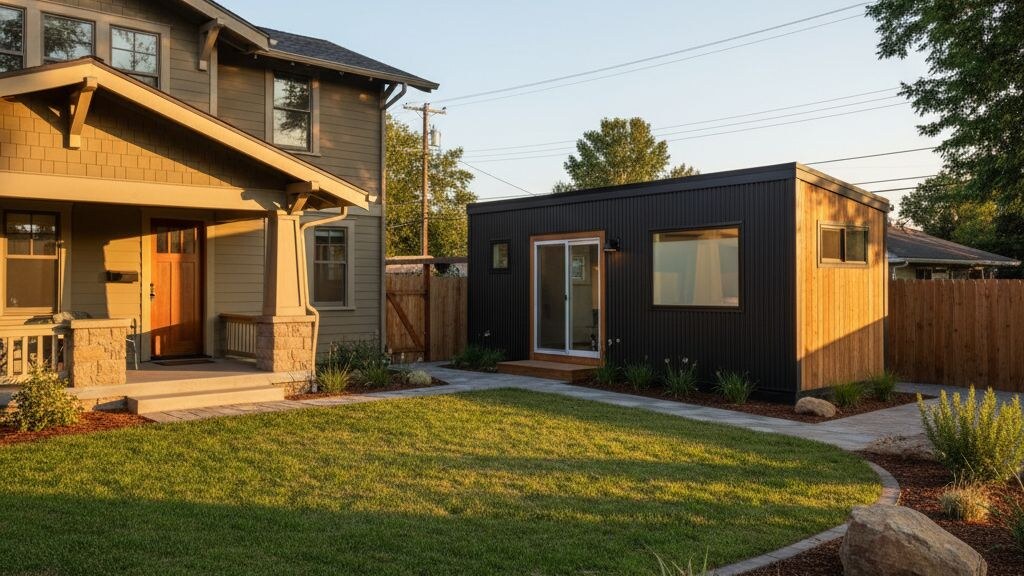
The accessory dwelling unit (ADU) is the most under-discussed and highest-leverage rental structure on the list. State-level ADU reform laws passed in California (2019), Oregon (2019), Washington (2020), Maine (2022), Vermont (2023), Montana (2023), and several others have made it legal to install a modular ADU on the same parcel as a primary residence in single-family zones — overriding local ordinances that previously banned multi-unit dwellings on single-family lots.
The ADU model works like this. You own the primary residence. You install a modular home behind it, beside it, or above the garage. You rent the ADU to a long-term tenant for $800 to $1,800 per month depending on market. The income covers the carrying cost of the modular and often generates positive cash flow within the first 18 months.
In tight housing markets, the ADU model has become the highest-return small real estate play available to a homeowner — sometimes generating cap rates in the 12 to 18 percent range on the modular installation, with very low management overhead because the primary residence is owner-occupied and the tenant is on a long-term lease.
What ADU Reform Has Changed Since 2019
Before 2019, most US cities required ADU installations to navigate single-family zoning prohibitions, owner-occupancy requirements, parking minimums, and lot-coverage maximums — any one of which could kill the project. The wave of state-level ADU reform laws starting in 2019 preempted many of these municipal restrictions, requiring cities to allow ADUs on most single-family parcels and capping the most restrictive rules (parking minimums and owner-occupancy requirements).
According to the California Department of Housing and Community Development's ADU handbook, California now allows ADUs on virtually all single-family residential parcels statewide, with streamlined permitting and no owner-occupancy requirement. Similar laws have spread to roughly 14 states through 2024.
The implication for modular buyers is significant. A modular home designed and installed as an ADU on a parcel in California, Oregon, Washington, Maine, or any of the other ADU-reform states has a clear legal rental path that did not exist five years ago.
NYC's 2024 Backyard Modular Law
New York City passed legislation in 2024 making it legal to install backyard ADU structures (including modular homes) on single-family lots in the five boroughs — a major shift in the most restrictive housing market in the country. The implementation is still rolling out through 2026 and the local zoning approval process remains challenging, but the legal path now exists where it did not before.
The Insurance Reality
Renting a modular home requires landlord insurance, not homeowner's insurance. The two are different products with different premium structures.
A typical landlord policy on a $109,000 modular installation runs $850 to $1,800 per year depending on state, market, and tenant profile. Add another $200 to $600 annually for adequate umbrella liability coverage. Short-term rental requires further specialized coverage, often through a commercial-style policy or a STR-specific carrier like Proper Insurance or Slice — premiums typically run $1,500 to $4,000 annually for short-term operation.
The most common insurance mistake is renting a modular under a personal homeowner's policy. Most personal policies specifically exclude tenant-occupied use, which means a tenant claim or liability event would be denied. Get a landlord policy before the lease starts.
Where This Strategy Wins and Where It Fails
Modular home rental works best in three specific scenarios. First, owned land in a tight rental market where supply is constrained. Second, a primary residence with available ADU space in an ADU-reform state. Third, a tourist market with state-level short-term-rental protection.
It fails in three scenarios. First, leased lot or mobile-home-park land — the home depreciates, financing is restricted, and rental authorities rarely issue certificates. Second, jurisdictions with strict short-term rental bans where the only path is long-term tenancy at rates that don't beat traditional residential investments. Third, markets where the modular home itself cannot be classified as a permanent dwelling due to foundation, utility, or code reasons — you can't rent out what the city won't legally call housing.
PERCH · Find yours. Free yours.
Find the homes that fit how you actually plan to buy, place, and live.
Join the waitlistRelated guides
- How to buy a tiny house in 2026
- How much does a tiny house cost in 2026
- How to finance a tiny house in 2026
The weekly brief for modern modular living.
Design concepts, zoning workarounds, and market strategies — the specific ones the 22 million families in the missing middle actually need.
Under 3 minutes. Every Friday afternoon. Unsubscribe with one click.
Frequently asked questions
Can I rent out a modular home as an Airbnb?
Do I need a permit to rent out a modular home?
What's the difference between a long-term rental and an ADU rental?
Will my homeowner's insurance cover a tenant?
Can I rent out a manufactured home on leased land?
How do I report modular rental income to the IRS?
Can I rent out a modular home as an ADU to family members?
What's the highest-return modular rental strategy in 2026?
Keep reading
Join the conversation
Comments
Reader questions get answered. Real names and a working email — that's it.