Guides
Foundation Types for Prefab and Modular Homes: The 2026 Reference
The foundation type a prefab or modular home is installed on determines whether it qualifies as real property, what lender will finance it, and how it appraises and resells. Five foundation types are common in 2026, with very different implications.
On this page
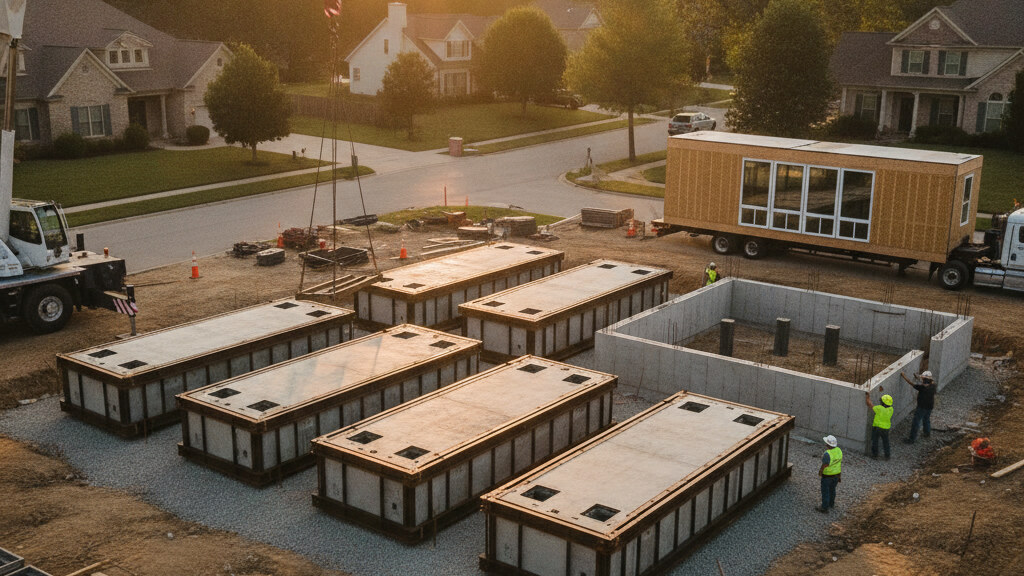
The foundation a prefab or modular home is installed on does more than hold the unit up. It determines whether the home qualifies as real property or remains personal property, which lenders will finance it, how it appraises, what insurance products apply, what local jurisdiction will issue a certificate of occupancy, and how it resells when the time comes. The foundation decision is one of the most consequential decisions in a prefab or modular project, and it is one of the most commonly underestimated by first-time buyers. This is the 2026 reference for the five foundation types most common in US prefab and modular installations and what each one means for the buyer.
The Five Foundation Types
Type 1 — Full Perimeter Foundation (Basement or Crawlspace)
A continuous concrete or masonry foundation wall around the perimeter of the unit, with either a basement (typically 7-8 feet of headroom) or a crawlspace (typically 2-4 feet) below the structure. Permanent, fully integrated with the unit, and typically requires the chassis (if present) to be removed.
Cost in 2026: typically $22,000 to $48,000 for a small modular unit, with basement configurations at the upper end and crawlspaces at the lower end. Provides the highest market acceptance and the strongest appraisal outcomes.
Type 2 — Pier-and-Beam with Permanent Skirting
Concrete piers driven to the frost line, supporting a structural beam grid on which the unit rests. Permanent skirting around the perimeter conceals the substructure and provides weather protection. The chassis (if present) may remain in place or be removed depending on local code.
Cost in 2026: typically $14,000 to $26,000 for a small modular or manufactured unit. Common for manufactured-home installations and for some modular configurations on sloped or otherwise complex parcels.
Type 3 — Monolithic Concrete Slab
A single continuous concrete pad sized to the unit's footprint, with the unit set directly on the slab. Permanent, simple, and well-suited to flat parcels in warm climates without significant frost-depth requirements.
Cost in 2026: typically $14,000 to $22,000 for a small modular or manufactured unit. Common in Southwest and Gulf Coast installations.
Type 4 — Runner-Style Concrete Pads
Discrete concrete runners (rather than a continuous slab) supporting the unit along the long axis. Permanent, less material-intensive than a full slab, suited to specific manufactured-home installation patterns.
Cost in 2026: typically $11,000 to $18,000 for a small manufactured unit. Less common in modular installations.
Type 5 — Chassis-Only on Temporary Blocks
The unit remains on its original chassis, supported by stacked concrete blocks at corners and intermediate points, with skirting that may be temporary or absent. The unit is technically movable.
Cost in 2026: typically $4,500 to $9,000. Maintains personal-property classification, which has implications for financing, insurance, and resale.
Why the Foundation Type Drives Almost Everything Else
The foundation type drives the legal classification of the unit (real property versus personal property), which in turn drives:
The financing pathway. Conventional mortgage products generally require a permanent foundation. Chattel financing applies to personal-property classification.
The insurance pathway. Standard homeowners insurance applies to real property; manufactured-home-specific policies or RV-style policies apply to personal property.
The tax treatment. Real property pays property tax based on assessed value; personal property typically pays a personal property tax based on a different valuation methodology.
The appraisal pathway. Real property appraises on the conventional residential comp curve; personal property appraises on a depreciation-based curve more similar to vehicle valuation.
The resale market. Real property resells through the conventional residential real estate market with MLS access and standard real-estate-professional involvement; personal property resells through specialty manufactured-housing markets with more limited buyer access.
How to Choose the Right Foundation Type
The realistic 2026 decision process:
For modular units intended as long-term primary residences, full perimeter or pier-and-beam with permanent skirting are typically the right call. The cost premium versus chassis-only is offset by the financing access, appraisal advantage, and resale value retention.
For manufactured units intended as long-term primary residences, the foundation conversion from chassis-only to permanent (pier-and-beam, runner pads, or monolithic slab) is typically the right call for the same reasons.
For units intended as short-term placement or as configurations where movability is a deliberate feature, chassis-only may be the right call — though the buyer should understand the financing and resale implications.
For installations in seismic zones, hurricane-zone coastal jurisdictions, or areas with unusual soil conditions, the foundation type may be partially or fully determined by code requirement rather than by buyer preference.
A parcel-level foundation evaluation by a verified prefab or modular operator is the most reliable way to confirm what foundation type is workable for a specific unit on a specific parcel.
Where PERCH Fits
PERCH was built specifically to compress the operator-and-process work this guide describes. The verified ADU and small-home builder directory covers operators in each US region with documented installation history, real references, and traceable post-sale support. The marketplace surfaces verified inventory for buyers comparing options across configurations.
Ready to apply this to your specific project? Join the PERCH waitlist → for early access to verified operator inventory and concierge buyer support.
Join the conversation
Comments
Reader questions get answered. Real names and a working email — that's it.