Guides
Manufactured vs Modular vs Site-Built: The 2026 Legal Category Primer
Manufactured, modular, and site-built are three distinct legal categories — different construction standards, different financing, different appraisal frameworks, different resale markets. The differences shape almost everything that follows in a purchase.
On this page
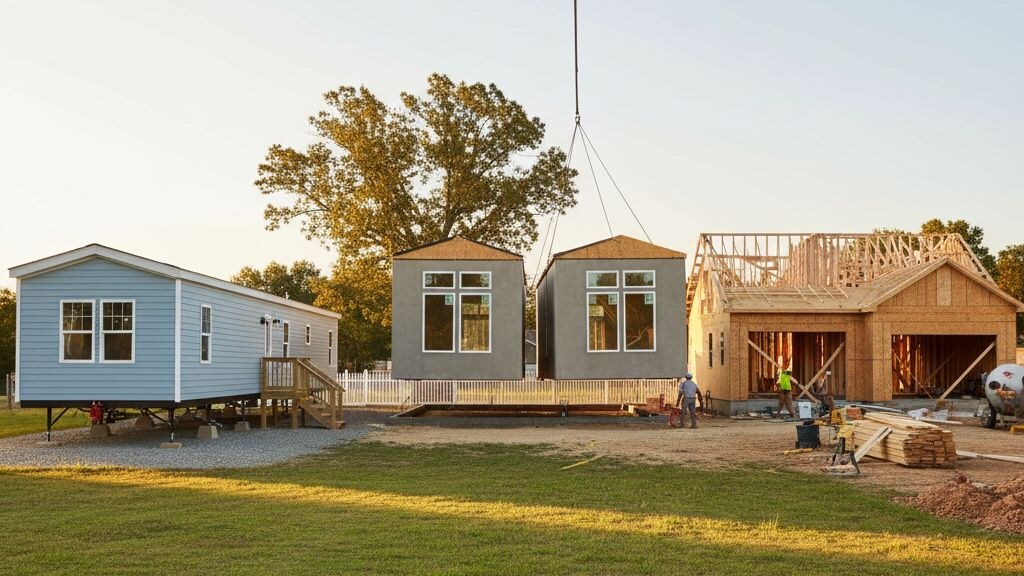
Manufactured, modular, and site-built are not synonyms for the same product. They are three distinct legal categories of residential construction in the US, governed by different building codes, financed through different lender pathways, appraised on different comp curves, and resold into different markets. The category determines almost everything that follows in a purchase — what permit office handles your project, which lenders will finance it, what insurance products apply, how it appraises and resells. This is the 2026 primer on the differences.
Manufactured Homes
A manufactured home is constructed to the HUD Code, the federal standard adopted in 1976 that governs all factory-built homes intended for primary residence use. Pre-1976 units are properly called "mobile homes" and are a separate category not generally permitted for new placement. Post-1976 units are properly called "manufactured homes."
The HUD Code preempts state and local building codes for the unit itself. Manufactured homes are built in factories certified by HUD, inspected during construction, and shipped with a HUD data plate documenting the standard the unit meets.
Manufactured homes finance through specialty lenders including 21st Mortgage, Triad Financial Services, Vanderbilt, and others. They can also finance through FHA Title I (chattel) and FHA Title II (after permanent foundation and title cancellation). They appraise on the manufactured-housing comp curve, which generally runs at a discount to site-built construction.
Modular Homes
A modular home is constructed to the same building code as site-built homes — the International Residential Code (IRC) for single-family, or the International Building Code (IBC) for larger or multi-family configurations. Unlike manufactured homes, modular homes are governed by state and local building codes rather than the federal HUD Code.
Modular homes are built in factories certified by the relevant state's modular construction program. The factory inspections happen during construction; site-final inspections happen on installation. The unit ships with a state modular certification label rather than a HUD data plate.
Modular homes finance through conventional mortgage products from the same lenders that finance site-built homes, with the unit appraised and underwritten as conventional residential construction once permanently installed. They appraise on the same comp curve as site-built homes in the same market.
Site-Built Homes
A site-built home is constructed entirely at the site using site labor. The structure is framed in place, the systems are installed in place, and the finish work is performed in place. The applicable building code is the IRC for single-family residential or the IBC for larger configurations.
Site-built construction is the reference standard against which manufactured and modular construction are typically compared. The site-built path is the most labor-intensive, typically the longest in timeline, and typically the most expensive per square foot — but it produces the unit that the conventional residential real estate market is most directly built around.
The Differences That Matter for the Buyer
The three categories differ on five dimensions that materially affect the buyer's experience.
| Dimension | Manufactured | Modular | Site-Built |
|---|---|---|---|
| Construction standard | HUD Code (federal) | IRC or IBC (state/local) | IRC or IBC (state/local) |
| Factory vs site labor | Factory dominant | Factory dominant | Site dominant |
| Typical project timeline | 1–4 months | 3–9 months | 8–18 months |
| Financing pathways | Specialty + FHA + conventional after conversion | Conventional from day one (with permanent foundation) | Conventional |
| Appraisal comp curve | Manufactured-housing | Same as site-built | Site-built |
| Property classification | Personal property until converted | Real property at installation | Real property at construction |
| Typical cost per sq ft | Lowest | Mid-range | Highest |
How to Decide Which Category Fits Your Project
The decision usually comes down to budget, timeline, parcel access, and long-term value priority.
Manufactured homes win for budget-priority projects, for projects on rural acreage with limited contractor access, and for buyers willing to manage the additional regulatory complexity around foundation conversion.
Modular homes win for projects where the buyer wants factory-built quality control plus conventional financing access and conventional appraisal — typically the right call for permanent-residence buyers who plan to occupy long-term.
Site-built construction wins for highly-customized projects, for projects on parcels where modular delivery is impractical, and for buyers who place a high value on long-term appraisal comparability with the surrounding market.
Where PERCH Fits
PERCH was built specifically to compress the operator-and-process work this guide describes. The verified ADU and small-home builder directory covers operators in each US region with documented installation history, real references, and traceable post-sale support. The marketplace surfaces verified inventory for buyers comparing options across configurations.
Ready to apply this to your specific project? Join the PERCH waitlist → for early access to verified operator inventory and concierge buyer support.
Join the conversation
Comments
Reader questions get answered. Real names and a working email — that's it.