Foundations
What Is a Prefab Home? The 2026 Buyer's Reference for an Often-Misused Term
"Prefab" covers four distinct factory-built categories — modular, manufactured, panelized, kit — each with different codes, financing, and resale. Here's the 2026 reference that clears the terminology fog and helps buyers pick correctly.
On this page
"Prefab home" is one of the most overloaded terms in residential real estate. In casual use it can mean any of four distinct categories — modular, manufactured, panelized, or kit homes — and each comes with different building codes, different financing options, different appraisal treatments, and different resale liquidity. A buyer who walks into a "prefab" purchase without knowing which subcategory they're actually buying often discovers the difference at the closing table, or worse, at the appraisal stage when a conventional mortgage falls through. This guide settles the terminology, walks through real 2026 cost and code data for each subcategory, and helps buyers pick the right category for their use case.
If you've been told "prefab is prefab" by anyone selling you a home, this is the reference that clears the fog.
The Four Prefab Categories — Quick Decision Map
| Category | Building code | Foundation | Financing | Build timeline | Resale appraisal |
|---|---|---|---|---|---|
| Modular | IRC (same as site-built) | Permanent required | Conventional mortgage | 4-7 months | Same as site-built |
| Manufactured | HUD code | Permanent or chassis | Real property (perm) or chattel | 3-5 months | Slightly slower appreciation |
| Panelized | IRC | Permanent | Construction-to-perm loan | 6-9 months | Same as site-built |
| Kit | Site-built (IRC) | Permanent | Owner-builder construction loan | 8-14 months (DIY) | Same as site-built |
For most buyers, the choice narrows to modular or manufactured. Panelized and kit are smaller niches that fit specific use cases.
Modular Homes — The 2026 Mainstream
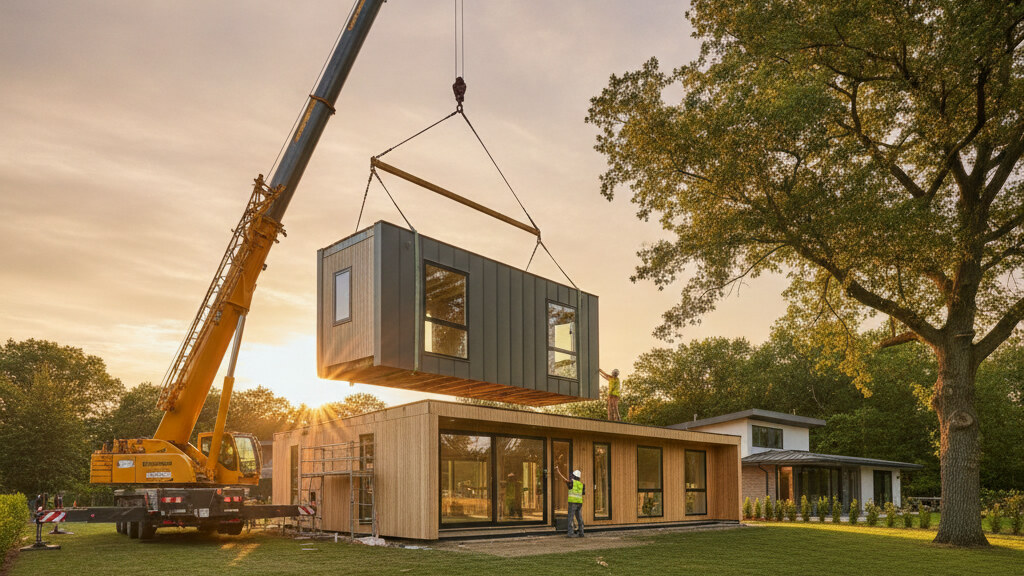
A modular home is built in sections (modules) in a factory under the same International Residential Code that governs site-built construction. The completed modules are transported on flatbed trucks, craned onto a permanent foundation, and finished on-site with utility connections, exterior trim, and final inspections.
What this means in practice:
- Indistinguishable from site-built once finished. No visible "prefab" markers in a finished modular home.
- Conventional mortgage financing available with most major lenders.
- Appraises at full residential value with comparable site-built homes as comps.
- Build timeline 4-7 months from order to certificate of occupancy.
- Cost typically 25-40% below comparable site-built construction.
Typical 2026 all-in cost for a 1,500 sq ft modular home: $185,000 to $295,000 depending on region, finish package, and site conditions.
Modular is the most common 2026 choice for buyers who want new-build quality at lower cost and faster timeline than traditional construction without sacrificing financing or resale.
Manufactured Homes — The Lowest-Cost Path
A manufactured home is built in a factory under federal HUD code (officially the HUD Code, Title VI of the Housing and Community Development Act of 1974, as amended). HUD code differs from the International Residential Code in specific ways — different wind-load requirements, different roof-load requirements, different egress and fire safety standards.
What this means in practice:
- Most manufactured homes ship with a steel chassis attached, which can be retained or removed depending on placement.
- Installation on a permanent foundation with title conversion from personal property to real property qualifies most manufactured homes for conventional mortgage financing.
- Installation on temporary blocks or with the chassis retained classifies the home as personal property — financed via chattel loans (similar to vehicle financing) with higher interest rates and shorter terms.
- Appraisal appreciation runs slower than modular or site-built homes — typically 1.5-3% annually versus 4-7% for site-built.
- Build timeline 3-5 months from order to certificate of occupancy.
Typical 2026 all-in cost for a 1,200 sq ft manufactured home: $115,000 to $185,000 installed on permanent foundation; $85,000 to $135,000 on temporary blocks.
Manufactured is the right category for buyers who prioritize lowest entry cost and accept the tradeoff of slower appreciation and less financing flexibility.
Panelized Homes — Customization with Factory Efficiency
A panelized home arrives at the site as factory-built wall and roof panels — not complete modules. A local construction crew assembles the panels on a poured foundation, then finishes interior and exterior work on-site.
What this means in practice:
- More floor-plan customization than modular (which is constrained to module dimensions transportable on highways).
- Factory production of structural panels delivers tight tolerances and efficient material use.
- On-site assembly retains most of site-built's flexibility for unique design.
- Built to IRC — appraisal and financing equivalent to site-built.
- Construction-to-permanent loan typically required.
Typical 2026 all-in cost for a 1,500 sq ft panelized home: $245,000 to $345,000.
Panelized is the right category for buyers who want a custom design with factory efficiency benefits, and who have a longer timeline than modular requires.
Kit Homes — Owner-Builder Niche
A kit home arrives at the site as a complete material package — pre-cut lumber, pre-fabricated components, plans, and assembly instructions. The buyer assembles the home, typically with the help of hired contractors for trades (electrical, plumbing, HVAC).
What this means in practice:
- Significant labor input from the buyer is non-optional.
- Build timelines run 8-14 months even for experienced owner-builders.
- Owner-builder construction loans are required from most lenders, with stricter documentation and inspection requirements than conventional construction loans.
- Final appraisal equivalent to site-built — but only if completed to permitting standards.
Typical 2026 all-in cost for a 1,200 sq ft kit home (materials only): $45,000 to $98,000. Total all-in including labor, foundation, utilities, and finish work: typically $145,000 to $245,000.
Kit homes are the right category for experienced builders who want to lower the labor portion of construction cost and have the time, skill, and tolerance to manage an extended build.
Why the Categories Often Get Confused
Three things drive the terminology confusion in the marketplace.
Sellers benefit from ambiguity. A dealer who can sell a manufactured home under the broader "prefab" umbrella often does, because manufactured carries more historical stigma than the broader prefab category. The buyer who hears "prefab" and thinks "modular" but signs a manufactured home contract carries the financing and resale implications of manufactured without realizing it until later.
Modular and panelized look similar in marketing. Both arrive at the site partially built. The technical distinction (full modules vs panels) matters for code, financing, and timeline but is rarely the headline feature in dealer marketing.
Kit homes have a strong owner-builder community that often uses "prefab" interchangeably with "kit." The community knows the distinction; new buyers often do not.
The functional path for a buyer is to verify the category explicitly before signing. The four questions that settle it:
- Is this built to the International Residential Code or to federal HUD code?
- Does the unit arrive as complete sections, as panels, or as a material package?
- Is permanent foundation required for financing?
- Will the appraisal treat this as real property or personal property?
The answers determine the category.
The Honest Cost Comparison for a 1,500 sq ft Home in 2026
| Category | 2026 typical all-in | Build timeline | Notes |
|---|---|---|---|
| Site-built | $345,000 to $545,000 | 12-18 months | Baseline for comparison |
| Modular | $185,000 to $295,000 | 4-7 months | Most common prefab choice |
| Manufactured (perm. foundation) | $145,000 to $235,000 | 3-5 months | Lowest cost; slower appreciation |
| Panelized | $245,000 to $345,000 | 6-9 months | More customization than modular |
| Kit (DIY assembly) | $145,000 to $245,000 | 8-14 months | Material savings, labor input required |
These ranges assume 2026 material costs, mid-range finish, and a flat suburban lot with municipal utilities available. Rural sites, premium finishes, complex utility runs, and high-cost-of-living regions push the upper end significantly higher. The U.S. Census Bureau's Manufactured Housing Survey tracks national manufactured-home pricing trends quarterly.
The Path Most Buyers Take
For most buyers, the decision comes down to modular versus manufactured.
Choose modular if:
- You want conventional mortgage financing
- You want full residential appreciation
- You can wait 4-7 months for completion
- Your budget supports the $185K-$295K range
Choose manufactured if:
- You prioritize lowest entry cost
- You're comfortable with slower appreciation
- You can pay cash or accept chattel financing for the lowest-cost path
- Your budget targets the $115K-$185K range
Panelized and kit are right answers in specific use cases — high-customization needs or owner-builder backgrounds — but the modular vs manufactured decision covers most buyers in 2026.
PERCH was built to surface verified factories across all four categories, with real comps, real financing options, and concierge support to help buyers identify which category actually matches their use case before committing.
Ready to identify the right prefab category for your lot and budget? Join the PERCH waitlist → for nationwide verified inventory and category-specific concierge support.
Related guides
Frequently asked questions
What is a prefab home?
What's the difference between modular and manufactured?
Can I finance a prefab with a conventional mortgage?
What's the typical 2026 cost for a prefab home?
Which prefab category has the strongest resale?
How long does prefab construction take?
What's the right prefab category for first-time buyers?
Keep reading
Join the conversation
Comments
Reader questions get answered. Real names and a working email — that's it.