Buyer Guides
Modular vs Manufactured vs Prefab vs Container Homes: Which Is Right for You?
Four words, four very different homes, four different financing paths. This guide settles the terminology — and tells you which category matches your land, your loan, and your resale timeline.
On this page
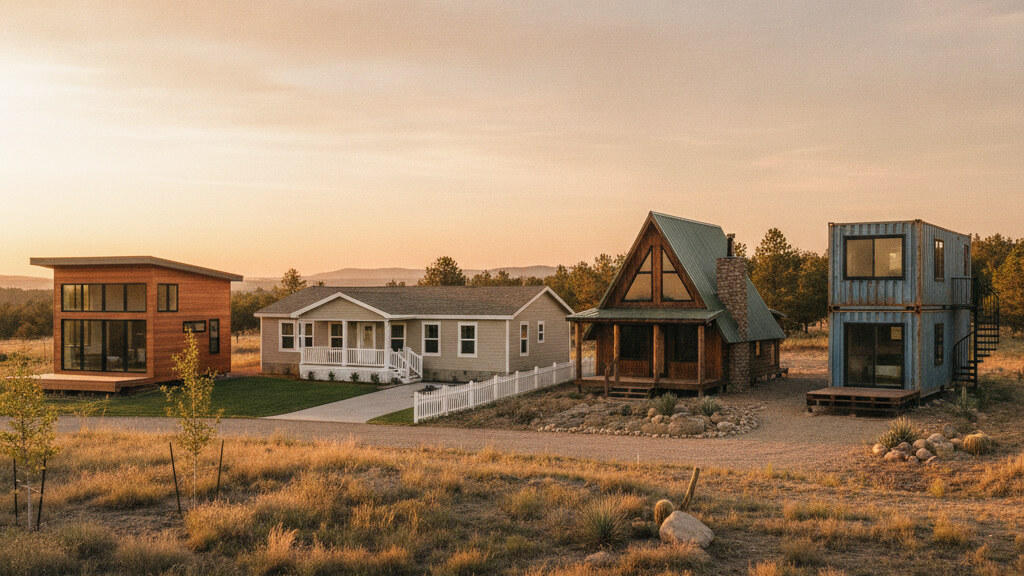
Four words, four very different homes, four totally different financing paths, and one nationally confused buyer market. The terminology around factory-built housing in the US is broken — even banks confuse the categories, which is a real problem because each one carries different code requirements, different loan products, different resale rules, and different long-term value math.
This guide settles the terminology. It tells you which type of home matches your land, your budget, your financing plan, and your timeline — and which type to avoid for your specific situation. By the end, you'll know exactly what to ask for when you call a dealer, what loan you actually qualify for, and which category will hold its value when you eventually sell.
Why the Terminology Confusion Exists (and Why It Costs You Money)
The four categories exist because they evolved from different industries and different regulatory regimes. Manufactured housing came out of the mobile-home trailer industry of the 1950s and 1960s, then was federalized in 1976 when the Department of Housing and Urban Development created the HUD Code. Modular construction came out of the stick-built residential industry trying to industrialize, and stayed under each state's residential code rather than going federal. Prefab is what marketers call anything factory-built, regardless of regulatory category. Container homes are a niche of the modular category that exploded culturally over the last decade.
The result is that the same physical-looking home — say, a 720-square-foot single-story unit with a kitchen, bathroom, and bedroom — can be sold as four different things depending on how it was built and how it's installed. According to HUD's published definitions, the regulatory boundary between a manufactured home and a modular home is whether it was built to the federal HUD Code or to the state's residential building code — not the shape, size, or material of the home itself.
The cost of this confusion is real. According to mortgage industry research, banks frequently deny loans because they classify a modular home as manufactured (or vice versa) and apply the wrong underwriting rules. The buyer walks in expecting a conventional mortgage on what they believe is a modular home, the underwriter sees a HUD data plate, and the loan re-routes to a chattel product with higher rates and shorter terms. The buyer either pays more for the same home or loses the deal.
What This Guide Will and Won't Solve
This guide solves the category question and the financing-fit question. It won't tell you which specific manufacturer to buy from, because that's market-specific and outside the scope of a 3,000-word piece. What it will do is make sure that when you talk to any manufacturer, you know exactly which category their product belongs in and what financing you should be asking for.
Modular Homes: The Stick-Built Cousin
A modular home is built in a factory in two to six sections (modules), trucked to your site on standard flatbed trucks, and assembled on a permanent foundation. The factory builds to the same state and local residential building code that a stick-built home in the same county would be built to. The building inspector signs off on the foundation, the install, and the final assembly. The home gets a regular property address and a regular real estate title.
From the curb, a finished modular home looks identical to a stick-built home. The roof has a normal pitch, the siding is conventional, the windows are residential-grade, and the floor plans match what a custom builder would deliver. The factory-build advantage is roughly 20 to 30 percent cheaper than stick-built construction and 3 to 6 months faster from contract to move-in.
Modular Financing
This is where modular wins. Because the home is built to residential code on a permanent foundation, it qualifies for the same financing as a stick-built home: conventional mortgages, FHA loans, VA loans, USDA loans. Interest rates match the residential market. Down-payment requirements match. Closing process matches.
The catch is that the home must actually be on a permanent foundation and titled as real property at the state level. A modular home stored on temporary blocks or set on a chassis without conversion is treated by the lender as personal property and re-routed to chattel financing, which runs 3 to 5 percentage points higher. The foundation decision is the financing decision.
Modular Resale
Modular homes appreciate with the land they sit on, the same way stick-built homes do. The factory-build origin is functionally invisible at resale because the home was constructed to local residential code. A 2026 buyer of a modular home built in 2010 in the same neighborhood faces the same appraisal process as the stick-built home next door.
Manufactured Homes: The Federal Code Category
A manufactured home is what the public still informally calls a "mobile home," though the term mobile home was phased out in 1976 when HUD took over federal regulation. The home is built in a factory to the federal HUD Manufactured Home Construction and Safety Standards, comes off the assembly line with axles and a chassis (some are removed at install), and arrives with a HUD data plate inside near a closet or utility room confirming the federal certification.
Manufactured homes are typically less expensive than modular homes per square foot because the federal HUD Code is less restrictive in some areas than state residential codes. The trade-off is in financing, resale, and zoning treatment.
Manufactured Financing
This is where buyer surprise happens most often. Manufactured homes finance differently from modular homes by default. The default loan product is a chattel loan, treating the home as personal property like a vehicle. Chattel rates run 7 to 12 percent in 2026 versus 6 to 7 percent for conventional mortgages. Terms are typically 15 to 20 years versus 30 for conventional.
The conventional-financing path for a manufactured home requires three conditions. The home must be built after June 15, 1976 (the HUD Code effective date). The home must be installed on a permanent foundation meeting the HUD Permanent Foundation Guide for Manufactured Housing. And the home's title must be converted from a vehicle title to a real estate title at the state DMV. This conversion is called "deeding" or "affixing" the home, and it converts the home from personal property to real property for both legal and financing purposes.
A manufactured home that meets all three conditions can qualify for conventional, FHA, VA, and USDA loans. A manufactured home that meets none of them is restricted to chattel financing only.
Manufactured Resale
Manufactured homes depreciate by default. A 2008 manufactured home sitting on leased lot land in a mobile home park is worth roughly 30 to 50 percent less in 2026 than it was at purchase, even after maintenance. The same home installed on a permanent foundation on owned land and converted to real property has held value much closer to the underlying real estate market.
The land question is the single biggest predictor of how a manufactured home will resell. Owned land + permanent foundation = the home behaves like real estate. Leased lot + chassis-mounted = the home behaves like a depreciating asset.
Prefab Homes: The Marketing Term
Prefab is short for "prefabricated," which means built off-site. Every modular home is prefab. Every manufactured home is prefab. Every container home is prefab. Some panelized homes, where wall sections are factory-built and assembled on-site like Lego pieces, are also prefab but don't fit cleanly into the modular or manufactured categories.
Prefab is not a regulatory category. There is no "Prefab Code." When a manufacturer advertises a "prefab home," what they mean depends on which factory built it and which code it conforms to. The same dealer in a Tampa lot might sell a HUD-code manufactured home in one row and a state-code modular home in the next row, calling both "prefab" in the marketing.
What to Ask When Someone Says "Prefab"
Three questions clarify what you're actually being sold. Is the home built to the federal HUD Code (manufactured) or the state residential code (modular)? Will the home have a HUD data plate inside, or a state modular certification label? What financing has the dealer pre-qualified for this specific home? The answers tell you the regulatory category, the resale trajectory, and the loan you should be asking for.
PERCH · Find yours. Free yours.
Find the homes that fit how you actually plan to buy, place, and live.
Join the waitlistContainer Homes: The Modular Niche
A container home is a modular home built from used or new shipping container shells. The container is structurally an Intermodal Shipping Container (ISO 1496), and the conversion process involves cutting openings for doors and windows, framing the interior, installing insulation (typically spray foam on the interior of the steel walls), running electrical and plumbing, and finishing the interior surfaces.
The category exploded in popularity through the 2010s for three reasons: containers are abundant and cheap as a raw material, the industrial-modern aesthetic became culturally popular, and the structural strength of the steel shell makes containers attractive in hurricane-prone and earthquake-prone markets.
Container Regulatory Status
This is where container homes get tricky. Some container homes are classified as modular (built to state residential code, set on permanent foundation, conventional financing eligible). Others are classified as manufactured (built to HUD Code, treated as personal property, chattel financing). Others — usually smaller single-container conversions — fall outside both categories and are treated as accessory dwelling units (ADUs), park-model RVs, or simply unpermitted structures depending on the local jurisdiction.
The right question for a container home is: which code does this specific factory build to? If the answer is "we follow our own standard" or "it's a custom build," you're looking at an unpermitted structure that may not be legal where you live and almost certainly won't qualify for traditional financing.
Container Financing
Container homes that meet modular standards qualify for conventional financing. Container homes that meet manufactured standards qualify for the same chattel-to-real-property conversion as any HUD-code home. Container homes that meet neither standard typically require cash, personal loans, or specialty lenders charging 10 to 18 percent interest.
A Side-by-Side Comparison
| Category | Code | Foundation | Title | Best Financing | Appreciates | Typical Cost (640 sq ft, all-in) |
|---|---|---|---|---|---|---|
| Modular | State residential | Permanent (required) | Real property | Conventional / FHA / VA | Yes | 95K – 165K |
| Manufactured (HUD) | Federal HUD Code | Optional (depends on use) | Vehicle by default, real with conversion | Conventional if real; chattel if not | Varies — yes on owned land + foundation, no on leased lot | 65K – 130K |
| Prefab (umbrella) | Whichever applies | Depends on category | Depends on category | Depends on category | Depends | 65K – 165K |
| Container (modular variant) | State residential or HUD, depending | Permanent (required for legal install) | Real property if modular-classified | Conventional if modular; chattel if HUD; specialty if neither | Yes if modular | 71K – 165K |
How to Choose: The Decision Framework
The right choice is determined by three inputs, in this order.
Do You Own the Land?
If you own the land, you have the option of installing on a permanent foundation and going modular or modular-equivalent manufactured. This unlocks conventional financing and long-term appreciation. If you do not own the land — you're buying into a manufactured-home park, an RV resort, or a leased lot situation — you're effectively restricted to manufactured homes treated as personal property. Modular and container homes generally cannot be installed on leased lots.
What's Your Financing Path?
If you can qualify for a conventional mortgage and want the lowest interest rate over 30 years, choose modular (or container built to modular code). If your credit, down payment, or income profile won't qualify for conventional, manufactured with chattel financing is faster to close, has lower documentation requirements, and accepts lower credit scores — at the cost of higher rates. FHA's manufactured home programs sit in the middle, providing federally-backed loans for HUD-code homes on permanent foundations.
What's Your Resale Timeline?
If you're planning to stay 10 years or more, the modular or modular-equivalent path almost always wins because the home appreciates with the land. If you're planning to sell within 3 to 5 years, the lower upfront cost of manufactured housing is more attractive — even with the depreciation, the math can favor manufactured if your move horizon is short.
PERCH · Find yours. Free yours.
Find the homes that fit how you actually plan to buy, place, and live.
Join the waitlistRelated guides
- How much does a container home cost? Understanding the expenses
- Container home pricing guide (2026)
- Modular homes explained — the 2026 buyer's guide
The weekly brief for modern modular living.
Design concepts, zoning workarounds, and market strategies — the specific ones the 22 million families in the missing middle actually need.
Under 3 minutes. Every Friday afternoon. Unsubscribe with one click.
Frequently asked questions
Is a manufactured home the same as a mobile home?
Will a modular home pass a regular home appraisal?
Can I get a conventional mortgage on a container home?
Why does a prefab home cost more than a manufactured home?
What's the lifespan of a manufactured home?
Can I move a modular home after it's installed?
Do container homes hold their value?
Which category is fastest to move into?
Keep reading
Join the conversation
Comments
Reader questions get answered. Real names and a working email — that's it.