Buyer Guides
How Much Does a Modular Container Home Actually Cost in 2026?
The advertised price for a container home is the factory module. The real cost — site prep, foundation, transport, crane, hookups — adds 40 to 60 percent. Here's the line-item budget for 2026, with the tariff math factored in.
On this page
The honest answer to "how much does a container home cost" is the answer no dealer will give you: it depends, and the advertised number is wrong by roughly 40 percent. The published price you see on Facebook ads, Alibaba listings, and "as-low-as" dealer banners is the factory price for the bare module. The real all-in cost — the cost to actually move into a finished modular container home on your land — is what we are going to break down here, in real 2026 dollars, with the line items that get hidden until contract signing.
This guide reflects the current market: post-tariff pricing, shifting freight rates, and the specific cost lines that a serious buyer needs to budget for before signing anything.
What the Advertised Price Actually Includes
Every dealer advertises a "starting price" for a container home. Read the asterisk. The starting price almost always means the factory module FOB (free on board) at the manufacturing point — typically a port in Asia or a domestic fabrication yard. That price includes the steel shell, the interior framing, basic insulation, factory-installed windows and doors, factory electrical rough-in, and the kitchen and bathroom fixtures the dealer has standardized.
What the starting price does not include is everything that turns the module into a home you can actually live in. That delta is where modular container home buyers are most often surprised, because the delta is not a small one. According to industry pricing data, Federal Reserve construction-cost indices show real construction inputs up roughly 11 percent year over year — and modular pricing has tracked that climb. Anyone quoting 2023 numbers in 2026 is using outdated math.
The Five Categories That Get Added
There are five cost categories every modular container home buyer must budget for beyond the module price. Site preparation, which covers land clearing, leveling, and access. Foundation, which can be anything from concrete piers to a full slab. Transportation, which covers trucking the module from the factory or port to your land. Setting, which covers the crane work to land the module on the foundation. And utility hookup, which covers connecting the module to water, sewer or septic, and power.
Each category has a realistic range. Skipping any of them is not optional. The dealer pretending these costs are "additional services" is selling you a wall of steel, not a house.
The Five Line Items, Broken Out
The actual breakdown of a 2026 modular container home budget looks like this. Numbers are real-world midpoints for a typical buyer with average site conditions and standard finishes.
Site Preparation
Budget $3,000 to $10,000 for site work on a flat, accessible lot. Add $5,000 to $25,000 on top of that for a sloped lot, a heavily wooded lot, or a lot that requires a new driveway. Site work covers clearing, grading, soil compaction testing, and any access road. The biggest cost driver is whether the heavy-equipment truck and delivery crane can reach your site without specialized access.
If your land is genuinely flat and already cleared, you'll come in at the low end. If you're building on raw acreage with mature trees and a long approach, your site prep alone can match the cost of the module.
Foundation
The cheapest legal foundation is concrete piers, running $2,500 to $6,000 for a single module. A full poured slab runs $8,000 to $18,000 depending on size and local concrete pricing. A crawlspace foundation falls in between. A basement foundation is uncommon for modular and typically does not justify the cost.
The foundation decision matters for resale. According to Fannie Mae manufactured-housing guidance, permanent foundations meeting HUD's Permanent Foundation Guide for Manufactured Housing are required for the home to qualify as real property — which means the home can be financed with a conventional mortgage instead of a higher-rate chattel loan. Spending 4,000 extra dollars on the foundation can save $30,000 in interest over the life of the loan.
Transportation
Trucking a single container module 500 miles costs roughly $5,000 to $8,500. According to trucking industry pricing, transport rates for modular homes run $15 to $20 per mile, plus permits and escort vehicles for any module over standard road width.
Wide-load modules (anything over 8 feet 6 inches wide, which includes most expandable container homes) require pilot vehicles, state permits, and route surveys. A double-module 1,000-mile transport with two pilot cars, permits in three states, and a tight delivery window can hit $12,000 to $18,000. Get a binding quote in writing before signing the manufacture contract.
Setting and Crane Work
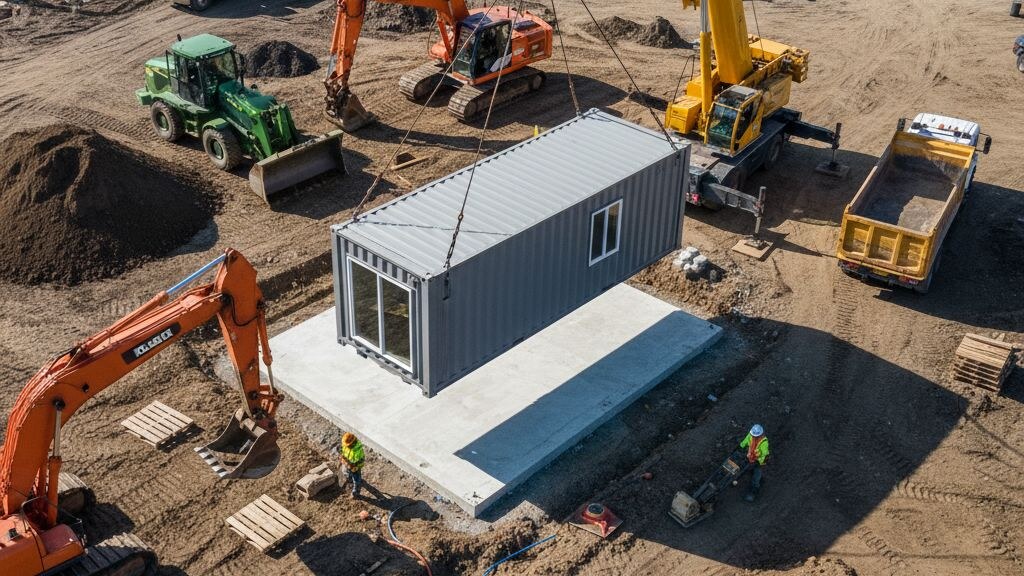
The crane that lifts your module off the truck and onto the foundation is the single most variable line item. For a single 20-foot module with standard access, expect $1,500 to $3,500. For a 40-foot expandable on a tight site requiring a larger crane, the cost can run $8,000 to $15,000. For a multi-module install requiring multiple pours and lifts over consecutive days, you're looking at $15,000 to $30,000 in crane time.
The crane operator does not include rigging, escort vehicles, or any leveling. Those are separate.
Utility Hookup
The cost line buyers most often underestimate. A new well runs $5,000 to $15,000. A new septic system runs $8,000 to $25,000 depending on soil percolation and system size. Connecting to existing municipal water and sewer typically runs $3,000 to $12,000 in tap fees and trenching. Power service extension from the nearest pole, if you're more than 100 feet away, can hit $8,000 to $20,000.
If your land has none of these utilities in place, your hookup budget alone can match the cost of the module itself.
The 2026 Tariff Picture
Container home prices climbed sharply in late 2024 and through 2025 as tariffs on imported steel structures, finished modular units, and component parts shifted twice within a 12-month window. By mid-2026 the market has partly stabilized but the new pricing floor is real: factory modules are roughly 20 to 35 percent more expensive than the 2023 baseline most buyers have anchored to.
Domestically fabricated modular container homes have benefited from the tariff shift, with US-based manufacturers regaining price competitiveness against imports. The buyer takeaway is that 2026 is no longer a great year to buy from Alibaba directly — the math has changed. Shop domestic fabricators first, factor the tariff line into any import quote, and assume the published Asian-factory price will land at 130 to 145 percent of advertised by the time customs, duties, and freight clear.
PERCH · Find yours. Free yours.
Find the homes that fit how you actually plan to buy, place, and live.
Join the waitlistWhat a Real 2026 Budget Looks Like
Here is what a realistic all-in budget looks like for three common configurations, assuming average site conditions and standard finishes.
Single 20-Foot Conversion (160 sq ft)
| Line item | Low end | Midpoint | High end |
|---|---|---|---|
| Module (factory) | 18,000 | 24,000 | 32,000 |
| Site prep | 3,000 | 5,000 | 8,000 |
| Foundation (piers) | 2,500 | 4,000 | 6,000 |
| Transportation | 4,500 | 6,500 | 9,000 |
| Crane and setting | 1,500 | 2,500 | 4,000 |
| Utility hookup | 8,000 | 18,000 | 35,000 |
| All-in total | 37,500 | 60,000 | 94,000 |
Two-Module 40-Foot Expandable (640 sq ft)
| Line item | Low end | Midpoint | High end |
|---|---|---|---|
| Module (factory) | 38,000 | 52,000 | 68,000 |
| Site prep | 5,000 | 8,000 | 14,000 |
| Foundation (slab) | 8,000 | 12,000 | 18,000 |
| Transportation | 7,000 | 10,000 | 14,000 |
| Crane and setting | 3,500 | 5,500 | 8,500 |
| Utility hookup | 10,000 | 22,000 | 42,000 |
| All-in total | 71,500 | 109,500 | 164,500 |
Multi-Module 800 Sq Ft Home (Modular Family Configuration)
| Line item | Low end | Midpoint | High end |
|---|---|---|---|
| Module (factory) | 58,000 | 78,000 | 105,000 |
| Site prep | 8,000 | 14,000 | 22,000 |
| Foundation (slab) | 12,000 | 18,000 | 26,000 |
| Transportation | 10,000 | 15,000 | 22,000 |
| Crane and setting | 8,000 | 14,000 | 22,000 |
| Utility hookup | 14,000 | 28,000 | 50,000 |
| All-in total | 110,000 | 167,000 | 247,000 |
Financing the Real Number, Not the Advertised Number
Most buyers walk into financing conversations anchored on the factory module price and discover their lender won't underwrite against that number. The lender needs to finance the all-in cost, and the all-in cost requires bids from contractors, foundation specifications, and a finalized site plan.
The two main financing paths are chattel loans and conventional mortgages. Chattel loans treat the home as personal property (like a vehicle) and run 7 to 12 percent interest in 2026, with 15-to-20-year terms. Conventional mortgages treat the home as real property — but only if the home meets HUD's Permanent Foundation Guide and is titled as real estate in the state. Conventional rates in 2026 sit roughly 4 to 5 percentage points below chattel rates, which over a 20-year loan saves tens of thousands of dollars.
FHA Title I and Title II loans are a middle ground for buyers who can't qualify conventionally but want better terms than chattel. The FHA's manufactured housing program covers loans up to specific category limits and requires the home to meet HUD construction standards (built after June 1976) and be installed on an FHA-approved foundation.
The single biggest mistake first-time modular buyers make is not pricing the financing alongside the home. A 5-percent rate difference over 20 years on a $110,000 loan is more than $60,000 in interest. Choosing the right loan structure can be a bigger financial decision than choosing the right floor plan.
How to Avoid the Hidden-Cost Trap
Three rules protect modular container home buyers from the 40-percent cost surprise.
The first rule is to require an itemized quote that includes all five categories — module, site prep, foundation, transportation, setting, utility hookup — before signing. Any dealer who refuses to itemize is hiding the real price. Walk away.
The second rule is to get independent quotes for the components the dealer doesn't control. The dealer's "preferred site prep partner" is usually marked up 25 to 40 percent above the local market rate. The independent grader, foundation contractor, and well driller working for you cost less and answer to you, not the dealer.
The third rule is to budget 15 percent contingency. Even with itemized quotes, modular projects discover surprises — soil that needs more compaction, a utility line ten feet farther than expected, a permit fee that wasn't in the local government's published schedule. Plan for it.
PERCH · Find yours. Free yours.
Find the homes that fit how you actually plan to buy, place, and live.
Join the waitlistRelated guides
- Modular vs prefab vs container homes: which is right for you?
- Container home pricing guide (2026)
- Modular homes explained — the 2026 buyer's guide
The weekly brief for modern modular living.
Design concepts, zoning workarounds, and market strategies — the specific ones the 22 million families in the missing middle actually need.
Under 3 minutes. Every Friday afternoon. Unsubscribe with one click.
Frequently asked questions
What's the cheapest container home I can actually live in?
Why is my advertised price 40 percent lower than the real cost?
Can I finance a container home with a regular mortgage?
How much does it cost to ship a modular home?
Are tariffs still affecting modular home prices in 2026?
What's the difference between a container home and a modular home?
Do I need a permit to install a container home?
Is a container home a good investment?
Keep reading
Join the conversation
Comments
Reader questions get answered. Real names and a working email — that's it.