Financing
How to Finance a Tiny House in 2026: All 6 Real Paths (Plus What Lenders Actually Say Yes To)
All 6 real financing paths for a tiny house in 2026 — RV loan, FHA Title I/II, conventional, personal, construction-to-perm. With the lenders who actually originate each.

On this page
Most people who call us at PERCH about financing a tiny house have already been turned down twice. Their bank said "we don't do that." Their credit union said "talk to an RV lender." The RV lender said "this isn't an RV." By the time they find us, they're convinced tiny house financing is a myth.
It isn't. There are six real paths, each with active lenders writing paper in 2026. The catch is that the path you qualify for depends almost entirely on three things: what the structure actually is (RV, manufactured, modular, or site-built), whether you own the land it sits on, and whether the unit carries the right certification. This guide walks you through all six, names the lenders who actually originate each one, and shows you the math on why a "park-owned" tiny house and an "owned-land" tiny house are two completely different loan applications. PERCH is a marketplace and concierge. We are not a lender. We do not originate, broker, or fund loans. We help you understand which path fits, then you take that path to a real lender.
Why Tiny House Financing Confuses Everyone
Tiny houses don't fit cleanly into any one lending bucket because the category itself isn't legally defined. A "tiny house" can be a 240-square-foot trailer with wheels (THOW), a HUD-coded manufactured home, a state-inspected modular set on a foundation, or a site-built IRC structure under 600 square feet. Each triggers a completely different set of lenders, rates, and requirements.
Here's the rule that simplifies everything: lenders don't lend on the word "tiny." They lend on what your structure is certified as and what it's attached to. RVIA gets you an RV loan. HUD code gets you a manufactured-home loan. State modular inspection on owned land gets you a real mortgage. Site-built on a foundation gets you a conventional mortgage. No certification gets you nothing.
This is why the uncertified kit trap is the single most expensive mistake in this category.
The 6 Paths, Side By Side
| Path | What It Finances | Rate Range (2026) | Max Loan | Term | Down Payment | Min Credit | Land Required |
|---|---|---|---|---|---|---|---|
| RV Loan (THOW) | RVIA-certified tiny on wheels | 7.5% - 12% | $100K typical, $150K+ for premium | 10-20 yrs | 10-20% | 660+ | No |
| FHA Title I | HUD-coded manufactured | 7.5% - 10.5% | $69,678 home only / $92,904 home+lot | 20-25 yrs | 5% | 580+ | Optional |
| FHA Title II | Modular on owned land | 6.5% - 7.5% | County FHA limit ($524K+) | 30 yrs | 3.5% | 580+ | Yes |
| Conventional Mortgage | IRC tiny on foundation | 6.75% - 8% | Conforming limit ($806,500) | 15-30 yrs | 5-20% | 620+ | Yes |
| Personal Loan | Anything, unsecured | 8% - 16% | $50K-$100K | 2-7 yrs | None | 660+ | No |
| Construction-to-Perm | Build then convert | 7.5% - 9% | Appraised value | 12-mo build + 30 yr | 10-20% | 680+ | Yes (usually) |
Path 1: The RV Loan (For Tiny Houses On Wheels)
If your tiny house has wheels and an RVIA green sticker, you can finance it as a recreational vehicle. This is the most common path for THOWs because the certification process is established, the lenders are familiar with the product, and the underwriting is fast.
Active 2026 RV lenders for THOWs include LightStream, Alliant Credit Union, USAA, Good Sam Finance Network, Southeast Financial, and Rock Solid Funding. Rates in 2026 are running 7.5% to 12% depending on credit, with 10-20% down and terms of 10 to 20 years.
The hard rule: no RVIA sticker, no RV loan. Period. PERCH does not originate RV loans. We can tell you which builders in our marketplace carry RVIA certification, but the loan itself comes from one of the lenders above.
Path 2: FHA Title I (Manufactured Homes)
FHA Title I is the federal program for financing manufactured homes that carry a HUD code (the red certification label on the back of the unit). It's the path most people don't know exists, and it's often the right answer for buyers who don't own land yet.
Title I lets you finance the home only, the lot only, or both together. The 2026 maximums are $69,678 for the home only, $23,226 for the lot only, and $92,904 for the home and lot combined. Terms run 20 to 25 years, and the minimum credit score is 580 (some lenders push to 620). Down payments start at 5%.
Active Title I lenders in 2026 are a smaller bench than people realize: 21st Mortgage, Vanderbilt Mortgage, Triad Financial Services, Cascade Financial Services, Credit Human, and ManufacturedHome.Loan. Your local bank almost certainly does not write Title I. PERCH is not a Title I lender.
Path 3: FHA Title II (Modular On Owned Land)
This is the path most buyers should aim for if they can. FHA Title II is a real 30-year mortgage on a modular home permanently set on land you own. The unit has to be on a permanent foundation, classified as real property, and titled to the land.
Rates in 2026 are 6.5% to 7.5%, which is the lowest of any path in this guide. The max loan size follows the county FHA limit. Term is 30 years. Minimum credit is 580 with 3.5% down.
Active Title II lenders include Rocket Mortgage, Guild Mortgage, Fairway Independent Mortgage, CrossCountry Mortgage, and most regional banks and credit unions that write FHA paper. PERCH is not an FHA Title II lender.
Path 4: Conventional Mortgage (IRC Tiny On Foundation)
If your tiny house is built to the IRC, set on a permanent foundation, and meets your local minimum square footage rules, you can finance it as a normal house with a normal conventional mortgage.
Rates in 2026 are 6.75% to 8%, terms are 15 to 30 years, minimum credit is 620, and down payments range from 5% to 20%. Lenders writing conventional in this category include Rocket Mortgage, Better Mortgage, Chase, Wells Fargo, and any community bank.
The challenge with this path is the appraisal. Conventional underwriters need comparable sales. If you're building a 500-square-foot IRC home in a county where no comparable 500-square-foot home has sold in the last 12 months, the appraiser will struggle.
Path 5: The Personal Loan
This is the path people take when nothing else works. A personal loan is unsecured, so the rate is higher (8% to 16%) and the term is shorter (2 to 7 years). But it doesn't care about certification, land ownership, or foundation.
Active personal-loan lenders in 2026 include LightStream, SoFi, Marcus by Goldman Sachs, Upstart, and Discover Personal Loans. Minimum credit is generally 660.
The math: a $60,000 personal loan at 11% over 7 years is roughly $1,030 per month. The same $60,000 financed as a 25-year Title I at 9% is roughly $503 per month. The personal loan costs you double per month but gets you in when nothing else will.
Path 6: Construction-to-Permanent
If you're building custom, on your own land, with a builder who isn't delivering a turnkey unit, you'll likely use a construction-to-permanent loan. This is a two-phase product: a 6-12 month construction loan that converts to a 30-year mortgage when the certificate of occupancy is issued.
Rates in 2026 are 7.5% to 9% during construction, then conversion to whatever the permanent mortgage rate is at the time of conversion. Down payment is 10-20%, minimum credit is 680.
The Uncertified Kit Trap
If you buy a tiny house "kit" from Amazon, Home Depot, Wayfair, or any general-merchandise channel, the structure almost certainly does not carry RVIA certification, HUD coding, or state modular inspection. It is, in the eyes of every lender in this guide, an uncertified pile of materials.
This means: no RV loan, no Title I, no Title II, no conventional mortgage. The only path left is a personal loan, which caps around $50,000-$100,000 with double-digit rates.
The hard rule: certification first, price second. A $45,000 RVIA-certified THOW is a financeable asset. A $25,000 uncertified kit is a yard ornament you can't get a loan on.
Park-Owned vs Owned-Land: The Math That Changes Everything
The single biggest variable in tiny house financing isn't credit score or even price. It's whether you own the land.
A manufactured home in a leased-land community is personal property, not real estate. The financing path is a chattel loan, which is what Title I writes. Rates are 7.5% to 10.5%, terms cap at 25 years, and the home depreciates like a vehicle.
The same manufactured home, moved to land you own, set on a permanent foundation, and re-titled as real estate, becomes a Title II property. Rates drop to 6.5% to 7.5%, terms extend to 30 years, and the home now appreciates with the land.
Run the math on a $150,000 project. As a park-lot chattel loan at 9% over 25 years, your payment is roughly $1,259. As an owned-land Title II mortgage at 7% over 30 years, your payment is roughly $998. Over the life of the loan, the owned-land path saves you roughly $46,000 in interest and gives you an appreciating asset.
PERCH · Home made for your land.
Talk to PERCH before you talk to a lender.
Join the waitlistRelated guides
The weekly brief for modern modular living.
Design concepts, zoning workarounds, and market strategies — the specific ones the 22 million families in the missing middle actually need.
Under 3 minutes. Every Friday afternoon. Unsubscribe with one click.
Frequently asked questions
Can I get a 30-year mortgage on a tiny house?
What credit score do I need?
Will an Amazon or Home Depot kit qualify for any loan?
What's the lowest rate path?
Is PERCH a lender?
Can I finance the land separately?
Do I need a down payment?
What's a chattel loan?
Can I refinance a THOW into a mortgage later?
Who actually lends on tiny houses in 2026?
What if I'm self-employed?
How long does approval take?
Join the conversation.
Share your take on this guide.
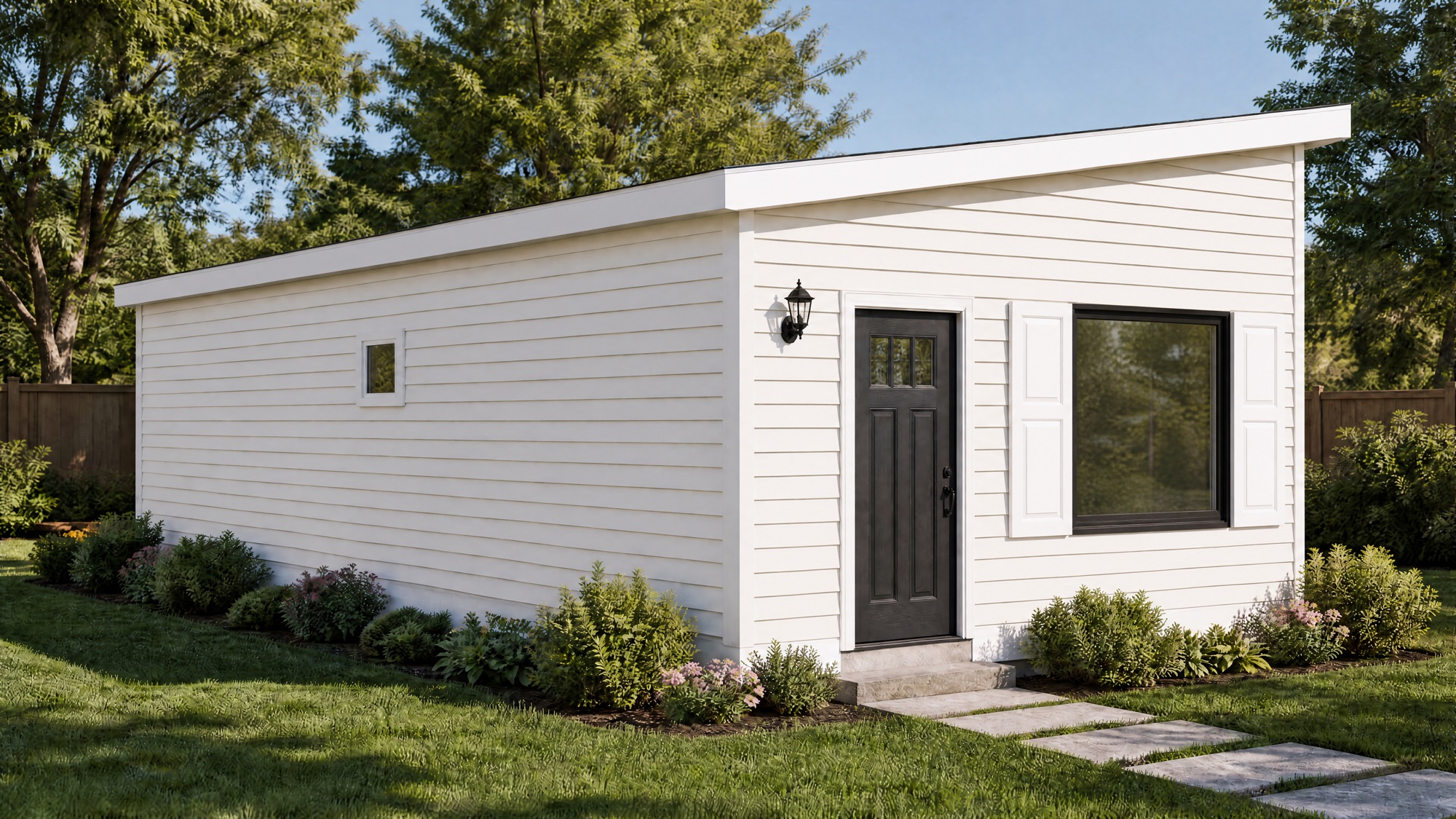 Available now
The Nest
Delivered to your parcel · 60–75 days
- PERCH-designed
- Escrow with proof
Refundable within 7 days.