Buyer Guides
Container Classrooms in 2026: The Operational Reference for School Districts and Education Innovators
U.S. school districts deployed 4,847 container classroom units in 2024 — a 312% increase from 2020. Here's the 2026 operational reference for procurement, costs, code compliance, and configurations that work.
On this page
U.S. public school districts deployed 4,847 container classroom units across 32 states in 2024 — a 312% increase from 2020 — and the trend has accelerated through 2025 and into 2026. The growth is driven by three structural pressures: traditional modular classroom construction has become significantly more expensive (averaging $245,000-$385,000 per classroom in 2026 versus $135,000-$215,000 in 2018), school capacity needs have outpaced bond-funded construction timelines in many districts, and container classroom designs have matured to a point where the educational outcomes match or exceed traditional portables. This guide explains how container classrooms function operationally for school districts and education innovators in 2026, what they cost, the code compliance that determines feasibility, and the configurations that produce strong educational outcomes.
If you're a district facilities manager, a superintendent evaluating capacity solutions, or an education innovator (charter, microschool, learning pod) considering container classroom infrastructure, this is the operational reference.
Why Container Classrooms Have Grown So Fast
Three pressures converged on school district facilities decisions.
Capacity expansion outpacing bond cycles. U.S. public school enrollment shifted dramatically post-2020 — some districts saw enrollment declines, others (particularly Sun Belt growth markets) saw double-digit increases. Districts facing unanticipated capacity needs cannot wait the typical 3-5 year bond-and-build cycle. Container classrooms deploy in 4-7 months.
Traditional portable cost inflation. Manufactured portable classroom costs increased approximately 78% from 2020 to 2024 according to multiple state department of education facility cost surveys. Container construction has absorbed less of that increase due to factory production efficiency.
Educational outcome data. Studies from districts that deployed container classrooms early (Houston ISD, Phoenix Union, San Diego Unified) have documented student academic outcomes equal to or better than students in traditional portable or permanent classroom settings. The data has eliminated the historical concern that container classrooms might be educationally inferior.
What a Container Classroom Costs in 2026
For a single classroom unit (320-640 sq ft) meeting full educational code:
| Cost component | Typical 2026 range |
|---|---|
| Factory-built unit with educational interior | $58,000 to $115,000 |
| Delivery and crane | $5,500 to $14,000 |
| Foundation (engineered for educational use) | $18,000 to $34,000 |
| Site prep, grading, ADA-accessible path | $11,000 to $24,000 |
| Utility connections (water, sewer, electric, HVAC oversized for occupancy) | $14,000 to $32,000 |
| Educational technology infrastructure (networking, AV, security) | $8,500 to $22,000 |
| Permits, plan review, inspections | $4,500 to $11,000 |
| ADA compliance (ramps, accessible restroom if included) | $8,500 to $22,000 |
| Fire suppression and egress | $5,500 to $14,000 |
Per-classroom all-in: $133,500 to $288,000.
By comparison, traditional manufactured portable classrooms in 2026 typically run $215,000-$345,000 all-in. Permanent stick-built classroom construction runs $385,000-$585,000+.
The Configurations That Work for Education
Single-Classroom Unit (320-480 sq ft)
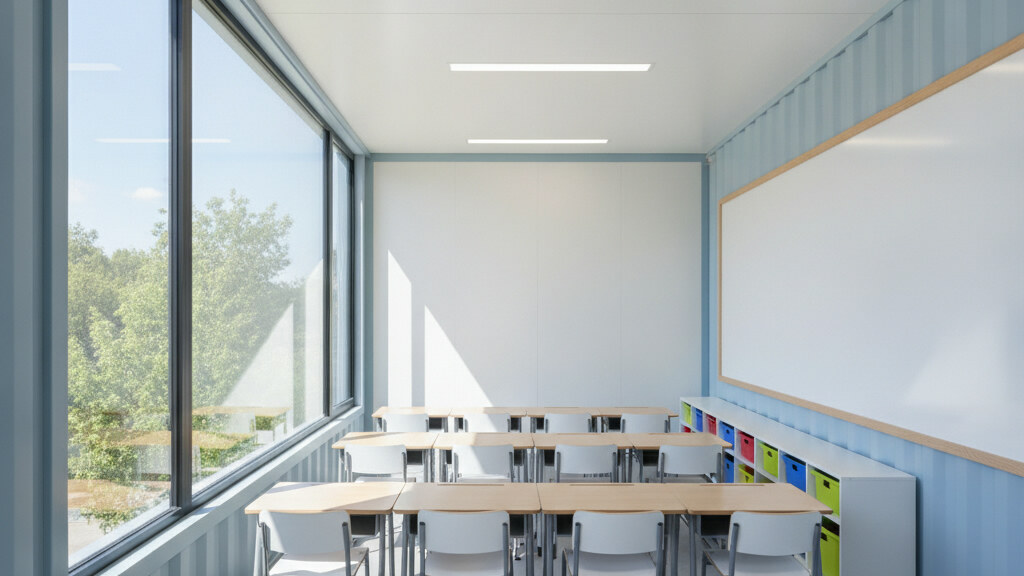
A single classroom serving 18-26 students in elementary or specialized instruction. The configuration:
- One main instructional space (24 students at typical desk spacing)
- One teacher workspace zone
- Storage cabinets along one wall
- Whiteboard or interactive display on primary wall
- Window placement for natural light
- Optional small ancillary storage closet
Best fit: capacity expansion for specific grade levels, specialized instruction (resource room, art, music), or rural schools with low-density needs.
Two-Classroom Unit (640-960 sq ft)
Two adjacent classrooms sharing a structural shell, typically with shared utility services. Configuration:
- Two classrooms separated by sound-isolated partition
- Shared restroom (if included)
- Shared mechanical
- Independent entrances for each classroom
Best fit: capacity expansion at scale, paired grade-level placement (Kindergarten + 1st, for example), or charter school launch facilities.
Multi-Classroom Building (3-6 classrooms, 1,500-2,400 sq ft)
A larger configuration combining multiple container modules into a building-scale facility. Configuration:
- 3-6 classrooms around a central corridor
- Shared restroom facilities (boys, girls, ADA-accessible single-occupant)
- Teacher workspace / break room
- Shared mechanical and electrical
- Multiple egress paths
Best fit: medium-scale capacity expansion, satellite campus facilities, or pilot school launches.
Educational Code Compliance Requirements
Container classrooms must meet International Building Code Group E requirements plus local school facility code. The specific requirements that differ from residential:
Occupancy load. Educational occupancy is calculated at 20 net square feet per student. A 480 sq ft classroom typically supports 24-28 students at maximum occupancy. This drives HVAC sizing, egress width, and structural live load requirements above residential standards.
Fire and life safety. Educational facilities require sprinkler systems (in most jurisdictions), exit signage with battery backup, fire-rated assemblies between classrooms, and specific door hardware (panic hardware on egress doors).
ADA accessibility. Educational facilities must meet ADA requirements including accessible entry, accessible interior path of travel, accessible restroom (if any restroom is provided), and accessible classroom features (whiteboard reach, desk clearance).
Acoustics. ANSI/ASA S12.60 standards for classroom acoustics require specific sound attenuation between classrooms and from exterior. Container construction with proper interior treatment typically meets these standards but requires specific design attention.
Indoor air quality. ASHRAE 62.1 ventilation rates for educational occupancy are significantly higher than residential. HVAC must be oversized for the higher occupancy density.
The compliance cost is real ($18,000-$45,000 per classroom) but unavoidable. Factories serving the educational market price this in. Factories without educational experience often produce units that cannot pass district facility inspection.
How Container Classrooms Compare to Alternatives
For a single classroom of 480 sq ft serving 24 students:
| Option | Per-classroom cost | Build timeline | Lifecycle |
|---|---|---|---|
| Traditional permanent construction | $385,000-$585,000 | 14-22 months | 40-60 years |
| Traditional portable (modular) | $215,000-$345,000 | 9-14 months | 20-30 years |
| Container classroom | $133,500-$288,000 | 4-7 months | 25-35 years |
| Temporary tent / tensile structure | $45,000-$95,000 | 2-4 months | 3-7 years |
Container classrooms hit the right balance for most capacity expansion scenarios — significantly cheaper and faster than traditional construction, with durability that matches or exceeds traditional portables.
The Three District Profiles That Work
Profile 1 — The fast-growth district. Districts in Sun Belt growth markets (Phoenix, Austin, Houston, Tampa, Atlanta, Las Vegas) facing 8-15% annual enrollment growth. Container classrooms close capacity gaps in 4-7 months versus the 2-5 years required for bond-funded permanent construction.
Profile 2 — The capacity-balancing district. Districts with stable overall enrollment but uneven distribution across schools. Container classrooms move with the demand — a unit serving over-capacity at School A in 2026 can be relocated to serve growth at School B in 2030.
Profile 3 — The innovation district. Districts piloting new educational models (project-based learning, microschools, hybrid programs) without committing to permanent capital expenditure. Container classrooms enable pilot deployment with reusability if the pilot succeeds or sunsets.
The Path Most Districts Take
The realistic 2026 path for container classroom procurement:
- Identify capacity need and timeline (this drives buy vs lease decision)
- Confirm site availability and zoning permits educational use
- Engage facilities engineer for site-specific design
- Get bids from 3+ factories with educational facility experience
- Lock factory pricing before site work begins
- Engage district-approved general contractor for site work and ADA compliance
- Submit complete permit application with educational code documentation
- Factory production (60-90 days) parallel with site prep (60-90 days)
- Delivery, set, finish, inspections, certificate of occupancy
- Educational fit-out (technology, furniture, materials)
End-to-end timeline: typically 5-8 months from procurement decision to classroom-ready occupancy.
PERCH was built to surface verified educational factories, real district permit timelines, real ADA and educational compliance specifications, and concierge support for districts navigating the procurement process.
Ready to evaluate container classroom solutions for your district or education innovation? Join the PERCH waitlist → for verified factory inventory and district-procurement concierge support.
Related guides
Frequently asked questions
What's a container classroom?
How much does a container classroom cost?
How long does deployment take?
Are container classrooms code-compliant for education?
Are educational outcomes affected?
Can container classrooms be relocated?
Do container classrooms support special education needs?
Keep reading
Join the conversation
Comments
Reader questions get answered. Real names and a working email — that's it.