Guides
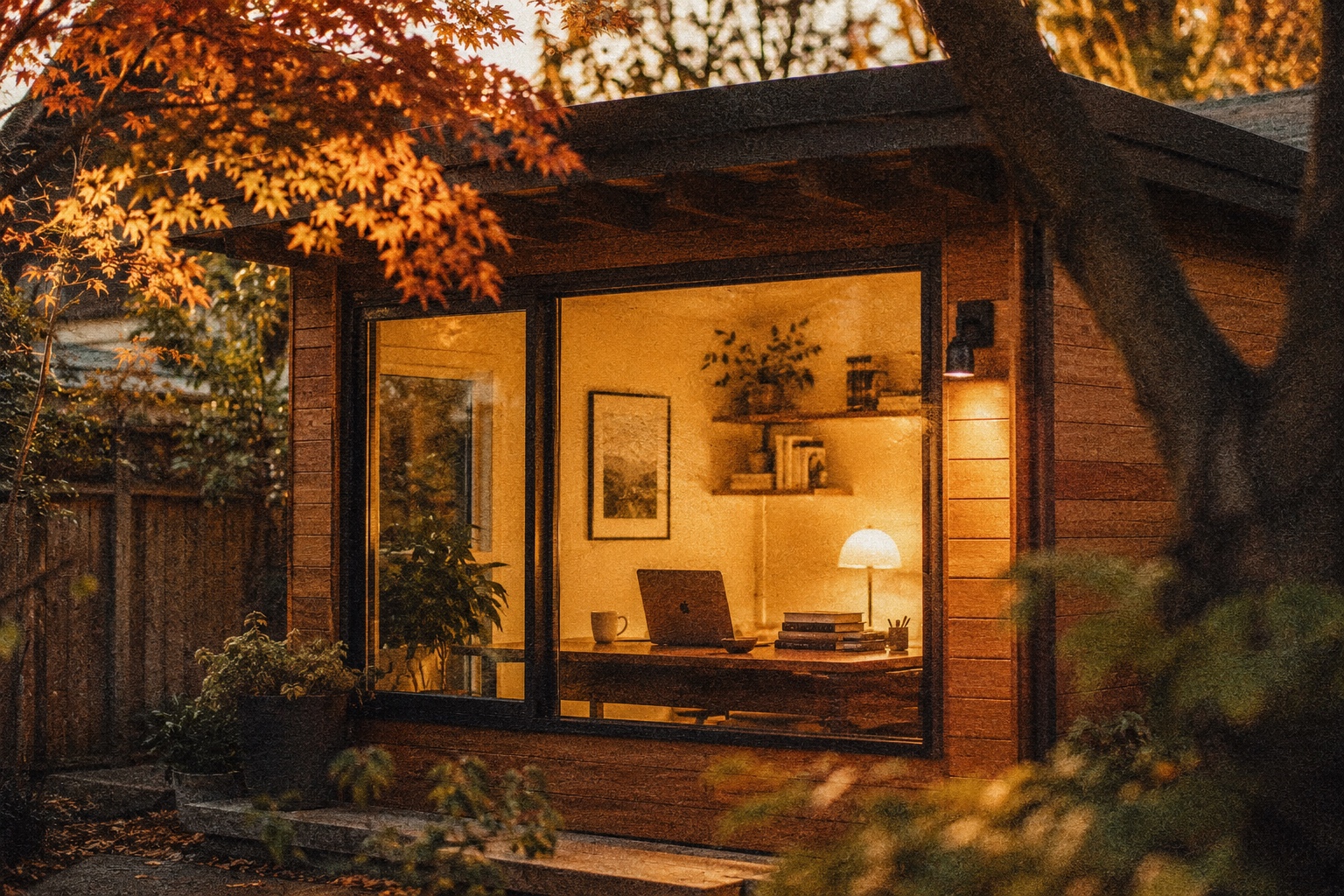
Backyard Office ADU: Multi-Purpose Guide
On this page
The garden office, the guest room, the backup plan.
You told your partner it was for work-from-home. Then when it was built, it also became the guest room. Then the yoga studio on Sundays. Then, quietly, the place where you drink coffee alone in the mornings before the house wakes up. Everyone gets what they wanted. This is how multi-purpose ADUs actually work in the wild.
Why this makes sense right now
Remote work is not a fad. As of Q1 2026, 32% of American full-time workers were in fully remote roles per Bureau of Labor Statistics data, and another 41% were in hybrid roles working from home 2+ days per week. That's roughly 100 million Americans regularly working from a home office — up from ~15 million in 2019.
Meanwhile, the median new-single-family-home floor plan does not include a proper office. Home offices in existing housing stock are typically converted bedrooms, kitchen nooks, or awkward corners of the primary bedroom. None of those setups produce good work.
The backyard office ADU solves the acoustic and psychological separation problem that plagues most home offices: the commute from bedroom to office is 15 seconds, but it happens through a real door across a real yard. The ritual of leaving the house to go to work — even to work sixty feet from your bedroom — recovers most of the productivity gap between a good office and a bad one.
Zoning cooperated. 38 states permit ADUs by right on single-family lots as of 2026. A backyard office ADU is legally identical to a backyard aging-parent ADU or rental ADU — it's the same permitted use, sized down.
The layout — the office that also works as a guest room
The multi-purpose backyard office ADU has five design decisions:
Excellent acoustics. Full insulation in walls and ceiling, insulated windows, thoughtful HVAC placement. A Zoom call at 10am and a lawnmower at 10:03am is a bad Wednesday.
Purpose-built work surface + storage. A built-in desk with power management, a small bookshelf, and a lockable file cabinet costs $2,500-$4,500 more than a bare shell but transforms the unit's usability.
A sofa bed or Murphy bed instead of a fixed bedroom. Frees up 100+ sq ft for daytime use. Handles a weekend guest without dedicating a whole room to a bed.
A compact bathroom. Full bathroom with a curbless shower and comfort-height toilet. 40-60 sq ft is enough.
Kitchen infrastructure without a full kitchen. Rough-in plumbing and electrical for a future full kitchen (in case you convert to rental). Install a compact wet bar with a small fridge, microwave, and sink. Adds $4K-$8K upfront but preserves the rental-conversion option.
Sweet spot on square footage: 350-500 sq ft. Big enough for a real office, a sleeper option, and a compact bathroom. Small enough to hit the affordable price band.
Two builders in 2026 doing purpose-designed backyard offices: Modern-Shed — 100 to 500 sq ft backyard office structures, $18K-$120K depending on finish level. Studio Shed — 100 to 400 sq ft prefab office structures, $22K-$140K.
Financing — the paths that support a mid-scale ADU
HELOC on the primary. Most common structure for backyard office ADUs. Q3 2026 rates 8.25%-9.75%. Fast, low fees. Works for $80K-$220K builds.
Fannie Mae HomeStyle Renovation loan. Rate ~0.25-0.5% above conventional. Rolls construction into a single mortgage.
Home office tax deduction offsets. If the ADU is dedicated to your business use, a portion of the depreciation and operating costs may be deductible as a home office expense. Talk to a CPA. Structure this correctly and the effective after-tax cost of the ADU drops meaningfully.
Cash from a taxable brokerage. Clean structure for higher-net-worth families or high-income remote workers with substantial savings.
Cash-flow math for a $130K backyard office ADU financed via HELOC at 8.75%: monthly interest ~$950. Property tax lift ~$130. Insurance ~$50. Utilities ~$45. Total carrying cost: about $1,175/month. Home office tax deduction (assuming 60% dedicated business use): typically $2,500-$5,000/year in reduced taxes. Effective after-tax carrying cost: about $950-$1,000/month.
The quiet part.
You said the ADU was for work-from-home. That was true. It was also for the version of you who wanted a small room to write in, or read in, or sit alone in for twenty minutes before the day started.
Multi-purpose ADUs work because they serve two or three real needs simultaneously — the stated one, the semi-stated one, and the one you didn't articulate. The stated need (a real office) gets it permitted and financed. The semi-stated need (a place for occasional guests) gets it built with a sofa bed and a full bathroom. The unstated need (a quiet room to be alone in) is the reason you'll use it every day for the next fifteen years.
Nobody has to know about the third need. It just quietly happens. That's the point.
Related guides
- Backyard Tiny Home for a Returning Adult Child — For when they move back in
- Backyard ADU for Family Space & Privacy — The second door your family has been asking for
- ADU Rental Income: Financing & Return Guide — The ADU that pays for itself. And the marriage.
Join the conversation
Comments
Reader questions get answered. Real names and a working email — that's it.