Guides
Tiny Home Communities in Atlanta: The 2026 Operator's Directory
An operator's directory of actually-operating Atlanta tiny home communities — by county, by ownership model, by what's real versus aspirational. With the four community models, realistic 2026 costs, and the three questions that separate well-run operators from vaporware.
On this page
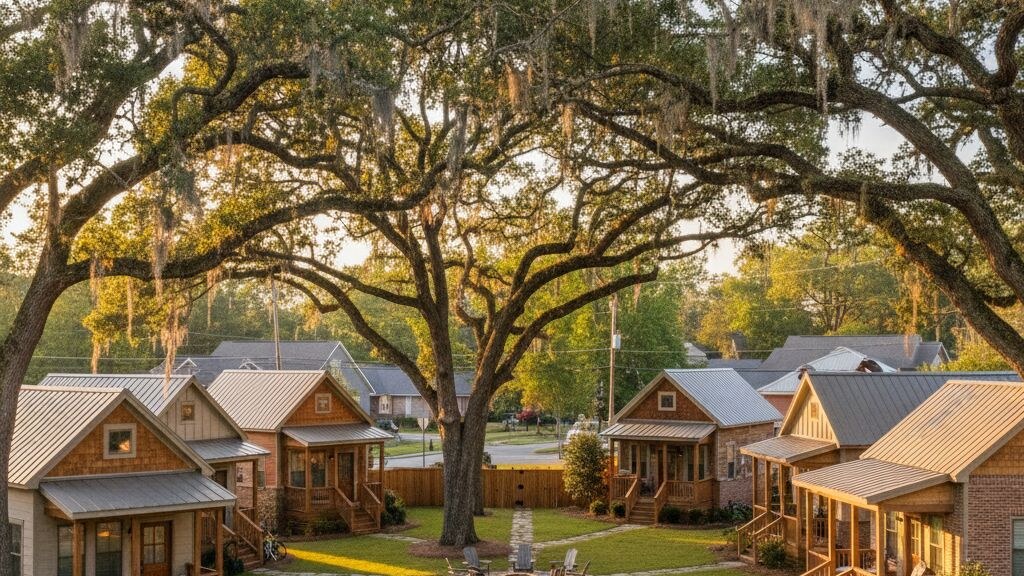
Atlanta's tiny home community landscape in 2026 is fragmented across three counties, a dozen municipalities, and a patchwork of zoning regimes that treat tiny homes very differently depending on whether the unit sits on wheels, on a permanent foundation, or as an accessory dwelling unit behind a primary residence. Most "Atlanta tiny home community" search results route buyers to lists that mix planned communities, RV parks renamed as tiny home villages, and aspirational projects that never broke ground. This directory only lists communities that are either operating, accepting reservations, or have entitlements in place as of 2026.
If you are looking for a tiny home community near Atlanta, the question that matters is not just "where can I live?" but "which model — owned lot, leased lot, cooperative, or ADU placement — fits how you actually want to live and finance the home?"
How Atlanta Treats Tiny Homes — The Zoning Frame
The City of Atlanta proper does not have a stand-alone tiny home zoning category. Tiny homes are permitted through three regulatory paths.
The first is as an accessory dwelling unit on a parcel with an existing primary residence. The city's ADU ordinance, updated in 2022 and refined in 2024, allows ADUs up to 750 square feet on most R-4, R-4A, and R-5 zoned parcels in the city, with administrative approval rather than a public hearing in most cases. This is the most-used path inside the perimeter and the easiest for a buyer who already owns Atlanta land.
The second is as a primary residence on a parcel zoned for the minimum square footage of the unit. Atlanta's smallest residential zone allows primary residences down to approximately 550 square feet on appropriately-zoned lots in select neighborhoods. The path requires a parcel with the right zoning, and those parcels are scarce.
The third is placement in a recognized tiny home community where the master site plan has been approved with reduced-footprint dwellings. These communities are the focus of this directory.
Operating Communities — Inside I-285
The Cottages on Vaughan (East Point)
East Point, an inner-ring municipality south of the airport, granted entitlements for a small-lot pocket community of detached cottages between 600 and 950 square feet. The site is built out and occupied as of 2026. Lot sales are by-resale rather than developer-direct at this point, with secondary-market pricing reflecting central Atlanta access and the limited supply. East Point's broader ordinance has continued to favor small-footprint single-family infill, which has made it the most consistent inner-ring jurisdiction for tiny home placement.
Pittsburgh Yards Adjacent ADU Cluster (South Atlanta)
Not a formal community in the master-planned sense, but a cluster of ADU placements on adjacent parcels in the historically Black Pittsburgh neighborhood south of downtown. The Annie E. Casey Foundation's Pittsburgh redevelopment work, alongside the Pittsburgh Yards commercial campus, created neighborhood conditions where ADU placement on infill lots became practical at scale. Buyers who want an Atlanta ADU placement in a transit-walkable urban context look here.
Operating Communities — Outer Ring
Tiny House Atlanta Affiliated Communities (Multiple Counties)
Tiny House Atlanta is an advocacy and education organization, not itself a community operator, but it maintains relationships with several community-scale projects across the metro. The organization's annual Decatur Tiny House Festival has been a primary buyer-builder matchmaking event for the region since 2015. Buyers considering Atlanta tiny home communities benefit from attending; many of the operating community options surface through that network rather than through general search.
MicroLife Institute Affiliated Projects (Decatur and Beyond)
The MicroLife Institute, an Atlanta-area non-profit focused on small-dwelling research and policy, has supported planning for several pocket-neighborhood-style projects in metro Atlanta. The Cottages on Vaughan was the most-publicized of these. Additional projects are in various stages of entitlement across Decatur, College Park, and Hapeville. Reservation status changes by quarter.
Rural Cooperative Communities (Cherokee, Paulding, Coweta)
The outer ring of the Atlanta metro contains several rural cooperative communities organized as land trusts, where buyers own their tiny home and lease a lot from the cooperative on long-term agreements. These communities tend to be 30 to 90 minutes from central Atlanta, with monthly lot fees that include water, septic maintenance, and shared common-area infrastructure. Lot fees typically run several hundred dollars per month, and the cooperative model allows buyers to participate without qualifying for a traditional mortgage on the land. Verification before committing is essential — cooperative governance varies widely in quality.
Counties to Know
| County | Position | Tiny home posture |
|---|---|---|
| Fulton (City of Atlanta) | Urban core | ADU framework strong; standalone tiny home placement limited to specific zones |
| DeKalb | Inner east | ADU framework adopted; some pocket-neighborhood entitlements in Decatur |
| Cobb | Inner northwest | Conservative — tiny homes mostly permitted only as ADUs or in manufactured-home subdivisions |
| Gwinnett | Inner northeast | Restrictive on standalone tiny placements; ADU framework limited |
| Cherokee | Outer north | Permissive for rural cooperative and acreage placements |
| Paulding | Outer west | Permissive; emerging community operator presence |
| Henry | Outer south | Mixed — depends on incorporated vs unincorporated parcel |
| Coweta | Outer southwest | Permissive on private acreage; manufactured housing tradition |
The Four Community Models — Which Is Right For You
Model 1 — Owned Lot in a Planned Tiny Home Subdivision
You buy the lot and you own the home outright. The community has shared infrastructure governed by a homeowners association. This is the most expensive model upfront, the most secure long-term, and the only one that builds traditional home equity. The Cottages on Vaughan and most outer-ring planned subdivisions follow this model.
Model 2 — Leased Lot in an Operating Community
You own the home, the community owns the land, and you pay a monthly lot fee for use of the parcel, utilities, and common areas. The upfront cost is lower because there is no land purchase. The long-term cost over a decade can rival or exceed an owned-lot purchase, depending on lot-fee inflation. Most outer-ring rural cooperatives follow this model.
Model 3 — ADU Placement on a Parcel You Own
You own a primary residence and you place a tiny home behind it as an accessory dwelling unit. The home is yours, the land is yours, and the configuration is governed by Atlanta's ADU ordinance. This is the dominant inner-perimeter path and the one that builds the most equity for buyers who already own Atlanta land.
Model 4 — Family Land Placement
You place a tiny home on land owned by a parent, sibling, or other family member, with a permitted ADU and a formal use agreement. The legal structure is the same as Model 3, but the financial dynamics are very different — there is no purchase of land at all. This is the path many multi-generational families use, especially in DeKalb and south Fulton.
What a Realistic Atlanta Tiny Home Placement Costs in 2026
For a 400 to 750 square foot factory-built unit placed on private Atlanta-metro land as an ADU or in a small-lot community:
| Cost component | Typical 2026 range |
|---|---|
| Factory-built unit (400 to 750 sq ft) | $52,000 to $115,000 |
| Delivery and crane placement | $4,800 to $9,500 |
| Permanent foundation and anchors | $14,500 to $28,000 |
| Utility connections (water, sewer or septic, electric) | $11,000 to $26,000 |
| Site prep, grading, driveway, hardscape | $7,500 to $16,000 |
| Permits, inspections, certificate of occupancy | $2,200 to $5,500 |
Delivered and permitted on a typical metro Atlanta lot, the total falls between roughly $92,000 and $200,000 depending on site complexity, jurisdiction, and the level of finish on the unit. Lot-leased model 2 communities reduce the upfront by removing the land purchase but add ongoing monthly lot fees.
The Atlanta-Specific Considerations
Atlanta's tree canopy ordinance affects most placements inside the perimeter and many outside it. Site work that requires removal of protected trees triggers either a replacement-tree replant or a fee in lieu of replanting. Buyers should budget for this when selecting a parcel — the same tiny home placed on a tree-dense parcel and a clear parcel can differ by thousands of dollars in compliance costs.
Stormwater requirements in DeKalb and parts of Fulton apply to most new impervious surface, including the driveway and foundation pad for a tiny home. The required stormwater management approach varies by parcel size and slope; on small parcels, the requirement is often met by a simple infiltration trench, but on sloped parcels it can require a more involved engineered approach.
How to Vet a Community Before Committing
The Atlanta tiny home community space includes both well-run operators and aspirational projects that have not yet broken ground. Three questions separate the two.
First, ask for the parcel ID and pull the county property record yourself. A real operating community has a deed, a master plan filed with the county, and recorded easements or common-area agreements. An aspirational project has none of these.
Second, ask to visit at least three occupied units. A community with five years of operating history will have residents happy to talk; one that just announced its first phase will deflect.
Third, ask for the monthly lot fee schedule for the last three years. Lot-fee inflation is the single biggest financial risk for buyers in Model 2 leased-lot communities. A well-governed community publishes its fee schedule transparently; one that does not is one to avoid.
For ADU placements, the same vetting applies to the contractor or verified ADU builder you select rather than to a community operator. PERCH was built specifically to surface verified factories and builders, real jurisdiction-by-jurisdiction permit timelines, and concierge support for buyers who want to find an Atlanta tiny home placement without navigating a fragmented market alone.
Ready to find your Atlanta tiny home community or ADU placement? Join the PERCH waitlist → for early access to verified Atlanta-metro inventory and operator vetting.
Join the conversation
Comments
Reader questions get answered. Real names and a working email — that's it.