Guides
Backyard Tiny Home for a Returning Adult Child
On this page
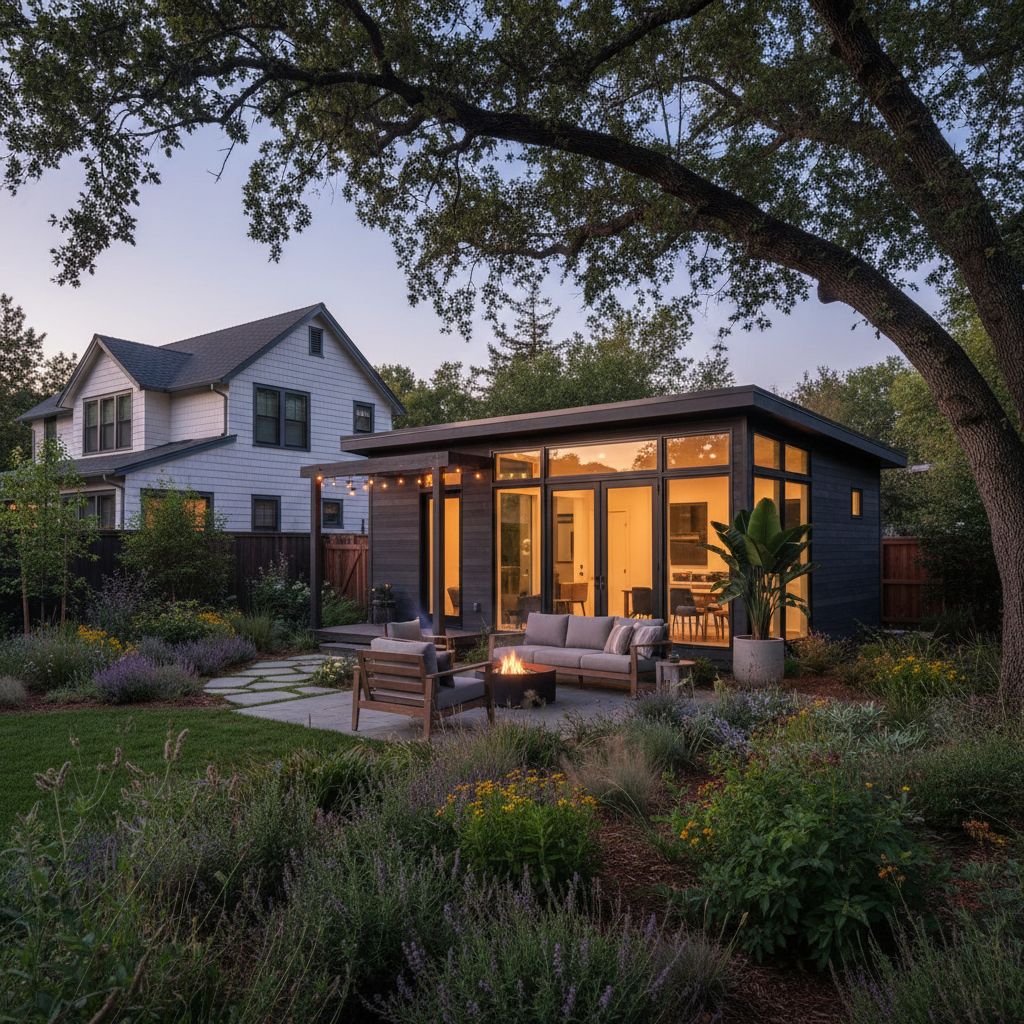
Your daughter is twenty-eight. She has a full-time job at a design agency and a lease that ended in April. Your son is twenty-four. He is finishing a graduate program he chose partly because the funding covered rent and partly because he did not know what else to do with the year. Neither one of them wants to move back into the childhood bedroom. Neither one of them can afford a studio in this market. Both of them, it turns out, would happily live in a small standalone building in your backyard.
You did not plan for this. But the industry did not either.
Why this makes sense right now
The share of adults 25 to 34 living with a parent hit 21% in 2025, per Pew Research Center. That is the highest it has been since the Great Depression. It is not because a generation forgot how to be adults. It is because rent in the top 50 metros grew 47% between 2019 and 2025 while wages grew 21%, per Zillow Observed Rent Index and BLS Employment Cost data. The math stopped mathing.
Meanwhile, the boomerang model of putting a twenty-eight-year-old back in the room with the varsity pennants and the Ikea desk is a bad model. Everybody knows it. Pew asked the parents; 61% said the arrangement was working fine, but 40% said it had created tension. Nobody asked the twenty-eight-year-olds because nobody had to.
A backyard tiny home solves for three of the four hardest problems in the boomerang setup:
- Privacy for the adult child. They can come home at 11 pm from a work dinner without narrating.
- Privacy for the parents. You can watch what you want at 11 pm without narrating.
- A legitimate address. They get to give it to a delivery driver, a landlord check, a bank, a doctor. They are not "living at home." They are living at a place that happens to be sixty feet from the main house.
The fourth problem — that everyone is still in each other's lives, which was the point of coming home in the first place — is the one the backyard tiny home is designed to preserve, not fix.
The layout — what a working adult needs
The mistake most families make is treating this like a bedroom addition. It is not. It is a home for an adult person who happens to be your child.
Sweet spot: 400 to 620 sq ft, one bedroom, one bath, one great room, one small work-from-home nook. The working-from-home nook is not optional. This is a person with a job, probably a hybrid one, and the ability to take a Zoom call without the noise of the main house is worth $18K in build cost.
Layout that works:
- One real bedroom with a closet
- One full bathroom with a walk-in shower
- Kitchen with a 24" range, a real fridge (28" min), dishwasher, and enough counter to cook a real meal
- Great room with couch space and a dining spot for two
- A defined work-from-home nook of at least 32 sq ft — not the kitchen counter
- Enough soundproofing that a work call at 10 am doesn't collide with a lawnmower at 10:03
- Its own entry, its own address (some cities will issue a "Unit B" address for a permitted ADU — worth asking)
Two builders in 2026 doing this well:
- Boxabl Casita — 361 sq ft foldable ADU, delivered on a truck, ~$60K plus site work. Not for everybody. But for the "under $100K, need it in three months, adult child working remotely" case, it is real
- Cover — Los Angeles-based, factory-built 400 to 800 sq ft backyard ADUs with excellent acoustic and daylight design. $220K to $380K turnkey. If your adult child does creative or engineering work from home, this is the caliber to look at
The mistake to avoid: a garage conversion. A garage conversion looks cheaper on paper. It ends up costing 70% of a purpose-built ADU with 40% of the outcome. A returning adult child in a converted garage is a returning adult child in a converted garage. A returning adult child in a purpose-built backyard tiny home is an adult with a home.
Financing — how families actually pay for these
The most common structure is a HELOC on the primary. Simple, fast, well-understood by every regional lender in the country.
HELOC on the primary home. At Q3 2026 rates of 8.25% to 9.75%, a $180K HELOC used to fund a $170K ADU costs roughly $1,350 to $1,500 a month interest-only during the draw period. If your adult child pays $900 a month in rent — market-rate for a studio equivalent in most metros — that's covering ~60% of the debt service alone. If they pay full market rate for the ADU as a standalone unit (typically $1,400 to $2,200 depending on metro), the HELOC pays itself.
Cash-out refinance. Only makes sense if your existing primary mortgage rate is above 7%. Otherwise you burn a lower rate to fund the ADU, and you never get it back.
Renovation loan (Fannie Mae HomeStyle or FHA 203(k)). These are useful if you have less than $150K equity in the primary and need to fold ADU cost into a single mortgage. Rate is typically 0.25% to 0.5% above conventional.
Builder financing. Boxabl, Cover, and Abodu all partner with lenders. Fine if you need speed. Not the cheapest structure.
Cash from a parent's brokerage account. If you have taxable investment assets, some families fund the ADU out of pocket in exchange for a formal rent structure from the adult child. Common structure: adult pays 60-80% of local studio market rent, all of which goes into a savings account earmarked as a down payment fund for their eventual move-out. Everyone benefits: the parent's asset base earns market returns on the rest of the portfolio, the adult child pays reasonable rent while building a real down payment, and when they eventually move, the ADU becomes a market-rate rental.
Permits: 38 states allow ADUs by right on any single-family lot in 2026. Permit fees typically run $2,500 to $8,500 and add 8 to 14 weeks. Some cities have expedited "adult child ADU" or "family ADU" tracks that halve the permitting timeline — worth asking.
The PERCH Financing Finder walks through eight questions and returns the two structures most likely to close for a backyard ADU situation. Free. Four minutes.
The quiet part.
Your kid is not a failure. The rental market is a failure.
You already know this. You have said it out loud, probably to a friend, probably after a glass of wine. But it is worth writing down anyway, because it changes the shape of the entire conversation you are about to have with your twenty-eight-year-old about the backyard.
This is not a rescue. It is a floor plan.
A backyard tiny home does two things at once. It gives an adult who is between phases a runway that does not carry the emotional freight of the childhood bedroom. And it gives you back the version of your kid you enjoyed most — the one who dropped by on a Sunday, made coffee at your machine, told you about the person they were dating, and then left. That version was possible when they had their own place across town. It is possible again when they have their own place across the yard.
The mother-in-law suite grew up. The garage conversion grew up. The backyard tiny home is the adult version of a house move that everybody in the family, quietly, is glad to be making. Nobody has to say so.
The kettle is on. That is the whole thing.
Related guides
- ADU for Adult Children: Independent Living Guide — for the kids who want their own front door
- Converting an Empty Nest into an ADU Rental — the empty nest, filled differently
- Backyard Cottage vs. Home Addition: Full Comparison — the addition that doesn't require permits, plumbing, or divorce
Join the conversation
Comments
Reader questions get answered. Real names and a working email — that's it.