Guides
Backyard Cottage vs. Home Addition: Full Comparison
On this page
The addition that doesn't require permits, plumbing, or divorce.
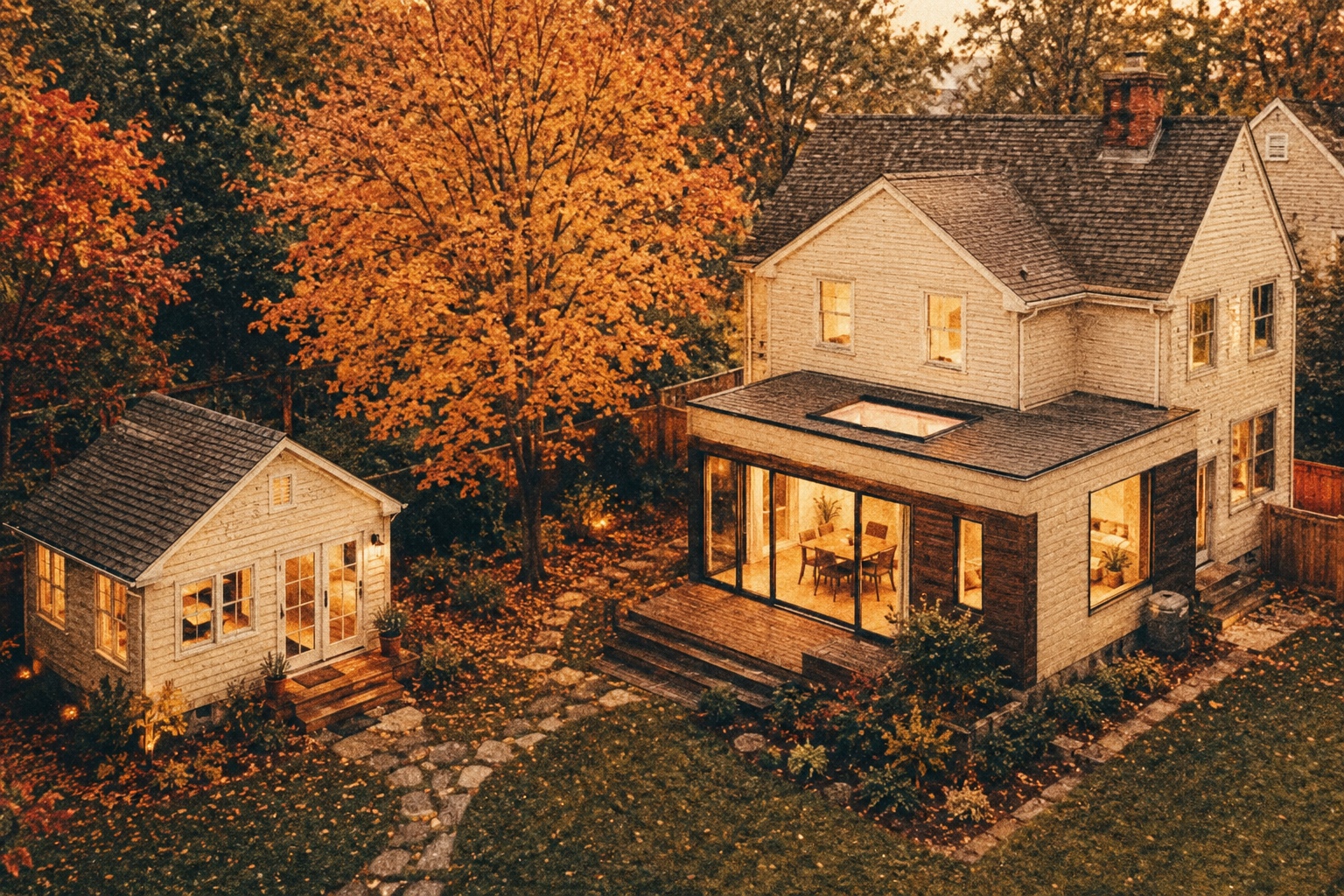
The classic home addition is a good idea that becomes a nightmare in ten specific ways: shared HVAC, shared plumbing, months of dust, months of construction noise inside your home, contractor scheduling delays, disrupted routines, invisible drift in the marriage, blown budgets, and — if you're really unlucky — structural surprises behind the wall you opened. The backyard cottage sidesteps every single one.
Why this makes sense right now
Home addition costs have risen faster than new construction costs since 2020. NAHB Cost Reports tracked home addition per-sq-ft costs rising 34% from 2020-2024, driven primarily by shortages in specialized labor (framers who can tie into existing structures) and by permit-inspection wait times that stretched to 3-6 months in most metros.
Meanwhile, factory-built backyard cottage prices actually fell 8% during the same period, per Modular Housing Institute tracked data. The gap between the cost of a comparable home addition and a comparable factory-built cottage has narrowed to under $30K in most metros — and after accounting for the disruption cost of on-site construction (relocation, interrupted work-from-home, family stress), the cottage frequently wins outright.
Zoning cooperated. 38 states permit ADUs by right on single-family lots as of 2026. The permit path for a detached backyard cottage is now shorter and more predictable than the path for a home addition in most metros.
The layout — comparing the two structures head-to-head
Home addition:
- Attaches to the primary home structurally
- Shares HVAC, plumbing, and electrical with the primary
- Construction happens on-site over 4-9 months
- Primary home is uninhabitable in the addition zone during construction
- Adds direct square footage to the primary home
- Resale premium: 60-75% of build cost
- Rental potential: none unless legally converted to an ADU
Backyard cottage (ADU):
- Standalone structure detached from the primary home
- Own HVAC, plumbing, and electrical (utility hookups tie into the primary or run new lines)
- Factory build (12-18 weeks) or on-site build (5-8 months)
- Primary home remains fully habitable during construction
- Adds an entirely separate dwelling to the property
- Resale premium: 85-105% of build cost, plus a "duplex-adjacent" property value lift
- Rental potential: $1,400-$2,400/month depending on metro
The cost gap is real but smaller than most families expect. A 500 sq ft home addition at $300/sq ft = $150K. A 500 sq ft backyard cottage at $350/sq ft turnkey = $175K. $25K premium for the cottage buys: no construction inside the primary, keeps HVAC/plumbing separate, adds rental potential, adds higher resale premium.
Two builders in 2026 doing high-quality backyard cottages: Villa — California, 500 to 800 sq ft factory-built cottages, $190K-$310K turnkey. Cover — California, factory-built 400 to 800 sq ft with excellent architectural quality, $220K-$380K turnkey.
Financing — most paths work for either structure
HELOC on the primary. Works for both. Q3 2026 rates 8.25%-9.75%.
Fannie Mae HomeStyle Renovation loan. Explicitly supports both attached additions and detached ADUs. Rate ~0.25-0.5% above conventional. Rolls construction into a single mortgage.
Cash-out refinance. Only makes sense if your existing rate is above 7%. Otherwise burns your low rate.
Cash from a taxable brokerage. Clean structure for higher-net-worth families.
One financing consideration specific to home additions: some renovation loans require the addition to be structurally integrated with the primary (not a separately-metered unit). If you want the option to sub-meter or convert to a rental later, tell your loan officer upfront.
The quiet part.
The home addition failed for the last generation of families in the specific ways it will fail for you: shared systems mean shared problems, on-site construction inside your home ruins six to nine months of daily life, and the finished product is technically part of your primary residence — which means when your marriage strains, your mother needs a place, or your adult child comes home, you don't have a separate structure. You have a bigger house.
A bigger house is not always the answer. Sometimes the answer is a second, smaller house on the same property. One where the mother-in-law lives without needing to negotiate the coffee maker. Where the adult child returns without regressing into the childhood bedroom. Where a home office actually feels like a separate office because it is a separate structure sixty feet from the kitchen.
The backyard cottage isn't a compromise version of a home addition. It's a different product entirely — and for most modern families, the better one.
Related guides
- Backyard Home for an Aging Parent: ADU Guide — A house for your mother, on your terms
- Backyard Tiny Home for a Returning Adult Child — For when they move back in
- ADU Rental Income: Financing & Return Guide — The ADU that pays for itself. And the marriage.
Join the conversation
Comments
Reader questions get answered. Real names and a working email — that's it.