Guides
Backyard Home for an Aging Parent: ADU Guide
On this page
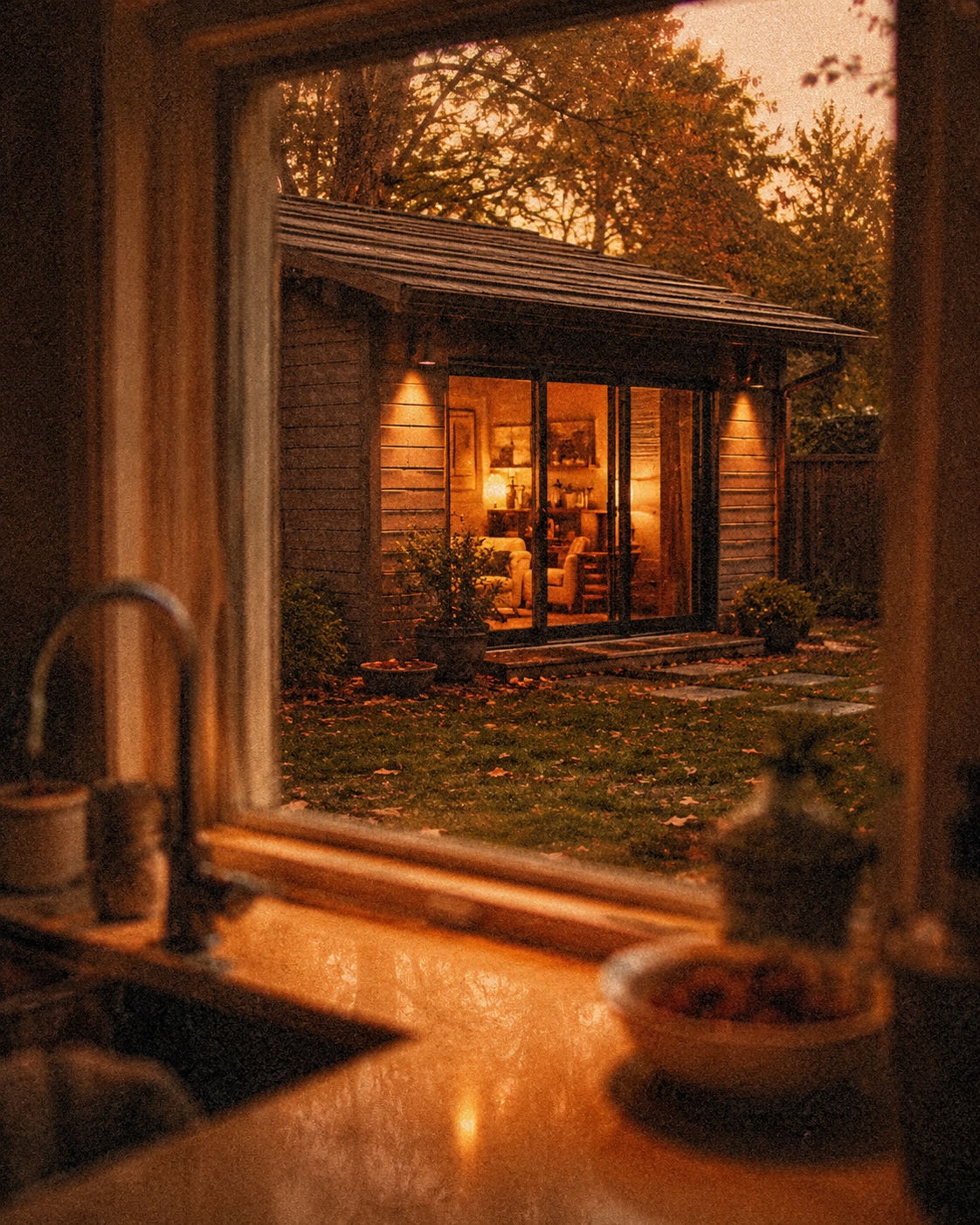
A house for your mother, on your terms.
That's not a soft phrase. It's the arrangement. She gets a home, not a room. You get a mother nearby, not a mother upstairs. The compromises everyone thought they had to make — the shared kitchen, the noise, the invisible negotiation about who gets the couch on Sundays — turn out to be optional.
Why this makes sense right now
Roughly 22 million Americans over 65 live in multi-generational households, per U.S. Census Bureau 2024 data. The number rose 32% between 2019 and 2024. Most families didn't set out to become multi-gen. It happened one conversation at a time — a health scare, a widowed parent, a rent hike, a phone call.
The financial math has quietly gotten better. Assisted living averages $6,000 per month nationally in 2025 per Genworth Cost of Care, and rose 5.7% year-over-year. A $240K backyard ADU financed at 8.5% costs roughly $1,700 per month in interest over the first decade — less than one-third of what assisted living costs, and the property remains yours at the end.
Zoning stopped being the wall it used to be. As of 2026, 38 states permit ADUs by right on any single-family lot. In California and Oregon, the state legislature preempted municipal restrictions entirely — cities cannot require owner-occupancy or on-site parking for ADUs under 1,200 sq ft. Local practice is catching up unevenly, but the direction is one-way.
The layout — designed for a real life, not a short stay
The backyard ADU that works as an aging-parent home shares five design decisions:
Single-story, zero-threshold. No stairs anywhere. Not to enter, not between rooms, not into the shower.
A real kitchen. 24" range, dishwasher, full-height fridge, prep counter with knee clearance. Your mother will cook. She will invite you over. The kitchen is not a symbol; it is the room.
One bedroom, one flex. The flex becomes an office, a den, or eventually a caregiver room. Build it as a proper bedroom (closet, window egress) so the option stays open.
A full bathroom, sized for a walker or wheelchair. 60" turning radius, 36" clear door, curbless shower with a folding bench, comfort-height toilet, blocking in the walls for future grab bars.
A covered porch and a separate mailbox. Both are dignity signals. Both cost under $2,000 to build. Neither is optional.
Sweet spot on square footage: 600 to 750 sq ft. Enough for real life, small enough that heating and cleaning don't overwhelm a single person.
Two builders in 2026 doing backyard aging-parent ADUs well: Cover — California, factory-built 400 to 800 sq ft units with excellent daylighting and acoustic engineering. Connect Homes — California, Washington, Colorado, Utah, 500 to 900 sq ft single-level ADUs with aging-in-place layouts.
Financing — how a $250K backyard build actually closes
Most families use one of three structures.
HELOC on the primary home. Q3 2026 rates: 8.25% to 9.75% variable, interest-only during the 10-year draw. Fast to close, low fees. Best when you have $200K+ in equity in the main house.
Fixed HELOAN. 7.5% to 8.75% fixed. Higher monthly cost, rate is locked. Best for families who plan to keep the ADU for 10+ years.
Fannie Mae HomeStyle Renovation loan. Rate ~0.25-0.5% above conventional. Rolls construction and permanent financing into a single mortgage. Best when equity is thin.
Cash from a taxable brokerage is an option for higher-net-worth families. Some CPAs will recommend it if the opportunity cost of pulling from equities is lower than the after-tax cost of a HELOC. Talk to your CPA. It's a fifteen-minute conversation.
Permit fees typically add $2,500 to $8,500 and 8-14 weeks to the timeline. Site work — grading, utility trenching, foundation — usually runs $18K to $42K depending on lot conditions and how far the ADU sits from the main house's utility taps.
The quiet part.
You are not building a room for your mother. You are building a house for the version of the family you want to have in ten years.
That version has more Sundays together than fewer. It has a mother who cooks in her own kitchen and drops by yours when she wants to, not because she has nowhere else to go. It has a routine that isn't punctuated by weekly guilt phone calls to a facility. It has a granddaughter who walks across the yard to see her grandmother, not through a lobby.
The house behind the house doesn't guarantee any of that. It just makes it possible. That is what you are paying for.
Related guides
- ADU for Elderly Parents & In-Laws: The 2026 Guide — Close, but not too close
- Modern Mother-in-Law Suite: ADU Design & Cost Guide — The mother-in-law suite finally grew up
- Financing an ADU for Aging Parents: 2026 Options — How to buy your parents' independence
Join the conversation
Comments
Reader questions get answered. Real names and a working email — that's it.