Guides
Modular vs. Container Home: The 2026 Comparison
On this page
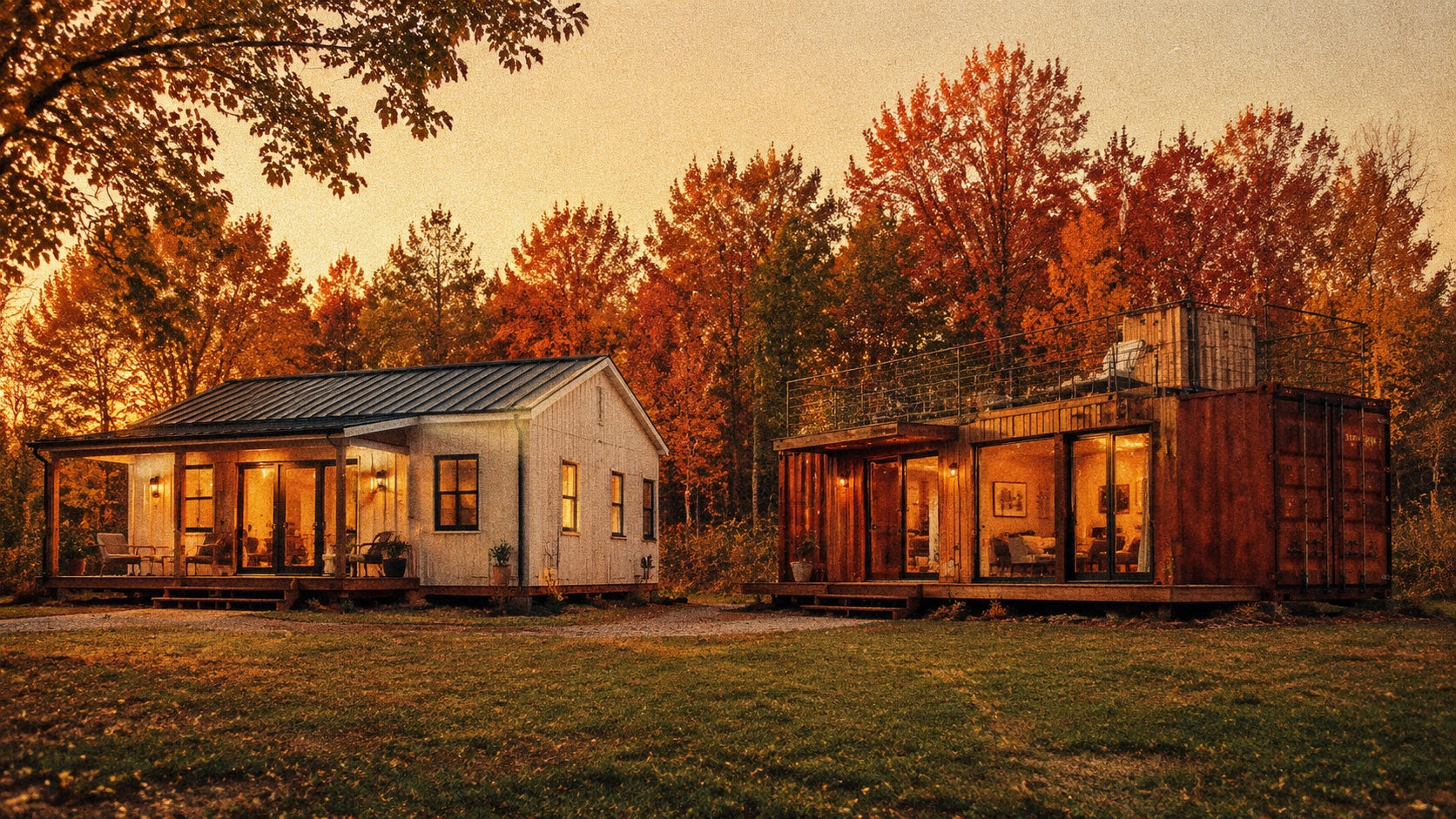
Same delivery truck, different building code.
Both arrive on a flatbed. Both get craned onto a foundation. Both are billed as "prefab." That is where the resemblance ends. Modular homes are built to residential code from the first stud; container homes are converted shipping containers that started life carrying refrigerators across the Pacific. The finished home can look nearly identical from the curb — but the mortgage, the insurance, and the resale live in different universes.
Why this makes sense right now
The container home market grew 26% in 2024 per Grand View Research — from $52B globally to $65B — driven primarily by ADU demand and off-grid buyers. The US market alone grew 18%. Meanwhile modular grew a steadier 18% per Modular Housing Institute, pulling from the mainstream homebuyer market rather than the alternative-housing niche.
The financing gap is the deciding factor. Conventional mortgage lenders finance modular homes as standard residential property. Container homes face three distinct financing frictions: (1) many lenders require the "conversion" to be complete before financing, (2) appraisers have fewer comparable sales to reference, (3) some jurisdictions have not yet updated code to explicitly allow container-based residential structures. Cash-heavy buyers dominate the container market for this reason.
Zoning cooperated for modular in 38 states by right. For container homes, zoning remains jurisdiction-specific — some cities have explicit container-home ordinances (Austin, Portland, Nashville), while others require case-by-case approval.
The layout — head-to-head on the 12 things that matter
Building code
- Modular: IRC + state amendments (identical to site-built)
- Container: IRC-adapted, often with structural engineer letter required for cut walls
Structure
- Modular: purpose-built wall panels + roof trusses
- Container: Corten steel shipping container (14 or 20 gauge), typically ISO 668 compliant
Cost per sq ft turnkey (2026)
- Modular: $180-$280
- Container: $150-$350 (huge variance based on preservation level)
Build time
- Modular: 4-9 months factory + 30-90 days on-site
- Container: 3-8 months factory + 45-90 days on-site
Financing
- Modular: conventional Fannie/Freddie mortgages, VA, FHA, USDA — all standard
- Container: specialty construction loans, cash, or portfolio lenders; few conventional
Insulation
- Modular: standard wall insulation (R-15 to R-30 typical)
- Container: spray foam or rigid board on interior + exterior; R-value achievable but requires careful design
Appreciation
- Modular: appreciates like site-built (3-5% annually in most markets)
- Container: appraisal variance high; some markets flat, others match modular
Resale
- Modular: broad buyer pool
- Container: narrower buyer pool; premium in tech-forward metros (Austin, Portland), discount in traditional markets
Zoning
- Modular: 38 states by right on residential lots
- Container: jurisdiction-specific; ~15 states have explicit container-home code
Structural integrity
- Modular: engineered for wind loads to IRC standards
- Container: Corten steel handles hurricane-force winds if properly anchored; some FEMA-approved as storm shelters
Design flexibility
- Modular: high — any residential floor plan works
- Container: constrained by 8'x20' or 8'x40' unit dimensions unless multiple containers combined
Warranty
- Modular: 10-year structural typical
- Container: builder-dependent, often 1-5 years
Two builders in 2026 doing purpose-designed modular: Plant Prefab — California, $220-$320/sq ft, LEED-certified. Method Homes — Pacific Northwest, $200-$300/sq ft, LEED-forward. Two doing serious container homes: Backcountry Containers — Texas, $150-$280/sq ft, off-grid capability. Custom Container Living — nationwide delivery, $130-$250/sq ft.
Financing — the fork that actually determines the deal
If you're financing (any amount):
- Modular: any Fannie/Freddie lender, standard construction-to-perm loan
- Container: First Bank of the Lake, First Bank, specialty portfolio lenders; expect 15-25% down, higher rates
If you're paying cash:
- Modular: no friction
- Container: no friction; this is the most common container buyer profile
If you're building off-grid:
- Modular: harder — most modular manufacturers require utility hookup for warranty
- Container: this is container homes' native use case
If you're building an ADU on financed primary land:
- Modular: HomeStyle Renovation or HELOC works
- Container: HELOC most common; HomeStyle Renovation requires appraiser familiar with container appraisals
Cash-flow math for a $250K modular vs. a $220K container on the same lot: modular P+I at 6.5% for 30 years = $1,580/month; container land-home construction at 8% for 20 years = $1,840/month (assuming portfolio lender). The container's lower purchase price is often offset by more expensive financing. The PERCH Financing Finder will route you to the actual lenders working with either category in your state.
Choose modular if...
- You need conventional mortgage financing
- Broad-market resale matters (10+ year hold expected)
- You want a traditional residential floor plan (not constrained by 8-ft width)
- Your jurisdiction is not yet container-code-adapted
- Insurance ease matters (standard homeowner's policy)
- You value the appreciation curve of standard residential real estate
Choose container if...
- You are paying cash or have specialty construction financing
- The industrial-aesthetic language is a positive, not a compromise
- You are building off-grid, on rural land, or on a jurisdiction that welcomes containers (Austin, Portland, Nashville)
- Hurricane wind resistance is a design priority
- You want a distinctive property that stands apart in the neighborhood
- Small-footprint (single or double container, 320-640 sq ft) fits your program
The quiet part.
Container homes photograph well. That is not a small thing. Ten years of Instagram, tiny-home YouTube, and design-forward Airbnb listings have made the container the aesthetic default for people who want their home to say "we made deliberate choices." Modular photographs like a normal house because it is a normal house.
The lender does not care about your aesthetic. The appraiser does not care about your aesthetic. The next buyer in 2036 might care about your aesthetic — or they might care about square footage and school district. The container is the honest answer if you can afford the financing friction and you love the material. The modular is the honest answer if you want the financing to be boring and the resale to be broad.
Buy the one that fits your ten-year plan. If the ten-year plan is "sell in five and cash out," modular wins in most metros. If the ten-year plan is "own it outright, live in it, love the steel," container is the more honest answer.
Related guides
- Modular vs. Prefab vs. Container Homes: The Full Comparison — the three-way overview
- Container Home vs. Prefab Home Comparison (2026) — narrower head-to-head
- Foldable vs. Expandable Container Homes — the two container categories most buyers confuse
Join the conversation
Comments
Reader questions get answered. Real names and a working email — that's it.