Guides
Foldable vs Expandable Container Homes: The 2026 Comparison
"Foldable" and "expandable" container homes get used interchangeably but describe two structurally distinct categories. Here's the 2026 comparison — how each mechanism works, where each wins, the realistic cost and timeline implications, and how to choose between them.
On this page
The phrases "foldable container home" and "expandable container home" are used interchangeably in most consumer search results, but they describe two structurally distinct categories of factory-built dwelling. The difference matters for cost, for installation timeline, for what kind of parcel the unit can be delivered to, for the available manufacturers, and for the financing path. The buyer who treats them as synonyms makes a worse decision than the buyer who understands which configuration fits their specific use case. This guide walks through the structural difference, the realistic 2026 cost and timeline implications, and the buyer profiles where each configuration genuinely wins.
If you are choosing between foldable and expandable in 2026, the question is not "which is better?" but "which mechanism — folding or expanding — fits your specific parcel, your budget, and your timeline?"
The Structural Difference
How a Foldable Container Home Works
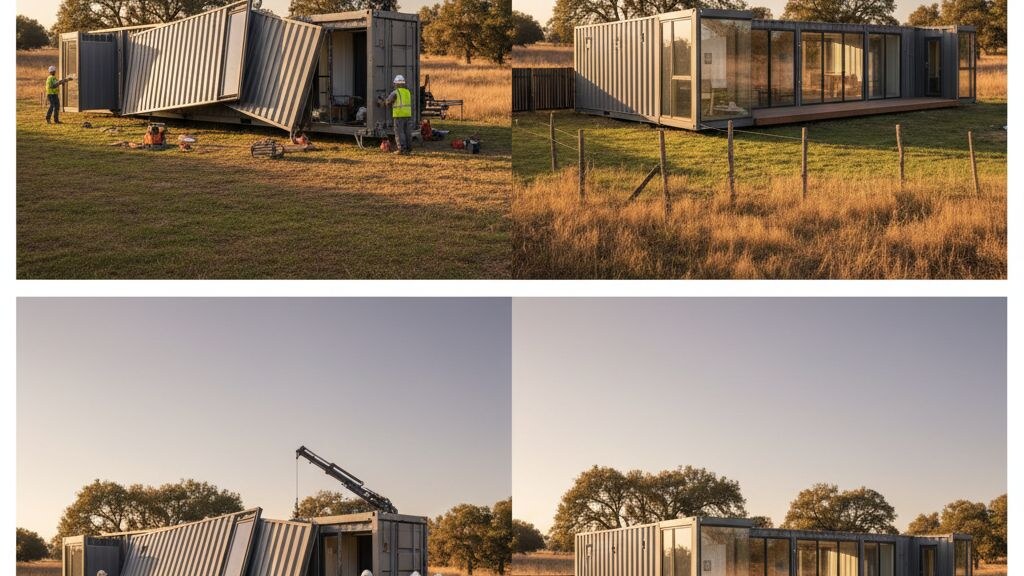
A foldable container home is built around a hinged-panel structural system. The factory builds the unit in a deployed configuration, then folds the walls, ceiling, and (in some designs) the floor down to a transport configuration that ships at a fraction of the deployed volume. On site, the folded unit is positioned on its foundation and unfolded through a sequence — typically requiring 30 to 90 minutes of mechanized unfolding plus several days of finish work to lock the unfolded configuration in place, complete utility connections, and prepare the interior.
The dominant foldable manufacturer in the US market in 2026 is Boxabl, based in Las Vegas, Nevada. Boxabl's Casita ships at approximately 8.5 feet tall and 20 feet wide and unfolds to approximately 375 square feet of deployed interior. Boxabl announced a smaller Baby Box product at approximately 120 square feet for a meaningfully lower price point. Boxabl has been preparing for a Nasdaq listing and has been the most-publicized foldable operator in the US market for several years.
Several smaller foldable operators serve workforce-housing and disaster-response markets but have limited residential-buyer distribution in the US.
How an Expandable Container Home Works
An expandable container home is built around a fixed-dimension chassis with hinged or telescoping side walls. The factory builds the unit at standard shipping-container dimensions (typically 20 by 8 by 8.5 feet for a 20-foot unit, or 40 by 8 by 8.5 feet for a 40-foot unit). On site, the unit is positioned on its foundation and the side walls mechanically expand outward — typically with a hand-crank or hydraulic system — to produce a deployed footprint two-to-three times the shipping footprint.
The US expandable container market is served by a broader set of manufacturers and distributors, including Backcountry Containers, Bob's Containers, AnchorWrx, Neo Smart Living, Alternative Living Spaces, and Honomobo at the premium end. The category includes both US-based factories and US-distributed international factories, with widely varying levels of code compliance and US delivery infrastructure.
The Three Differences That Matter Most for Buyers
Difference 1 — Deployment Speed and Equipment
A foldable container home typically deploys faster on site than an expandable container home. The Boxabl Casita unfolding sequence is designed to complete in a matter of hours with specialized but limited equipment. An expandable unit's side-wall extension sequence is typically faster than initial assembly, but the unit-to-habitable timeline from chassis arrival to full configuration is broadly comparable across both categories once foundation, utility, and finish work are included.
Foldable units typically require less specialized site equipment for the deployment itself but require more careful access for delivery — the folded transport configuration is taller than an expandable unit's transport configuration, which constrains the delivery route on parcels with overhead obstacles.
Difference 2 — Cost Per Deployed Square Foot
Expandable container homes typically price lower per deployed square foot than foldable container homes in the 2026 US market. The price differential is most pronounced at the entry end of each category, where expandable options from operators like Alternative Living Spaces compete on price against the foldable category's headline product.
At the premium end, the cost differential compresses. A premium expandable from Honomobo or Plant Prefab can price comparable to a premium foldable on a deployed-square-foot basis, with the comparison turning on finish quality, smart-home integration, and warranty rather than on the deployment mechanism.
The Boxabl Casita has held a publicized base price target in the $50,000 ex-factory range for several years, though actual delivered cost including foundation, site work, utility connections, and permits typically lands meaningfully higher.
Difference 3 — Manufacturer Selection and Distribution Network
The expandable container category has more US-market manufacturers, more US distributors, and more dealer infrastructure than the foldable category. A buyer in most US markets can identify multiple expandable operators serving their region; the same buyer may find only one or two foldable operators with active US distribution.
The implication is that expandable buyers have more comparison shopping available and more accessible warranty and post-sale support, while foldable buyers more often work with a single manufacturer for the full sales-to-warranty lifecycle.
When Foldable Wins
The foldable container home fits three specific use cases well.
The first is constrained-access parcels where the folded transport configuration permits delivery routes that an expandable's standard-container transport cannot. Urban infill parcels with narrow alley access, rural parcels with low-clearance approach roads, and lots with mature tree canopy blocking standard truck routes all favor the foldable configuration.
The second is rapid-deployment scenarios where the on-site unfolding time advantage matters. Disaster response, temporary housing, and rapid-occupancy situations all favor the faster on-site sequence.
The third is buyer preference for the architectural language of unfolding panels. Foldable units typically present a different visual language at the deployed state than expandable units; some buyers find the foldable aesthetic preferable for design reasons.
When Expandable Wins
The expandable container home fits the broader residential market well across several dimensions.
The first is cost-priority configurations. Expandable units at the entry and mid-tier price points typically deliver more deployed square foot per dollar than foldable equivalents.
The second is manufacturer selection. Buyers wanting multiple operator quotes, regional dealer support, or specific custom-configuration preferences typically have more options in the expandable category.
The third is established financing pathways. The broader manufacturer ecosystem means more lender familiarity, more comparable comp sales for appraisal, and more workable financing paths than the foldable category's narrower distribution.
The fourth is post-sale support. The broader US-market dealer infrastructure for expandable units typically produces more accessible warranty and service support than the more-concentrated foldable distribution.
What's the Same Across Both Categories
The cost components beyond the unit itself — foundation, utility connections, site preparation, permits, regional code upgrades, and interior completion where applicable — apply broadly identically to both categories. A 400-square-foot deployed unit, whether foldable or expandable, typically requires comparable foundation, utility, site, and permit work on a comparable parcel.
The certification and code-compliance requirements are also broadly identical. Both categories require IBC or IRC structural certification, applicable wind / snow / seismic ratings, and a manufacturer's data plate with traceable identification for legal primary-residence placement.
The financing constraints are also broadly identical. Both categories face more limited conventional mortgage availability than conventional manufactured or modular construction, with construction-to-permanent loans and manufactured-home specialty lenders as the most workable paths.
How to Choose Between Them
The realistic 2026 buyer decision process:
Step one is parcel evaluation. If the parcel has constrained access that an expandable unit cannot reach but a foldable can, the choice is largely determined by access. If both can reach the parcel, the choice opens to other factors.
Step two is cost benchmarking. Request line-itemized quotes from at least one expandable operator and one foldable operator for comparable deployed-footprint configurations. Compare the ex-factory unit cost, the delivery cost, and the on-site deployment cost separately.
Step three is timeline benchmarking. Both categories typically run 30 to 90 days from chassis arrival to habitable certificate of occupancy. The on-site portion differs more than the total, but the total project timeline is usually comparable.
Step four is verification of manufacturer track record. The most important variable in either category is the specific operator's history of permitted, occupied installations in jurisdictions comparable to yours. PERCH was built precisely to compress this verification — the verified ADU and small-home builder directory covers operators across both foldable and expandable categories.
Ready to find your foldable or expandable container home? Join the PERCH waitlist → for early access to verified operator quotes for both categories.
Join the conversation
Comments
Reader questions get answered. Real names and a working email — that's it.