Buyer Guides
Tiny Houses on Wheels vs Expandable Container Homes: The 2026 Decision Framework
THOWs and expandable container homes look like alternatives but sit in different regulatory categories with different financing, occupancy rules, and 10-year economics. Here's the 2026 decision framework with real cost and appreciation math.
On this page
Tiny houses on wheels (THOWs) and expandable container homes are often presented to buyers as competing options in the same purchase decision — but they sit in fundamentally different regulatory categories, qualify for different financing, and produce sharply different long-term economics. A buyer choosing between the two on aesthetics alone usually discovers the consequence at the financing stage, the permit stage, or the resale stage. This guide separates the two categories cleanly, walks through the real 2026 cost and code data, and helps buyers identify which category actually matches their use case.
If you've been told "they're basically the same thing in a different shape" by anyone selling you one, this is the reference that settles the real differences.
The Categorical Difference That Determines Everything
The foundation is the legal divide.
A THOW is mobile by design. It's built on a chassis with axles and tires, can be hitched to a vehicle and towed on public roads, and is registered with the state DMV. RVIA certification (the most common THOW certification path) confirms compliance with NFPA 1192 standards for recreational vehicles — fire safety, electrical, propane systems, towing structural integrity.
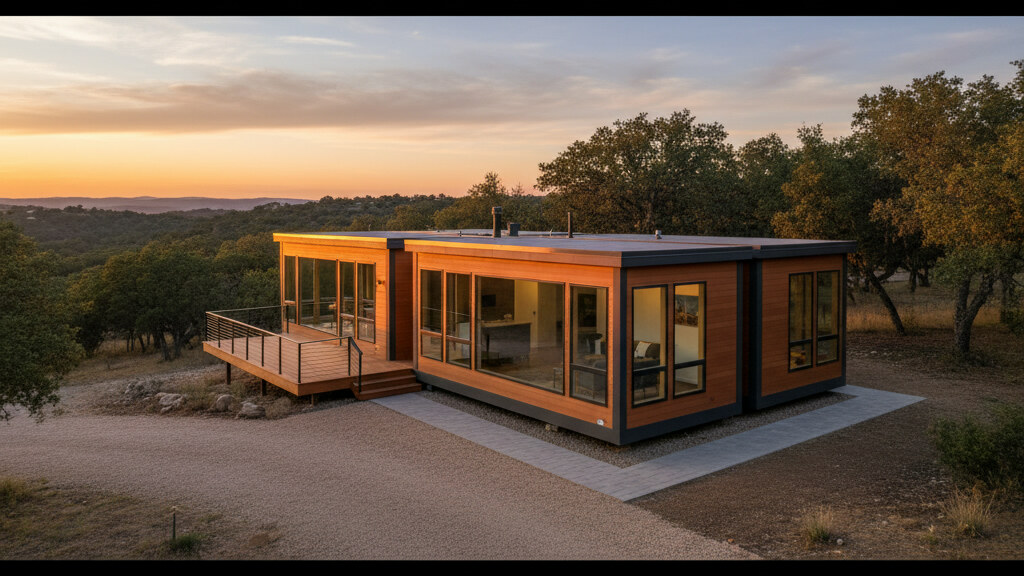
An expandable container home is stationary by design. It ships to a site, deploys via mechanical or hydraulic expansion, and is anchored to a permanent foundation. The deployed structure is engineered to International Residential Code or local equivalent — standards for residential dwellings, not vehicles.
The legal classification follows the foundation. Wheels and tow capability put a structure in the RV category. Permanent foundation and IRC compliance put a structure in the residential category. This single distinction cascades into every other downstream consequence.
What This Means for Occupancy
Most U.S. municipalities permit RVs (including THOWs) for short-duration occupancy — typically 14-30 consecutive days, sometimes up to 90 days with special permits — but prohibit them as primary residences. The rationale is that RVs are not built to residential standards for things like winterization, full-time HVAC capacity, structural longevity, and sanitation systems.
Expandable container homes installed on permanent foundations with utility connections and certificate of occupancy can be occupied as primary residences year-round, the same as any single-family home.
A few jurisdictions have created specific "tiny home village" zoning that permits THOW long-term occupancy — including portions of Spur, Texas; portions of Fresno, California; portions of Portland, Oregon — but these are narrow exceptions. The default rule across the United States is RV occupancy = temporary; residential occupancy = permanent foundation required.
What This Means for Financing
The financing gap is the most consequential 2026 difference.
THOW financing typically runs through RV lenders or specialty tiny home lenders. Interest rates in mid-2026 average 8-14% (RV rates run higher than mortgages because of vehicle depreciation), terms run 5-20 years, and down payment requirements typically 15-25%. Conventional residential mortgage financing is not available because the unit is not real property.
Expandable container home financing typically runs through residential lenders once the unit is installed on permanent foundation with real-property titling. Interest rates in mid-2026 average 6-8% (conventional 30-year mortgage rates), terms run 30 years, and down payment requirements typically 10-20% (FHA programs run lower for qualifying buyers). The unit is real property and qualifies for standard residential mortgage products.
On a $115,000 build, the financing cost difference over 30 years runs approximately $42,000 in favor of the container home — entirely from the gap between RV and conventional mortgage rates.
What This Means for Appreciation
THOWs depreciate. Like other RVs, they lose value over time. A $95,000 THOW typically sells for $58,000-$72,000 at five years, $35,000-$48,000 at ten years. The exact depreciation curve varies but the direction is consistent — THOWs lose value the way vehicles do.
Expandable container homes on permanent foundations appreciate at rates comparable to other residential real estate in their market. A $145,000 container ADU in a $1.04 million median market (LA County) typically appreciates 3-6% annually — both the structure and the underlying land contribute to the appreciation.
Over a 10-year hold period, a $115,000 THOW typically loses $60,000-$80,000 of value while an equivalent-cost container home on permanent foundation typically gains $35,000-$80,000. The net difference: roughly $95,000-$160,000 over ten years.
The Real 2026 Cost Comparison
| Cost line | THOW | Expandable container home |
|---|---|---|
| Unit cost | $55,000 to $135,000 | $52,000 to $112,000 |
| Foundation | None required | $14,000 to $34,000 |
| Site prep | Minimal | $6,500 to $18,000 |
| Utility connections | Hookup at RV pad | $9,500 to $24,000 |
| Permits | RV registration (~$200) | Building permits ($2,800-$9,500) |
| Insurance | RV policy (~$800-$1,200/yr) | Homeowner policy ($1,200-$2,400/yr) |
| Annual property tax | Personal property (~0.5-1.5% of value) | Real property (~0.8-1.5% of value) |
| Total upfront | $58,000 to $140,000 | $99,800 to $233,000 |
The THOW's lower upfront cost is real. But the foundation, permit, and utility costs of the container home unlock financing options and appreciation that THOWs cannot access.
When THOWs Are the Right Choice
THOWs are the right answer for three specific use cases:
Use case 1 — True mobility. A buyer who wants to relocate the home periodically — to follow seasonal work, to travel, to move between properties owned in different states. THOWs deliver this; foundation-based containers cannot.
Use case 2 — RV pad placement. A buyer who has access to an RV pad (private or commercial campground, RV park, family land with RV hookups) and wants to occupy under RV-permitted duration limits.
Use case 3 — Short-term primary residence. A buyer who plans to use the unit as a primary residence only during transitional life periods — building a permanent home, between job locations, post-retirement travel — where the unit's mobility offsets the lack of appreciation and financing flexibility.
For these use cases, a THOW is genuinely the better product. The mobility is the feature.
When Expandable Containers Are the Right Choice
Expandable container homes are the right answer for most other tiny-home use cases:
Use case 1 — Permanent primary residence. Buyers who want to live in the unit year-round, qualify for residential financing, and capture residential appreciation.
Use case 2 — Rental income property. Buyers building an ADU on existing residential land for long-term or short-term rental. ADU rules across most jurisdictions require permanent foundation installation — THOWs typically don't qualify as ADUs.
Use case 3 — Resale-focused investment. Buyers planning to sell within 5-15 years. Foundation-based containers retain or grow value; THOWs depreciate.
Use case 4 — Multi-generational housing. Buyers placing a unit for an aging parent, adult child, or extended family. Permanent foundation supports long-term occupancy that THOW permitting typically prohibits.
For these use cases, the container home's higher upfront cost is justified by financing access, appreciation, and legal occupancy duration.
The Hybrid That Doesn't Work
The most common mistake is buyers who purchase a THOW intending to "eventually" remove the wheels and install it on a permanent foundation. This generally does not work in 2026 for two reasons:
THOWs are not built to IRC. Converting an RV-spec structure to IRC compliance typically requires more engineering and modification cost than building a new IRC-compliant structure from scratch.
Title conversion from RV to real property is procedurally difficult. State DMVs and county recorders rarely have established processes for this conversion. The RV title cannot be merged with land title the same way a manufactured home's title can.
Buyers planning long-term residential occupancy should choose an expandable container or modular home from the start. Buying a THOW with the intent to "convert later" usually doesn't survive the conversion attempt.
The Path Most Buyers Take
The realistic 2026 decision tree:
Step 1. Define use case. If true mobility is the feature → THOW. Otherwise continue.
Step 2. Define occupancy duration. If permanent primary residence or ADU rental → expandable container. If transitional or short-duration → either may work.
Step 3. Define financing approach. If conventional mortgage required → expandable container on permanent foundation. If cash or RV loan acceptable → either may work.
Step 4. Define appreciation expectation. If resale value matters → expandable container. If pure utility with no resale concern → either may work.
For most buyers, the answer ends up being expandable container or modular — even though THOWs often look more affordable in the initial marketing.
PERCH was built to surface verified factories for both categories with the regulatory and financing reality made explicit upfront — so buyers can make this decision based on actual long-term economics, not on initial sticker price.
Ready to identify the right category for your use case? Join the PERCH waitlist →.
Related guides
Frequently asked questions
Can I live full-time in a tiny house on wheels?
Can I finance a THOW with a mortgage?
Do expandable container homes appreciate?
What's the long-term cost difference?
Can I convert a THOW to a permanent foundation later?
Are there places I can live in a THOW long-term?
When is a THOW the right choice?
Keep reading
Join the conversation
Comments
Reader questions get answered. Real names and a working email — that's it.