Guides
Expandable Container House: The 2026 Buyer's Guide
The expandable container house has moved from prototype to volume product in four years. Here's the 2026 buyer's guide — what code-compliance actually means, who actually builds for the US market, what one realistically costs delivered, and the three buyer profiles where the configuration genuinely works.
On this page
The expandable container house has moved from prototype to volume product in roughly four years. What started as a workforce-housing and disaster-response category — units that ship at standard shipping-container dimensions and mechanically expand to two-to-three times that footprint on site — has become one of the fastest-growing segments in the alternative-housing market. The trouble for the 2026 buyer is that the category is filled with both legitimate factory-built units that meet US building codes and uninspected import units sold off marketplaces at impossible prices. The same phrase — "expandable container house" — describes both ends of the quality spectrum. This guide walks through what an expandable container house actually is, who actually builds them, what one realistically costs delivered and permitted in the US in 2026, and the buyer profiles where the configuration genuinely makes sense.
If you are buying an expandable container house in 2026, the question is not "how cheap can I get one?" but "which factory, with what certifications, in what installed configuration, on what kind of US land?"
What an Expandable Container House Actually Is
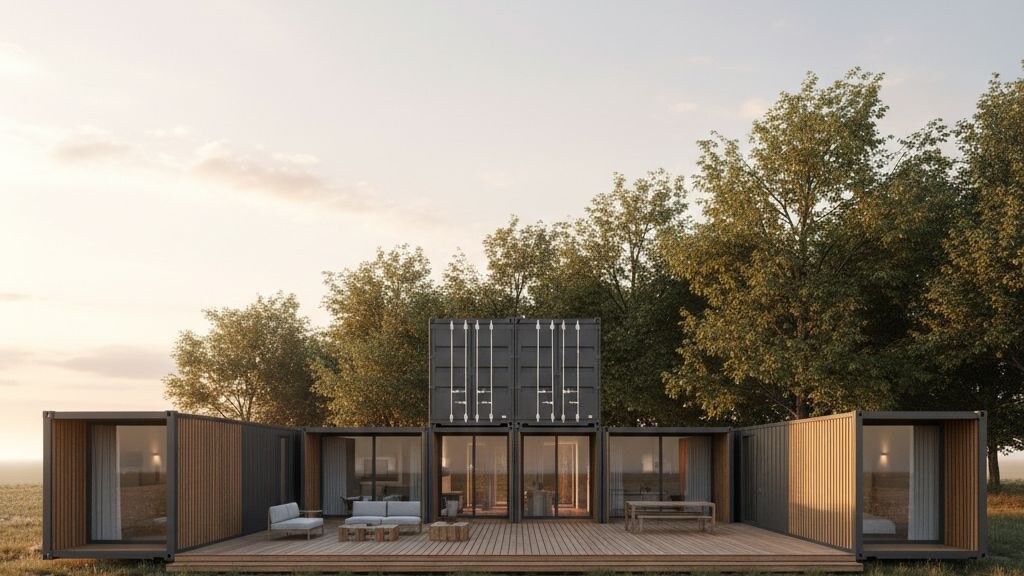
An expandable container house consists of a fixed-dimension steel-frame chassis sized to ship at standard ISO container dimensions. The chassis includes the floor, the roof, two end walls, and a base level of utilities. The side walls of the chassis are hinged or telescoping, and on site, the unit mechanically expands — typically with a hand-crank or hydraulic mechanism — to produce a deployed footprint two-to-three times the shipping footprint.
A 20-foot expandable container house ships at approximately 160 square feet (20 × 8) and deploys to approximately 320 to 480 square feet. A 40-foot expandable ships at approximately 320 square feet and deploys to 640 to 960 square feet. The expansion mechanism distinguishes the category from a static container conversion (where the unit's footprint at delivery equals its footprint at deployment) and from a foldable unit (where the unit unfolds rather than expands).
The category emerged primarily from Chinese factory production serving workforce-housing, disaster-response, and hospitality markets. US-market adoption accelerated as factory-built quality improved, as US distributors began handling import logistics and US code compliance, and as a small number of US-based factories began producing units to American building standards.
What "Code-Compliant" Actually Means for an Expandable Container House
This is the single most important distinction in the category in 2026. The same physical product can be legal or illegal depending entirely on how it is documented, where it is delivered, and how it is installed.
A code-compliant expandable container house for US primary-residence use typically has International Building Code or International Residential Code structural certification, an HUD Code or HUD modular state-approval label where applicable, and documented compliance with the local jurisdiction's wind, snow, and seismic load requirements.
A unit without these certifications can be legally placed only in specific accessory-structure configurations (storage, workshop, recreational use) with strict duration limits, or in commercial workforce-housing applications with separate compliance pathways. Buyers who purchase an uncertified unit intending primary-residence placement typically discover during the permit-application process that the unit cannot be permitted.
The factory you buy from determines the certification you can get. A factory producing for the US residential market with documented code compliance, certified weld inspections, and a stamped manufacturer's data plate produces a unit that can be permitted. A factory producing for hospitality, workforce, or international markets without these documentation systems does not.
Who Actually Builds Expandable Container Houses for the US Market in 2026
The category includes several distinct types of operator. The 2026 verified-US-market list is shorter than the 2026 search results suggest.
US-based custom container builders. Backcountry Containers, Bob's Containers, and AnchorWrx — all Texas-based — produce custom container-based homes with expandable options as part of broader custom-build programs. Pricing runs at the higher end of the category, with quality and code compliance correspondingly higher.
US-based prefab modular factories with expandable product lines. Plant Prefab, based in California, produces prefab modular units that can be configured with expandable elements. Connect Homes and Dvele similarly serve the premium prefab end of the market with code-compliant modular products that overlap the container-style category.
US-distributed prefab from international factories. Neo Smart Living, headquartered in Chino, California, produces prefab Capsule, Cube, and Trio series units with US dealer distribution and US-spec construction. The model bridges international factory production with US-market certification and dealer support.
Publicly-traded prefab and container operators. Safe & Green Holdings, formerly SG Blocks, is a US-public-traded operator producing container-based modular construction with a focus on commercial, multi-family, and rapid-deployment applications.
Premium container-home specialists. Honomobo, based in Alberta, Canada and serving US markets, produces premium container-based modular homes with high-end finishes and integrated smart-home systems.
Affordability-focused operators. Alternative Living Spaces, based in Las Vegas, Nevada, produces container-based units focused on entry-level pricing and standardized configurations.
The list of operators that ship a verifiable code-compliant US expandable container house in 2026 is meaningfully shorter than the list of operators that show up in expandable container house search results. The marketplace listings filled with sub-$20,000 expandable container homes typically reroute to uncertified import units; buyers should treat any sub-$30,000 expandable container house listing with significant skepticism.
What an Expandable Container House Actually Costs Delivered in the US in 2026
For a legitimate US-market expandable container house:
| Cost component | Typical 2026 range |
|---|---|
| Factory unit ex-factory (20- or 40-foot expandable) | $32,000 to $85,000 |
| US import logistics and inland freight (for imported units) | $6,500 to $14,500 |
| Permanent foundation and anchors | $14,500 to $28,000 |
| Utility connections (water, sewer or septic, electric) | $9,500 to $24,000 |
| Site prep, grading, driveway, access path | $7,500 to $16,000 |
| Permits, inspections, certificate of occupancy | $1,800 to $5,500 |
| Wind / seismic upgrade (where required) | $0 to $9,500 |
| Interior finish completion (where not factory-included) | $0 to $24,000 |
Delivered, permitted, and livable on private US land, the all-in total typically falls between approximately $78,000 and $206,500 in 2026. The largest single variable is whether the unit ships with finished interior or arrives shell-only — many factory listings price the shell only, with interior finish as an additional contracted scope.
The sub-$20,000 expandable container houses advertised on consumer marketplaces are nearly universally unfinished or unfinishable units shipped without US compliance documentation. Buyers who pay that price typically discover that the additional cost to make the unit legally habitable exceeds the cost differential to purchasing a code-compliant unit in the first place.
The Three Buyer Profiles That Fit the Category
Profile 1 — ADU Placement on an Existing Residential Parcel
The buyer who already owns a primary residence and wants to place an additional dwelling unit behind it. The expandable container house category fits this configuration well because the shipping dimensions allow delivery to lots that cannot accommodate larger-footprint modular delivery, and the deployed footprint typically falls within standard ADU size limits across most US jurisdictions.
The configuration competes against detached site-built ADUs and small modular ADUs. The expandable container house wins on timeline (factory production plus deployment is typically faster than site-built) and on access to constrained lots. It typically loses on perceived market value at resale — appraisers and buyers often value container-style construction at a discount to conventional modular.
Profile 2 — Rural Acreage Primary Residence
The buyer purchasing rural acreage who wants the smallest legal primary residence delivered fast on a remote site. The category fits this configuration well because the shipping dimensions allow delivery to sites where larger units would face access difficulties, and the deployment-on-site mechanism reduces the duration of on-site construction.
The competition is small manufactured homes and small modular homes. The expandable container house wins on delivery flexibility and on speed of habitation. It loses on the financing path — conventional mortgage products are less available for container-style construction than for conventional manufactured or modular construction, even when the unit is permanently installed.
Profile 3 — Rapid-Deployment Hospitality or Workforce
The commercial buyer who needs to deploy multiple units quickly on a site for short-stay rental, workforce housing, or hospitality cabin use. The category fits this configuration well because the standardization, the deployment speed, and the cost-per-unit at volume all favor the configuration over alternatives.
This is a different buyer entirely from the residential profiles, with different regulatory pathways, different financing structures, and different operating economics. The PERCH marketplace focuses primarily on the residential buyer profiles; commercial buyers typically benefit from a direct relationship with a specialized operator like Safe & Green Holdings or one of the dedicated workforce-housing distributors.
How to Vet an Expandable Container House Listing
Five questions separate a credible listing from a trap.
First, what is the factory of origin, and what certifications does the factory hold? A verified US-market factory or a US distributor with documented compliance is the gate. An anonymous import listing without documented manufacturing source is not.
Second, what is the documented compliance package? IBC or IRC structural certification, applicable wind / snow / seismic load ratings for the buyer's specific US jurisdiction, and a manufacturer's data plate with traceable identification.
Third, what is the deployed condition specification — shell only, weathered shell, or finished interior? Most low-price listings are shell-only. The cost to complete a shell to habitable specification typically runs an additional $15,000 to $35,000.
Fourth, what is the warranty? A 12-month structural warranty minimum is standard for legitimate US-market units. Units without manufacturer warranty are typically uncertified and uninsurable.
Fifth, who is the US contact for delivery, warranty, and post-sale support? A US-based dealer, distributor, or manufacturer representative with a verifiable address is the gate. An overseas-only contact with marketplace listing as the only US presence is a strong negative signal.
PERCH was built precisely to make this five-question vetting layer concrete and pre-completed for buyers. The PERCH marketplace surfaces only verified manufacturers and distributors with documented US-market compliance, US delivery infrastructure, and traceable warranty support. The verified ADU and small-home builder directory covers each major US market.
Ready to find a verified expandable container house? Join the PERCH waitlist → for early access to verified inventory and operator vetting.
Join the conversation
Comments
Reader questions get answered. Real names and a working email — that's it.