City Guides
Container Homes in Tampa, FL: The 2026 Hillsborough County Buyer's Guide
Tampa permitted 612 container and modular homes in 2024 — up 240% from 2021. Here's the 2026 cost breakdown, Florida wind-code requirements, FEMA flood elevation rules, and submarket rental yields.
On this page
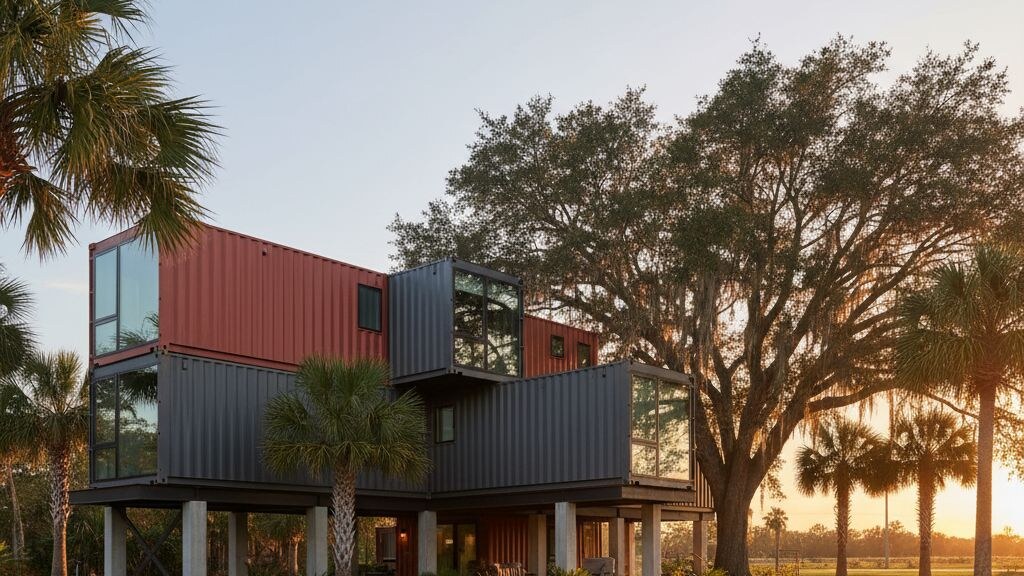
Tampa permitted 612 container and modular residential structures in 2024 — a 240% increase from 2021 — and Hillsborough County has emerged as the most container-friendly large jurisdiction on Florida's west coast. The growth is driven by Tampa's median single-family home price climb to $389,000, persistent post-2018 housing supply shortage, and Florida's 2023 ADU framework that expanded permitted accessory dwelling configurations across most municipal jurisdictions. This guide explains the Tampa permitting reality in 2026, what container homes actually cost in Hillsborough County, the Florida wind-code and flood-elevation requirements, and the configurations that have produced strong outcomes for the buyers who've already built.
If you own a parcel in greater Tampa and you're weighing a container home build, this is the practical view.
Why Tampa Has Become Florida's Container Home Capital
Three structural factors:
Affordability pressure. Tampa-area median home prices climbed 47% from 2020 to 2024, outpacing wage growth in the metro. Buyers priced out of standard new construction have moved toward smaller new-construction alternatives.
Florida's 2023 ADU legislation. Florida HB 261 (2023) standardized ADU rules across the state and explicitly permitted modular and container ADUs in single-family residential zones. Hillsborough County and the City of Tampa both adopted the full state framework.
Tampa Bay Lightning growth corridor. Population growth in Hillsborough County has averaged 23,000 net new residents per year since 2020, while new home construction has lagged absorption by approximately 4,200 units per year. Container homes compress build timeline to 5-8 months versus 12-18 months for typical site-built, helping close the supply gap faster.
What a Tampa Container Home Costs in 2026
For a 320 to 640 square foot container home on permanent foundation in Hillsborough County:
| Cost component | Typical 2026 range |
|---|---|
| Container unit (320 to 640 sq ft, full finish) | $52,000 to $112,000 |
| Delivery from factory | $4,200 to $9,500 |
| Crane placement | $2,800 to $5,500 |
| Foundation (concrete pier or slab, flood-elevated where required) | $14,000 to $38,000 |
| Site prep, grading | $6,500 to $14,000 |
| Utility connections | $9,500 to $22,000 |
| Permits, plan review, inspections | $3,800 to $9,500 |
| Florida wind-code certification | $5,500 to $11,000 |
| FEMA flood elevation (if applicable) | $14,000 to $38,000 |
Delivered, permitted all-in total: $112,300 to $258,500.
The lower half covers smaller units on inland flat Hillsborough County lots. The upper end covers larger configurations, sites within Special Flood Hazard Areas requiring elevation, or coastal exposure placements with the strictest wind-rating requirements.
By comparison, the median new single-family home price in Hillsborough County is approximately $425,000 in mid-2026.
Why Florida Wind-Code Compliance Is Non-Negotiable
The Florida Building Code requires specific wind-load engineering for every residential structure, with ratings ranging from 140 mph (most inland Tampa) to 170 mph (coastal Pinellas-adjacent). A unit shipped to Florida without proper wind certification cannot be insured under standard homeowner policies and will not receive a certificate of occupancy.
Florida's Building Code overlay also requires impact-rated glazing on windward exposures, engineered roof-to-wall connections, and continuous load-path engineering from foundation through roof. The premium over a mainland-spec build runs $5,500 to $11,000 — and is the most common single point of failure on improperly-spec'd container homes shipped to Florida from out-of-state factories.
Rental Income by Tampa Submarket
For a permitted 400 to 640 square foot container home in mid-2026:
| Submarket | Long-term monthly | STR average daily rate | Net monthly (STR) |
|---|---|---|---|
| South Tampa (Hyde Park, Davis Islands) | $2,200 to $3,200 | $145 to $235 | $3,000 to $5,200 |
| Downtown Tampa / Channel District | $2,000 to $2,900 | $135 to $215 | $2,800 to $4,800 |
| West Tampa / Westshore | $1,750 to $2,500 | $115 to $185 | $2,400 to $4,000 |
| Brandon / Riverview / Valrico | $1,500 to $2,100 | $95 to $145 | $1,800 to $3,000 |
| North Tampa / Carrollwood | $1,650 to $2,300 | $105 to $165 | $2,100 to $3,400 |
| Plant City / inland Hillsborough | $1,250 to $1,800 | $85 to $135 | $1,600 to $2,600 |
South Tampa produces the highest yield per dollar of build cost across both long-term and short-term rental.
The Tampa Permit Path
City of Tampa container home permit timelines run 60 to 120 days for complete first-submission applications. Hillsborough County unincorporated runs 75 to 150 days. The four documents that most often determine first-pass approval:
- Foundation engineering specific to the lot's soil report (Tampa's sandy soil has different requirements than expansive clay)
- Florida wind-code certification documentation
- FEMA flood elevation certificate for SFHA-zone lots
- Utility connection coordination with Tampa Water Department or applicable county utility
The most common Tampa permit delay is missing windstorm certification — buyers who ordered units from out-of-state factories without Florida-spec wind ratings face plan corrections that add 60 to 120 days to the timeline.
The Configurations That Work in Tampa
The 320 sq ft South Tampa ADU. Compact studio on a small infill lot near Hyde Park or Davis Islands. All-in $112,000 to $158,000. Rents $1,800 to $2,400 long-term, $135-185 daily short-term. Strong economics in walkable South Tampa neighborhoods.
The 480 sq ft suburban primary. One-bedroom on a quarter-acre Brandon or Riverview lot. All-in $145,000 to $215,000. Common first-time-buyer configuration. Rents $1,800 to $2,300 long-term.
The 640 sq ft coastal-adjacent vacation rental. Larger one-bedroom in St. Pete-adjacent or Apollo Beach. All-in $185,000 to $258,000. Configured for short-term rental income with hurricane-season vacancy planning.
Hurricane Reality for Tampa Buyers
Hillsborough County has not been struck by a major direct-hit hurricane since Hurricane Donna in 1960 — the longest active streak of any major Florida metro. The actuarial reality is that the streak will end. Container homes built to current Florida wind-code routinely outperform older site-built construction in storm events because the structural steel monocoque is inherently more wind-resistant than wood framing.
Properly-engineered container homes with TDI-equivalent Florida wind certification, impact-rated glazing, and engineered foundation anchorage have a documented better survival rate in named storms than typical residential construction. The premium for full certification is the right investment.
NOAA's National Hurricane Center maintains the historical track database. Buyers should review their parcel's storm-strike history before committing to a build spec.
The Path Most Tampa Buyers Take
The realistic 2026 path:
- Pull parcel's flood zone, wind-load requirement, and soil report
- Get bids from 3+ Florida-certified factories with full wind-code certification included
- Lock factory pricing before site work begins
- Engage Hillsborough County licensed general contractor
- Submit complete permit application with engineering, wind certification, flood elevation documentation
- Factory production (60-90 days) parallel with site prep (45-60 days)
- Delivery, set, finish, inspections, certificate of occupancy
End-to-end timeline: 5 to 8 months.
PERCH was built to surface Florida-certified verified factories, real Tampa permitting timelines, real wind and flood compliance specs, and concierge support.
Ready to build a container home on your Tampa-area lot? Join the PERCH waitlist →.
Related guides
Frequently asked questions
Are container homes legal in Tampa?
What wind rating do I need in Tampa?
What's the typical Tampa container home cost in 2026?
Do I need flood elevation?
How long does the Tampa permit take?
Can I run a container home as a short-term rental in Tampa?
What's the rental payback period?
Keep reading
Join the conversation
Comments
Reader questions get answered. Real names and a working email — that's it.