Buyer Guides
Park Model Homes vs. Tiny Homes vs. Manufactured Homes: The 2026 Comparison
Park models, tiny homes, and manufactured homes look similar from the curb but follow three different codes, financing tracks, and zoning rules. The 2026 comparison table — and which one fits your situation.
On this page
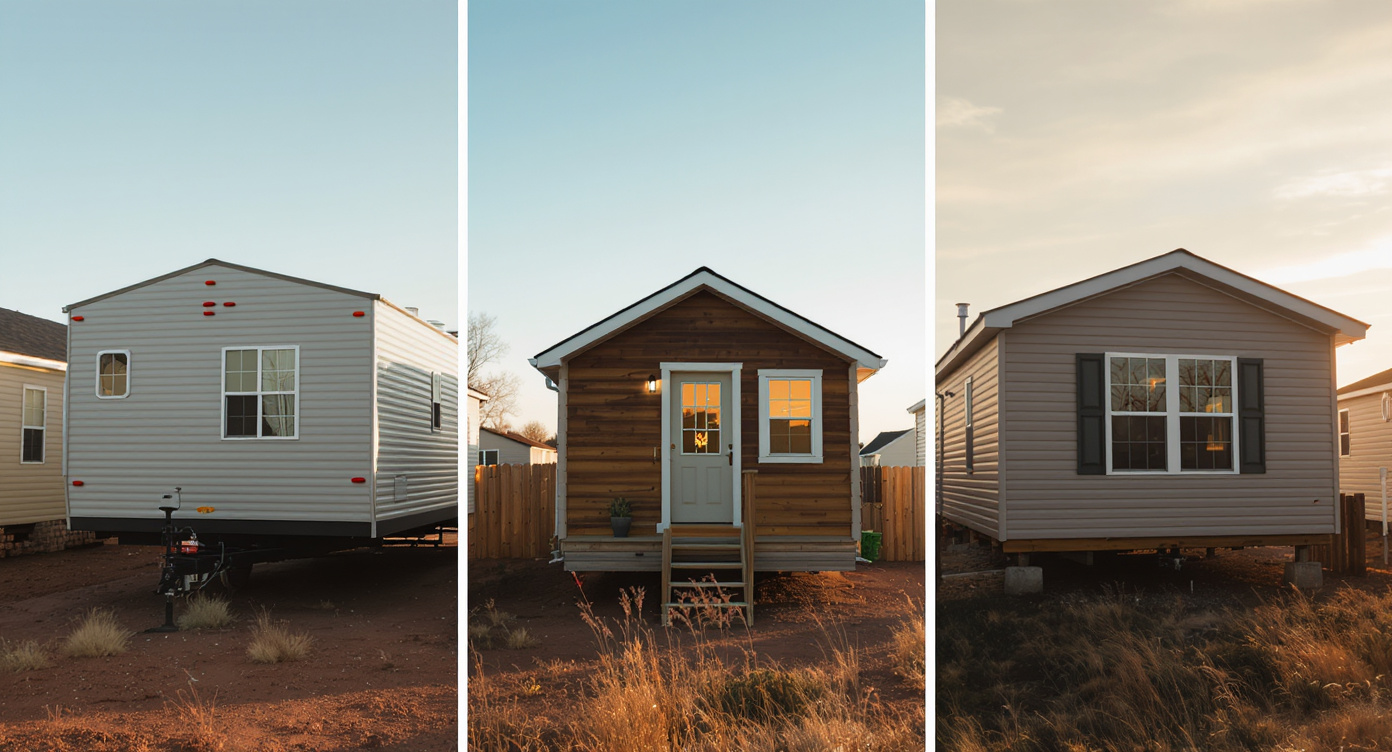
If you've spent any time looking at small, factory-built housing, you've probably noticed something frustrating: the categories blur. A listing calls itself a "tiny home" but sits on a HUD chassis. A "park model" is marketed as a permanent residence in a state where that's not legal. A "manufactured home" gets quoted at park-model pricing, then the delivery invoice doubles. The three categories look similar from the curb, but they're built to three different code authorities, financed through three different lender pools, and placed under three different sets of zoning rules.
This guide settles the comparison cleanly. We'll walk through what each category actually is, what it costs in 2026, where you can legally put it, and which buyer profile each one fits. By the end you'll know which lane you're shopping in before you ever open a listing.
The Big Comparison Table
| Attribute | Park Model Home | Tiny Home | Manufactured Home |
|---|---|---|---|
| Definition | RVIA-certified recreational park trailer | THOW (RVIA) or foundation tiny house (IRC) | HUD-code factory-built single or multi-section home |
| Max living area | 400 sq ft (ANSI A119.5) | 400 sq ft typical; no hard cap on IRC builds | 400 to 2,400+ sq ft (single, double, triple wide) |
| Code authority | ANSI A119.5 + RVIA seal | RVIA (THOW) or IRC Appendix Q (foundation) | HUD Title 24 CFR Part 3280 |
| Wheels or foundation | Permanent steel chassis with wheels | Either — trailer or foundation | Steel chassis; placed on piers, runners, or permanent foundation |
| Legal placement | RV parks, park-model communities, some counties as ADU | Varies wildly by jurisdiction; IRC builds easiest | Private land (most counties), MH communities, leased lots |
| 2026 cost range | $45K to $135K base | $30K (DIY shell) to $180K (high-end IRC) | $75K to $250K+ depending on size and finish |
| Financing | RV loan, personal loan, chattel; not conventional mortgage | RV loan (THOW) or construction loan (IRC) | Chattel, FHA Title I/II, conventional if real property |
| Insurance | RV or park-model policy | RV policy or homeowners if IRC | Mobile home or homeowners policy |
| Resale market | Active in retirement and resort markets | Thin and inconsistent | Largest of the three; established comps |
Park Model Homes: The RVIA-Certified 400 Sq Ft Lane
A park model home is a factory-built recreational structure regulated under ANSI A119.5 and sealed by the Recreational Vehicle Industry Association. The single most important number to memorize is 400 square feet of living area. That cap is what keeps the unit classified as a recreational vehicle rather than a manufactured home, which changes everything downstream — code, financing, insurance, placement.
Park models ship on a permanent steel chassis with wheels and a hitch. They're transportable, but most never move again after they're set on a pad. The wheels stay on (or stay accessible) because removing them and pouring a permanent foundation in many jurisdictions reclassifies the unit and triggers HUD or IRC review.
2026 pricing. A base park model from a regional builder runs $45,000 to $75,000. A loaded unit with lofted ceilings, a real kitchen, full-size appliances, residential windows, and exterior upgrades runs $85,000 to $135,000. Delivery and setup typically add $4,000 to $12,000 depending on distance and site prep.
Where they can legally go. Three lanes: park-model communities and RV resorts designed specifically for them, private campgrounds that allow extended-stay placement, and a growing number of counties that allow them as accessory dwelling units or short-term vacation structures on rural land. The third lane is the most volatile — what's allowed in one county is banned in the next. Always pull the zoning code before you buy.
Financing. No conventional mortgage. Buyers use RV loans (10 to 20 years, 7 to 11 percent in 2026), personal loans, or chattel financing through the dealer. Loan-to-value is usually capped at 80 to 90 percent.
Insurance and resale. Insured under park-model or RV policies, not homeowners. Resale is healthy in retirement corridors (Florida, Arizona, the Carolinas, parts of Texas) and resort markets. Depreciation looks more like an RV than a house.
Tiny Homes: The Category With No Single Definition
Tiny homes are the broadest and most confusing of the three. The word "tiny" describes a size philosophy, not a code. A tiny home can be any of the following:
- THOW (tiny house on wheels): Built to RVIA or NOAH certification, ships on a trailer, treated legally like an RV. Most common.
- Foundation tiny house (IRC Appendix Q): Built to International Residential Code with the small-dwelling appendix, placed on a permanent foundation, treated like a small site-built home.
- Skoolies, container conversions, DIY shells: Often uncertified, hardest to insure, hardest to finance, hardest to legally park.
The legal placement question depends entirely on which sub-category you bought. An IRC-certified tiny on a foundation is just a small house — it gets a building permit, a certificate of occupancy, and homeowners insurance. A THOW lives under RV rules and is restricted to the same lanes as a park model in most jurisdictions, with the added wrinkle that many municipalities cap RV stays at 30 to 180 days per year.
2026 pricing. A DIY trailer shell starts around $30,000. A turnkey THOW from a reputable builder runs $75,000 to $130,000. A high-end IRC foundation build with custom millwork and full-size systems can reach $180,000.
Financing. THOW units finance through RV loans. IRC foundation builds finance through construction loans. Uncertified DIY builds finance through personal loans or cash.
Resale. This is the honest weakness. The tiny home resale market is thin. Comps are inconsistent, buyers are scattered, and a custom build that cost the original owner $140,000 may sell for $70,000 to $90,000 three years later.
Manufactured Homes: The HUD-Code Primary Residence
Manufactured homes are factory-built single-family houses regulated under HUD Title 24 CFR Part 3280 — the federal building code that replaced "mobile home" rules in 1976. The HUD code covers structure, fire safety, plumbing, electrical, energy, and transportation. Every manufactured home ships with a red HUD certification label on the exterior.
These are not park models. The category is meant for primary residence use, sizes start where park models end (400 sq ft and up), and the typical buyer is purchasing a 1,200 to 2,000 sq ft single-wide or double-wide as a long-term home.
2026 pricing. A new single-wide runs $75,000 to $130,000. A new double-wide runs $130,000 to $220,000. Triple-wides and high-spec builds reach $250,000 and up. Delivery, setup, foundation, utility hookups, and site prep typically add $25,000 to $75,000 depending on the lot.
Where they can legally go. Most counties allow manufactured homes on private land with standard residential zoning. They also place into manufactured home communities (leased-lot parks) and resident-owned communities (ROCs).
Financing. The strongest of the three categories. Chattel loans for personal-property titling, FHA Title I and Title II loans, VA loans, USDA Rural Development loans, and conventional mortgages (Fannie Mae MH Advantage, Freddie Mac CHOICEHome) when the home is permanently affixed and titled as real property.
Insurance and resale. Standard homeowners or mobile home policy. The resale market is the largest and most established of the three categories, with public comps and a deep buyer pool.
Which Should You Buy?
A short decision tree.
Buy a park model if: you want a second home, a vacation lot retreat, or a downsized retirement unit in a resort or 55+ community. You're fine with RV-style financing. You don't need to title the unit as real property.
Buy a tiny home if: you've already verified your specific jurisdiction allows your specific build type, you have a clear placement plan, and you're optimizing for lifestyle and craftsmanship over resale value. If you can't answer the zoning question in one sentence, you're not ready to buy yet.
Buy a manufactured home if: you want a primary residence on land you own (or plan to own), you want access to conventional or government-backed mortgage financing, and you want the deepest resale market of the three. This is the lane for buyers who want a house, not a recreational structure.
A useful rule: if you're trying to choose between a park model and a manufactured home and the deciding factor is price, look at the manufactured side. The financing terms usually make the monthly cost lower even though the sticker is higher.
How PERCH Fits
PERCH is the Autotrader-meets-Zillow of the modular and factory-built housing market — a marketplace where buyers, sellers, and builders meet in one honest place. Across all three categories above, we list units from verified builders and individual sellers, run TourReady walkthroughs so you can see the actual home before you drive to it, and walk you through your financing options as an educational layer (we are not a lender — we explain what RV loans, chattel, FHA Title I, and conventional mortgage paths look like for the unit you're considering, then connect you to lenders who specialize in that category).
When you're ready to close, our concierge coordinates transport and title work through our partner network. We don't own trucks, we don't write loans, we don't do in-house title — we run the marketplace, vet the listings, and quarterback the close.
PERCH · Home made for your land.
Browse verified park model, tiny home, and manufactured home listings at ownperch.com.
Join the PERCH waitlistRelated guides
The weekly brief for modern modular living.
Design concepts, zoning workarounds, and market strategies — the specific ones the 22 million families in the missing middle actually need.
Under 3 minutes. Every Friday afternoon. Unsubscribe with one click.
Frequently asked questions
What is a park model home?
What's the difference between a park model and a tiny home?
What's the difference between a manufactured home and a park model?
How much does a park model home cost in 2026?
Can I live in a park model home full-time?
Can I get a mortgage on a park model?
Are park models the same as RVs?
What's the lifespan of a park model home?
Do park models hold their value?
Can PERCH help me find a park model home?
Join the conversation.
Share your take on this guide.
 Available now
The Nest
Delivered to your parcel · 60–75 days
- PERCH-designed
- Escrow with proof
Refundable within 7 days.