Guides
Container Home vs. Shipping Container: The 2026 Comparison
On this page
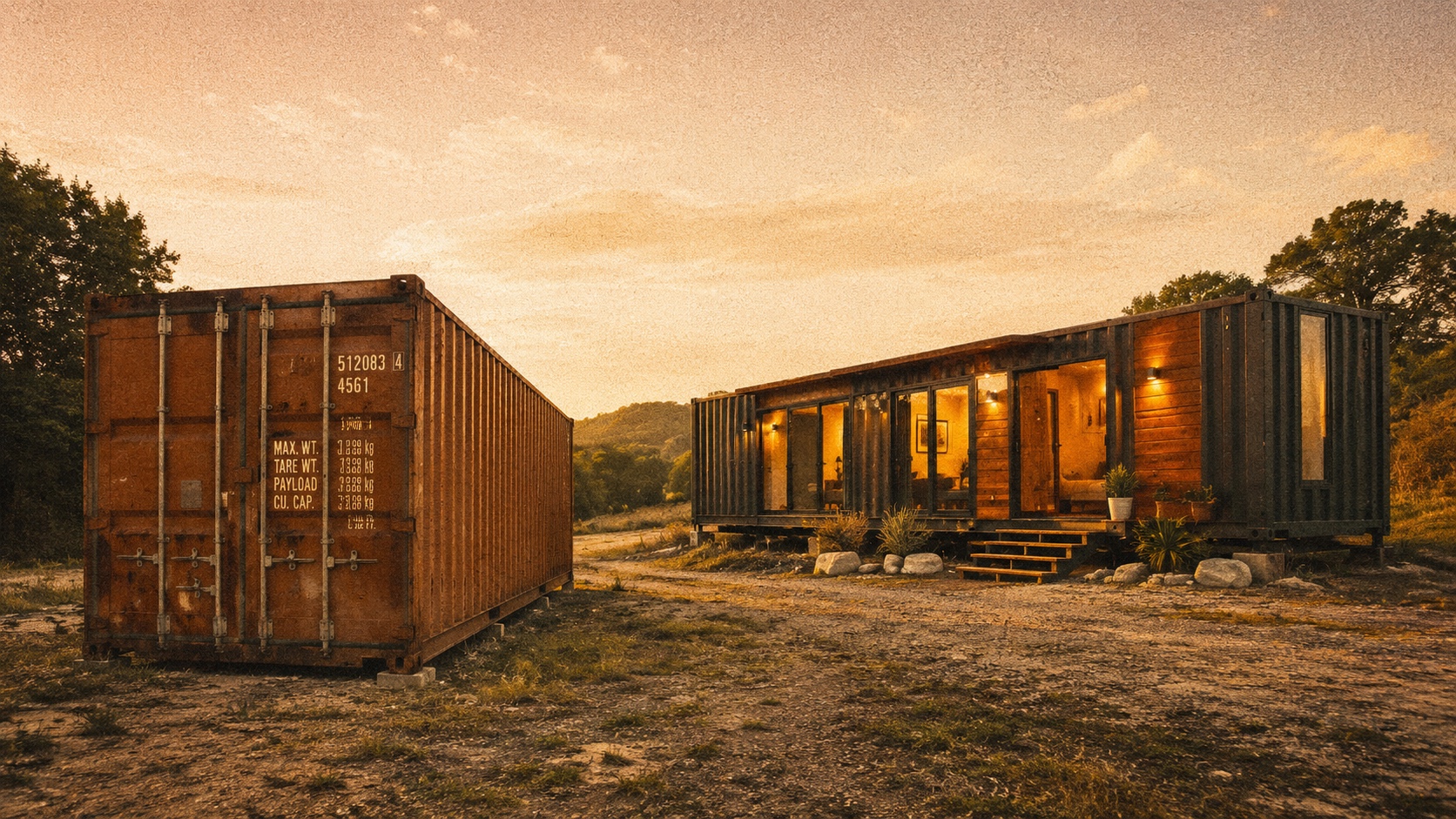
One's a home. One's a box. Sometimes the box becomes the home.
The terms get used interchangeably in listings. They shouldn't. A shipping container is industrial cargo equipment. A container home is a residential structure that started life as a shipping container and got converted through cutting, welding, insulating, and finishing to residential code.
Why this makes sense right now
Container home market grew 26% in 2024 per Grand View Research, from $52B to $65B globally. The used shipping container market grew only 8% — the growth is happening in conversion, not raw supply. Meanwhile, Sea Containers Association reports the average used 40-ft container price in the US: $3,200-$5,400 depending on condition.
The layout — from box to home
Raw shipping container
- Not habitable
- No windows, doors, plumbing, electrical, insulation
- Corten steel, ISO 668 dimensions (8 ft wide × 8 ft 6 in high × 20 or 40 ft long)
- Used $2K-$6K; new $5K-$9K
Container converted for basic habitation (backyard office, guest space)
- Windows + door cut
- Basic insulation (spray foam or rigid board)
- Basic electrical
- Cost: $15K-$45K on top of container cost
- Not typically permitted as permanent residence
Container home (full residential)
- Multiple containers combined (typical: 2-4 for a small home)
- Full insulation to R-value spec
- Permanent foundation
- Plumbing, electrical, HVAC to IRC or IRC-adapted
- Cost: $150-$350/sq ft turnkey
Two builders in 2026 doing serious container homes: Backcountry Containers — Texas, $150-$280/sq ft, off-grid capable. Custom Container Living — nationwide, $130-$250/sq ft.
Financing math
Buying a shipping container: cash or short-term commercial loan. Buying a finished container home: specialty portfolio lender or cash. $200K container home at 8% for 20 years (portfolio lender) = $1,670/month. Same monthly as a $250K modular at 6.5% for 30 years = $1,580/month.
Choose a shipping container if...
- You are building custom yourself
- Off-grid or remote build
- Budget is under $50K for a small structure
- Comfortable with sweat equity + engineering complexity
Choose a container home if...
- Cash or specialty financing available
- Want the industrial aesthetic finished professionally
- Building an ADU or primary residence
- Jurisdiction is container-code-friendly
The quiet part.
The container-home Instagram fantasy usually starts with "I bought a container for $3,500." The reality involves an engineer's letter for wall cuts, hurricane-rated tie-downs on the foundation, spray foam that adds $8K per container, custom window and door openings that cost $2K-$4K each. A "$3,500 container home" ends up being a $95K-$150K project by month twelve.
Buy the finished home if you want the aesthetic. Buy the raw container if you want the project.
Related guides
- Modular vs. Container Home Comparison (2026) — the head-to-head
- Prefab vs. Container Homes Detailed Comparison — the prefab angle
- Foldable vs. Expandable Container Homes — the two conversion categories
Join the conversation
Comments
Reader questions get answered. Real names and a working email — that's it.