Guides
Prefab vs Container Homes: The 2026 Honest Head-to-Head Comparison
On this page
The prefab-vs-container question is one of the most asked and most badly answered in the small-home category. Most of the published comparisons collapse the two into "factory-built homes" and miss that they're regulated, financed, insured, and built under different frameworks. They also share a lot of visual vocabulary, which is why the categories get conflated — a Connect Homes modular module looks an awful lot like a container at first glance, and a high-design Honomobo container reads like a factory-built modular.
The differences underneath are decisive. This guide walks through them honestly: code path, cost, financing, insurance, resale, longevity, and the specific buyer scenarios where each one is the better answer. PERCH lists both — verified US modular, manufactured, and container builders — and we have no preference between the categories. The right answer depends on your site, your budget, and your tolerance for the constraints each one carries.
Definitions, Because Everyone Uses These Terms Differently
Prefab is the umbrella term. It covers any home where significant construction happens in a factory rather than on site. Inside the umbrella sit modular homes (built in modules under state modular code), manufactured homes (built in a factory under HUD code), panelized homes (factory-built panels assembled on site), and kit homes (factory-precut components assembled on site).
For this comparison, "prefab" means modular — the dominant factory-built category for buyers researching modern small homes. Manufactured homes are a related but legally distinct category that we'll address briefly where the comparison matters.
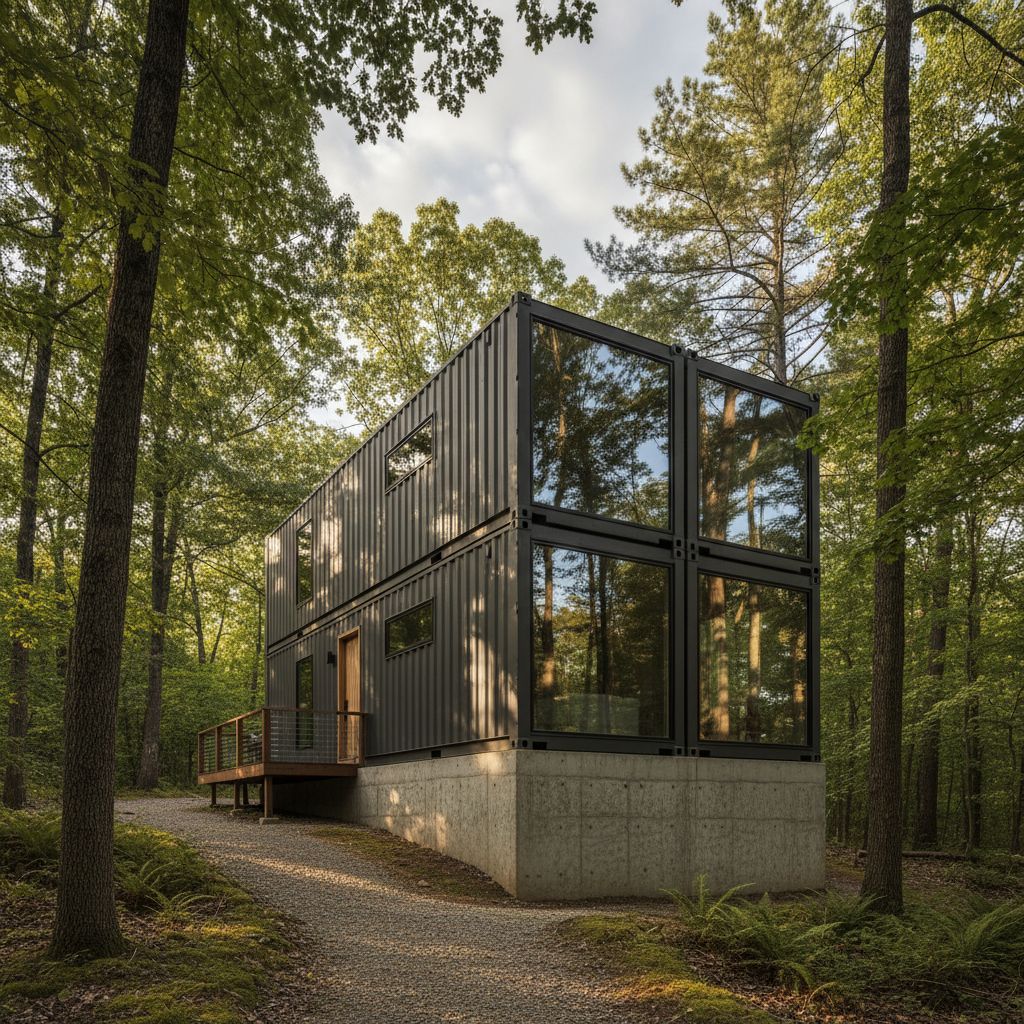
Container homes are conversions of ISO shipping containers — the same 20-foot or 40-foot steel boxes used in global ocean freight — into habitable structures. The container provides the structural shell, and the build modifies the steel (cutting openings, adding insulation, framing interior walls, installing systems) to produce a livable space.
The categories overlap visually. They don't overlap legally.
Code: The Distinction That Decides Everything Else
Modular prefab homes are built under state modular code. Each state administers its own modular program through third-party agencies accredited by ICC. The factory builds against the state-approved plan set, the third-party inspector signs off on the production, and the unit ships with a state modular insignia. That insignia is recognized by lenders, insurers, and local building departments as a legally certified residential structure.
Container homes follow a more complicated path. A container conversion can be code-compliant in three ways: as a state-modular home if the factory holds modular certification and builds the conversion under it, as an ICC-ES-certified product under one of the structural evaluation reports issued for modified shipping containers, or as a site-built structure permitted under the International Residential Code with stamped engineering for the modified steel.
The first path is the cleanest. A handful of builders, including Honomobo, pursue full modular certification for their container-based units. The second path works but is rarer. The third path is the most common in practice and the most variable in outcome — a container home permitted as a site-built custom structure is legitimate but lives or dies on the quality of the engineering report and the local department's willingness to review it.
The practical effect: a state-modular insignia gives you national reciprocity and lender recognition without further discussion. A site-built-permitted container is a one-off that has to be re-defended every time it touches financing, insurance, or resale.
Cost: Where the Number Lands When Honest
Modular prefab from a US builder, finished and delivered, typically runs $150 to $300 per square foot. That covers the unit, the factory finishes, the transport, the foundation, and standard site connections. Premium modernist builders like Plant Prefab, Method Homes, and Dvele push higher — $350 to $700 per square foot — for the architecture and the building science.
Container homes vary wildly by who builds them. A DIY container conversion can come in under $100 per square foot if you do the labor and accept the constraints. A professional container build from a serious shop runs $200 to $500 per square foot finished and delivered, comparable to mid-range modular. Multi-container modernist homes from builders like Honomobo can run $300 to $600 per square foot.
The cost-per-square-foot comparison is closer than most buyers expect. The genuine cost advantage of the container category is at the small end and in DIY configurations. At professional-build scale, the categories converge.
The hidden cost in containers is steel modification. Cutting openings, adding headers to maintain structural integrity, removing wall sections for indoor-outdoor connections — every modification requires engineering and adds labor cost. A container that ships unmodified costs $3,000 to $7,000. A container that's been engineered, modified, insulated, and finished into a livable shell costs $40,000 to $120,000.
Financing: The Sharpest Divider
Modular prefab finances conventionally. A state-modular-certified home placed on a permanent foundation appraises as real property and qualifies for conventional construction-to-permanent loans, conforming mortgages from Fannie Mae and Freddie Mac, and government-backed loans through FHA, USDA, and VA. The financing experience is essentially identical to financing a site-built home.
Container homes finance variably. A container conversion that holds state modular certification finances like any modular. A container permitted as a site-built custom structure can be financed through a construction-to-permanent loan from a local lender willing to underwrite the project, but the lender pool is smaller and the underwriting takes longer. A container without any of those certifications is essentially uncollateralized for mortgage purposes and is paid for in cash, with personal loans, or with home equity from other property.
The financing reality alone pushes many buyers from container toward modular once they understand it.
Insurance: The Other Sharp Divider
Modular homes write as standard dwellings. Any major carrier — State Farm, Allstate, Liberty Mutual, the regional mutuals — will issue a standard homeowner's policy on a state-modular-certified home on a permanent foundation. Coverage is full, premium is competitive with site-built, and claims process normally.
Container homes face a narrower insurance market. Certified container builds from established builders can usually get standard dwelling coverage, but the underwriting process is slower and some carriers will decline. Custom-permitted container builds often get written through specialty carriers at higher premiums. Uncertified container conversions are typically uninsurable as dwellings and get written as outbuildings — which leaves enormous gaps in liability and contents coverage.
This is a recurring cost the buyer carries forever. It's worth pricing before committing.
Longevity and Maintenance
Modular homes have a comparable lifespan to site-built — 50 years and up with normal maintenance. The factory construction is often higher quality than site-built because of controlled conditions, consistent labor, and tighter quality control. Maintenance schedules and replacement cycles for roofs, siding, mechanical systems, and finishes match site-built norms.
Container homes face two longevity questions site-built doesn't. First, the steel structure has to be protected against corrosion indefinitely — coating systems are maintenance, not one-time. Second, the thermal performance of steel walls is fundamentally worse than wood-framed walls, which means insulation, air sealing, and mechanical conditioning have to do more work to achieve comfort and avoid condensation problems.
Done well, container homes can match modular longevity. Done poorly, the steel shows wear faster than wood-framed construction.
Resale
Modular homes resell as real property. The comparable sales are other homes in the neighborhood. The appraisal process is conventional. The buyer pool is the same as any other residential buyer.
Container homes resell into a smaller market. The aesthetic limits the buyer pool. The financing constraints limit which buyers can purchase. In design-conscious markets — California, Pacific Northwest, parts of Colorado, Austin — there is real resale demand for quality container builds. In most other markets, the resale is slower and the price is more variable.
This isn't fatal to the container category. It is a real factor for any buyer treating the purchase as a financial asset rather than purely a place to live.
When Each One Is the Right Answer
Choose modular prefab if you want a home that finances, insures, and resells like a normal home; your site supports conventional foundation work; you're in a jurisdiction with active code enforcement; or you're aiming at the modernist architectural end of the small-home spectrum and want a real builder with a real factory.
Choose container if the aesthetic is genuinely what you want (not what you settled for after looking at the cost-per-square-foot of modular); you're working on a tight site where the container's structural pre-fab simplifies the build; you're paying cash or have flexible financing; you're either DIY-capable or buying from a serious certified container builder; or you're in a design-conscious market where the architecture appreciates rather than depresses value.
Choose neither if you're treating the question as a way to get a small home cheaply. Both categories cost real money to do well, and the cheapest version of either is the version most likely to disappoint.
The Comparison Table
| Factor | Modular prefab | Container conversion |
|---|---|---|
| Typical delivered cost | $150-$700/sqft | $100-$500/sqft (DIY to pro) |
| Certification path | State modular insignia | Modular, ICC-ES, or site-built permit |
| Lender recognition | Conventional | Variable |
| Insurance | Standard dwelling | Specialty or limited |
| Permit reciprocity | National via state modular | Case-by-case |
| Resale market | Comparable to site-built | Limited to design-conscious markets |
| Longevity | 50+ years standard | 30-50+ years with discipline |
| Maintenance burden | Conventional residential | Corrosion + thermal management |
| Lead time | 4-14 weeks factory | 8-20 weeks (more for modifications) |
| Best fit | Primary residence, financed, design-flexible | Cash buyer, design-committed, right market |
The PERCH Take
Both categories have legitimate buyers and legitimate use cases. The wrong answer is choosing based on aesthetic photos without understanding which financing, insurance, and code constraints come along for the ride. PERCH lists both — verified US modular and manufactured home builders alongside serious container builders — so the comparison can be made with the full picture in view. Worth a walk-through before you commit to either.
Data Sources & Further Reading
The specifics in this guide reference the following authoritative sources — check them directly for the current numbers, program rules, and code text before finalizing a purchase or build decision:
- International Code Council (IRC/IBC)
- HUD manufactured-home construction standards (24 CFR Part 3280)
- Fannie Mae MH Advantage
For federal manufactured-housing dispute and repair resources, see HUD's Manufactured Home Dispute Resolution Program. For financing standards on factory-built product, Fannie Mae MH Advantage and Freddie Mac CHOICEHome set the terms most lenders reference.
Join the conversation
Comments
Reader questions get answered. Real names and a working email — that's it.