Guides
Types of Tiny Homes: The Four Categories, Their Code Paths, and What Each One Actually Finances (2026)
On this page
"Tiny home" is a marketing word, not a regulatory one. It covers at least four legally distinct products — each with its own code path, its own financing reality, and its own answer to the question every buyer eventually asks: can I actually live in this thing legally?
If you've been searching tiny home options and getting hit with a wall of Instagram photos and zero clarity on what's legal where, this is the honest version. PERCH is the marketplace where verified US modular and manufactured builders list real inventory. We don't sell units. We don't manufacture. We do spend a lot of time helping buyers figure out which tiny home category they actually want before they put down money on the wrong one.
There are four real categories: tiny house on wheels (THOW), tiny house on a foundation (THOF), park model RV, and accessory dwelling unit (ADU). Here's what each one is, how it's regulated, and how it finances.
1. Tiny House on Wheels (THOW)
A THOW is a tiny home built on a trailer, designed to be towed. Typical size: 100–400 sq ft. Typical price new: $40K–$120K finished, $20K–$60K shell.
Code path. THOWs occupy a gray zone. The strongest builders certify their THOWs through the RVIA (Recreation Vehicle Industry Association) — meaning the unit is built to ANSI A119.5 (park model RV) or NFPA 1192 (recreational vehicle) standards. RVIA certification makes the THOW a recognized recreational vehicle, registerable through the state DMV.
Other THOWs are built to no certification at all. Owner-built THOWs and uncertified factory THOWs are the most common — and the most likely to cause problems at a county building department, insurance underwriter, or lender's desk.
Where you can park it. Legally, an RV-certified THOW can stay in an RV park, a campground, or on private rural land that allows RV occupancy. Most cities prohibit full-time RV residence. Some states have carved out tiny home villages, RV-zoned residential land, and "tiny home friendly" jurisdictions, but they are the exception, not the rule. A buyer who plans to park a THOW on a friend's suburban lot and live there permanently is almost certainly going to hear from code enforcement.
Financing. RV loans through specialty lenders. Term typically 10–15 years, rates higher than mortgages. Cash is common. No conventional mortgage path because the unit is personal property, not real estate.
Best-fit buyer. Someone with rural land that allows RV occupancy, a touring or seasonal-living lifestyle, or a spot in an established tiny home community. Not a primary-residence path for most suburban or urban buyers.
2. Tiny House on a Foundation (THOF)
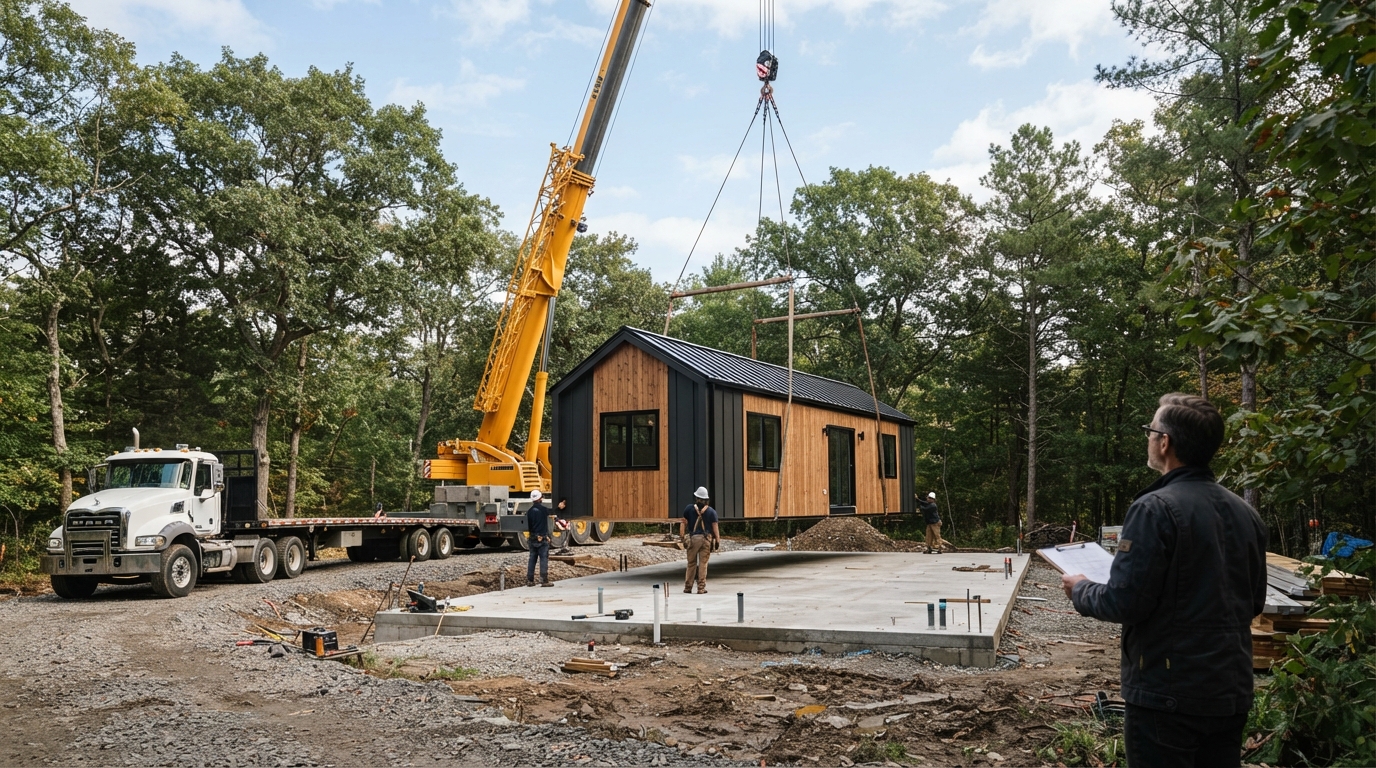
A THOF is a tiny home built on a permanent foundation — slab, crawl space, or basement. Typical size: 200–600 sq ft. Typical finished cost: $80K–$200K depending on land prep.
Code path. IRC Appendix Q — "Tiny Houses" — applies to dwellings 400 sq ft or smaller, excluding lofts. Appendix Q relaxes ceiling height, loft access (ladders allowed), egress, and emergency escape rules versus the main IRC. The buyer's local jurisdiction has to have adopted Appendix Q for the relaxed rules to apply. Not every jurisdiction has — adoption varies widely by state and county.
If the local code does not include Appendix Q, the THOF has to meet the full IRC (which makes a 200 sq ft home with a loft hard to permit) or be built as a modular under the state modular program.
Where you can put it. Anywhere zoning allows a single-family dwelling of that size. Many residential zones have minimum dwelling size requirements (often 800–1,200 sq ft) that effectively exclude THOFs as primary residences. Buyers commonly use them as ADUs in jurisdictions that allow them, or as primary dwellings on rural lots without minimum size rules.
Financing. Conventional construction-to-permanent loan if the home is built by a licensed GC, permitted, and inspected as a small site-built or modular home. Lenders vary on appetite for sub-600 sq ft dwellings — some treat them as fine, some require a minimum square footage.
Best-fit buyer. A buyer with land in a jurisdiction that allows small dwellings, or a buyer adding a small primary home on rural acreage. The financing path works when the home is built like a real house, not like an RV.
3. Park Model RV
A park model RV is a factory-built recreational unit, larger than a typical RV (usually 400 sq ft or less by federal definition), designed for long-term placement in an RV park, resort, or tiny home community. The two regulatory paths are ANSI A119.5 (the dominant standard, RVIA-certified) and HUD Code 233 — a path for park models built as small manufactured homes.
ANSI A119.5 / RVIA path. Treated as a recreational vehicle. Registered through the DMV. Cannot be used as a permanent dwelling in most jurisdictions, but is permitted in RV parks and licensed tiny home communities. This is by far the most common path.
HUD 233 path. Treated as a small manufactured home. Carries a HUD tag. Can be financed with chattel or real-property loans and used as a permanent dwelling where local zoning allows manufactured homes. Less common but growing.
Cost. $50K–$120K typical. HUD-tagged park models trend slightly higher because they meet a stricter code.
Best-fit buyer. Someone in an RV park or planned tiny home community (ANSI path) or a rural buyer in a manufactured-home-friendly jurisdiction who wants a small permanent dwelling (HUD path). Major builders include Champion Homes, Cavco Industries, and Skyline Homes.
4. Accessory Dwelling Unit (ADU)
An ADU is a second dwelling unit on a single-family lot — a backyard cottage, a garage conversion, a basement apartment, or a small detached home. Size limits vary by jurisdiction, typically 400–1,200 sq ft. ADUs can be stick-built, modular, manufactured, panelized, or prefab tiny.
Code path. Local zoning code (ADU ordinance) plus the standard building code (IRC) for the construction method chosen. California, Oregon, Washington, and a growing list of states have passed state-level ADU laws that override restrictive local zoning. Other states leave ADU rules entirely to the city or county.
Where you can put one. On a parcel that allows ADUs under local zoning. Most major metros now allow ADUs in single-family zones, with restrictions on setbacks, height, owner-occupancy, parking, and short-term-rental use. The variability is enormous — what's legal in Los Angeles is illegal three counties over.
Cost. $80K–$300K for a finished prefab or modular ADU including site work and utility connections. Site-built ADUs run higher.
Financing. HELOC, cash-out refinance, ADU-specific construction loan, or — in California — state-supported programs that bundle the build into a primary mortgage refi. Builders in this category include Abodu, Cover, Honomobo, and many regional specialists.
Best-fit buyer. A homeowner with land, equity, and a jurisdiction that allows ADUs — adding rental income, multi-generational housing, or workspace.
Side-by-Side Code and Financing Snapshot
| Type | Typical cost | Code path | Financeable | Legal as primary residence |
|---|---|---|---|---|
| THOW (RVIA) | $40K–$120K | ANSI A119.5 + DMV | RV loan or cash | Rarely — only in RV-zoned land |
| THOF | $80K–$200K | IRC Appendix Q or full IRC | Construction-to-perm | Yes, where zoning allows |
| Park model (ANSI) | $50K–$110K | ANSI A119.5 + DMV | RV loan or cash | No — RV-park only |
| Park model (HUD 233) | $70K–$120K | HUD Code | Chattel or real-property | Yes, where zoning allows |
| ADU | $80K–$300K | Local ADU + IRC/HUD | HELOC, refi, ADU construction loan | Yes (as second unit) |
The Question to Ask First
Before you fall in love with a floor plan, the question to answer is: what code does my jurisdiction enforce, and what's actually allowed on my land? The cheapest THOW in America is useless if the buyer's county won't let it park there full-time. The most beautiful ADU is irrelevant if the lot is in a zone that prohibits accessory dwellings.
Buyers who start with the land and the code path end up with homes they can finance, insure, and keep. Buyers who start with Instagram end up with units they can't permit.
When Each Category Makes Sense
THOW makes sense when you have rural acreage that allows RV occupancy, a spot in an established tiny home community, or a touring lifestyle.
THOF makes sense when you have land in a small-dwelling-friendly jurisdiction and want a real, financeable, permanent home that just happens to be small.
Park model RV makes sense when you're in an RV park, a resort, or — for HUD 233 — a rural manufactured-home-friendly zone.
ADU makes sense when you already own a single-family lot in an ADU-permissive jurisdiction and want a second dwelling for rental, family, or workspace.
The PERCH View
PERCH is the honest marketplace for modular, manufactured, and prefab homes — including the small-format categories where the gap between marketing and reality is the widest. If you're trying to figure out which tiny home category matches your land, your code, and your financing, the right next step is to confirm the legal path before you shop the floor plans.
Data Sources & Further Reading
The specifics in this guide reference the following authoritative sources — check them directly for the current numbers, program rules, and code text before finalizing a purchase or build decision:
- HUD manufactured-home construction standards (24 CFR Part 3280)
- International Code Council (IRC/IBC)
- U.S. Census Bureau — Housing Vacancies and Homeownership
For federal manufactured-housing dispute and repair resources, see HUD's Manufactured Home Dispute Resolution Program. For financing standards on factory-built product, Fannie Mae MH Advantage and Freddie Mac CHOICEHome set the terms most lenders reference.
Join the conversation
Comments
Reader questions get answered. Real names and a working email — that's it.