Guides
Tiny Home Retirement Plan: A 2026 Guide
On this page
Fidelity did not put this in the brochure.
A paid-off 720 sq ft home in a walkable community. A property tax bill under $1,800 a year. No mortgage. No HELOC. No line item on your December statement for a landscaper you never wanted. The 401(k) is doing what it was supposed to do the whole time, because you finally stopped asking it to also cover a four-bedroom colonial you rattle around in on Tuesdays.
This is a real retirement plan. Nobody sold it to you because there was no commission in it.
Why this makes sense right now
The median home price at retirement (age 65) hit $416,000 in 2025 per the National Association of Realtors' Home Buyer and Seller Generational Trends Report. The median home owned by a person over 65 was worth $329,000. Most Baby Boomers are sitting on more equity than they can spend down through home-equity products alone. Meanwhile, 42% of retirees report their monthly expenses exceed their monthly income, per the Employee Benefit Research Institute's 2025 Retirement Confidence Survey — and the largest single line item, for the 68% of retirees who still have one, is the mortgage or property tax bill on a home built when they had three kids and a dog.
The tiny home retirement play unwinds all of that. The math looks like this: sell a $400K primary for $370K net after commission. Buy or build a $180K tiny home outright, on-foundation, in a jurisdiction that allows it. Invest the remaining $190K at a conservative 5% and it pays out roughly $9,500 a year in perpetuity while leaving the principal for heirs. Property taxes drop from $6,200 to under $1,800. Utilities drop from $340 a month to under $140. Insurance drops from $1,900 a year to under $700. Total annual cost of living drops by roughly $14,000. Your Social Security check is now cash flow, not triage.
Nobody in the retirement-planning industry ran this model for you because the industry is compensated on assets under management. The moment you take $180K out of the market and put it in a house, that money stops paying anyone at Fidelity. That is the entire reason this plan is not in the brochure.
The layout — what a real retirement tiny home looks like
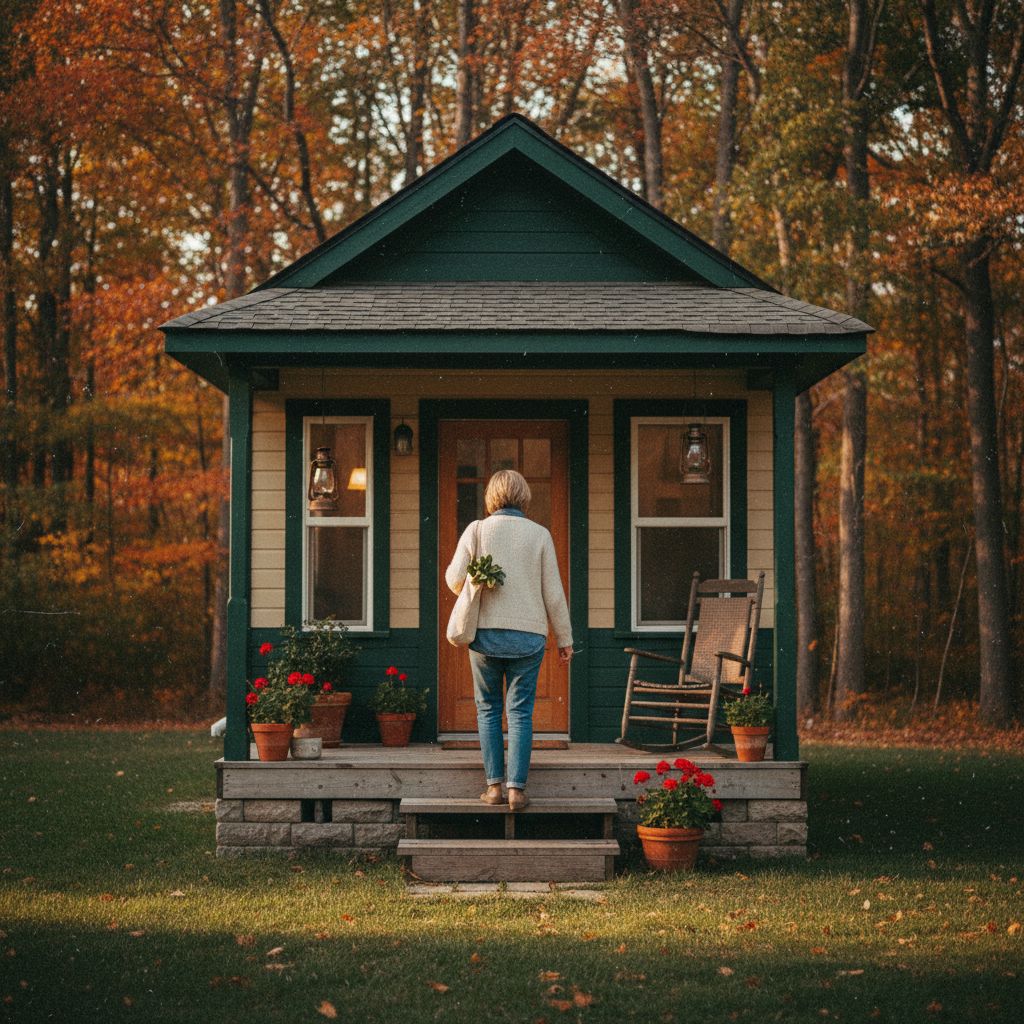
The version of a tiny home that works in retirement is not the one on the HGTV special. It is a real one-bedroom home that happens to be small.
Sweet spot: 550 to 780 sq ft, single-level, on a permanent foundation. Not on wheels. On wheels, you cannot get a conventional mortgage, you cannot get a homestead exemption in most states, and you cannot leave it to your kids without a title fight. On a foundation, it behaves like real property — deeds, taxes, insurance, and inheritance all work the way they are supposed to.
Layout that works:
- One bedroom with a real closet (not a nook)
- A full bathroom with a curbless shower and comfort-height fixtures
- A real kitchen with a 24" range and a full-height refrigerator
- A great room that combines living, dining, and a small home office
- A covered outdoor porch of at least 100 sq ft — non-negotiable, this is where you actually live in retirement
- 8'6" ceilings minimum. 9' if the builder will do it
- A mudroom or entry vestibule of at least 20 sq ft, sized for a walker to turn
Aging-in-place decisions to make now:
- No steps at the entry
- Blocking behind the walls in the bathroom for grab-bars later
- Rocker light switches, not toggle
- Lever door handles, not knobs
- A 36" primary door, 34" interior doors
Two builders in 2026 doing retirement-scale tiny homes on foundation:
- Escape Homes — 400 to 720 sq ft on-foundation models, park-and-cabin community placement, $95K to $180K turnkey
- Wheelhaus — 400 to 800 sq ft on-foundation, aging-in-place layouts as a stock option, $130K to $260K turnkey
The mistake most retirees make: buying a 250 sq ft tiny on wheels because it looked cute on YouTube. You need a real house. Just a small one.
Financing — how a retirement tiny home actually closes
Most retirees buying a tiny home for retirement pay cash from the sale of the primary. That is the cleanest structure and the whole point of the play. But if you need to bridge — because your primary is under contract but not yet closed, or because you want to hold the primary as a rental — there are three real paths.
Conventional purchase mortgage on the tiny home (foundation-set only). If the tiny is on a permanent foundation and titled as real property, a conventional purchase mortgage works. Fannie Mae accepts tiny homes as long as the appraisal comes in at value and comparables exist within a five-mile radius. Rates as of Q3 2026 run 6.75% to 7.5% on a 30-year fixed for owner-occupied. Lenders that actually do these: Guild Mortgage, 21st Mortgage, and Cascade Land Home Financing.
Chattel loan (tiny on wheels or in a park). Rates are higher — 9.5% to 13% — and terms shorter, typically 15 to 20 years. Do not use this structure for retirement financing. It defeats the plan.
Cash from primary sale, held in escrow. The standard structure. Sell the primary, park the proceeds in a money-market or short-duration Treasury ladder, close on the tiny within 90 days of the primary sale, and use the excess to top up the retirement portfolio.
The 1031 exchange play (advanced). If you are retiring from a primary you have owned less than two years OR the property has been a rental, a 1031 exchange into an investment-classed tiny home can defer capital gains. Complex, but real. Talk to a 1031 qualified intermediary before you list.
Property taxes: a $180K tiny home on 0.15 acres in most states runs $1,400 to $2,400 a year. Homestead exemption applies once you occupy it as primary. Insurance: $500 to $900 a year for a foundation-set unit. Utilities: expect $80 to $160 a month all-in, depending on climate.
Zoning is the friction. Forty-four states have at least one jurisdiction that permits stand-alone tiny homes on foundation. Fourteen states — California, Oregon, Washington, Colorado, Utah, Vermont, Maine, Rhode Island, Hawaii, New Hampshire, New Mexico, Arizona, Nevada, and North Carolina — have statewide legislation making it easier. Everywhere else, check the local ordinance, or check with the American Tiny House Association state map, which is more current than most planning departments' own websites.
The PERCH Financing Finder walks through eight questions and returns the best loan structure for a retirement tiny home purchase. It is free. It takes four minutes.
The quiet part.
Retirement is not a party. It is a math problem you finally get to solve on your own terms.
For thirty years you optimized around a mortgage, a commute, a school district, and someone else's calendar. You did the whole thing correctly. You raised the kids. You paid the taxes. You watched the market do what the market does. Nobody threw you a parade.
Now you get to reset the operating cost.
The retirement tiny home is not about downsizing. It is about de-frictioning. The four-bedroom with the acre lawn was engineered for a version of you that had three kids under twelve. You are not that person anymore. The house is a memory of a version of your life. Memories are worth keeping. Foundations are not.
Move the memory. Sell the foundation. Rebuild the operating cost around who you actually are now — a person who reads on the porch, who walks the dog at seven, who might learn pottery, who might finally take that Portugal trip your daughter has been sending you links about since 2019.
The plan Fidelity did not sell you costs less than the plan Fidelity sold you. And the plan Fidelity did not sell you is the one that lets you buy the Portugal ticket.
Related guides
- Downsize Without Selling: ADU & Tiny Home Options — you don't have to sell the house to downsize
- Age in Place: ADU & Tiny Home Solutions Guide — a tiny house in the backyard, and other ways to age in place
- Aging-in-Place Home Design for Retirement — the house you build for the you at 75
Join the conversation
Comments
Reader questions get answered. Real names and a working email — that's it.