Guides
Prefab Homes: Types, Costs, and Code Compliance Explained (2026 Guide)
On this page
"Prefab" is the most overloaded word in the housing category. It gets used to describe a $7,900 Amazon flat-pack container, a $40,000 single-section manufactured home that rolls in on its own steel chassis, a $400,000 modular by Plant Prefab, and an $800,000 net-zero panelized home by a custom architect. All of these are technically prefabricated. None of them follow the same rules, the same code, the same financing path, or the same cost curve.
If you've been searching "prefab homes" trying to figure out what category you actually want, this guide is the honest version. PERCH is the marketplace where verified US builders list modular and manufactured homes — Autotrader meets Zillow for the housing category. We don't manufacture, we don't sell units, and we have no incentive to push you toward one category over another. What follows is the breakdown we wish more buyers got before they put down a deposit.
What "Prefab" Actually Means
Prefab is an umbrella term for any home where significant construction happens in a factory before the structure arrives at the building site. Inside that umbrella, there are five distinct categories — each with its own code path, its own financing reality, and its own cost band. They are not interchangeable.
The five categories are modular, manufactured, panelized, kit, and tiny. A site-built (stick-framed) home is the only thing that is not prefab. Everything else lives under this umbrella.
Modular Homes
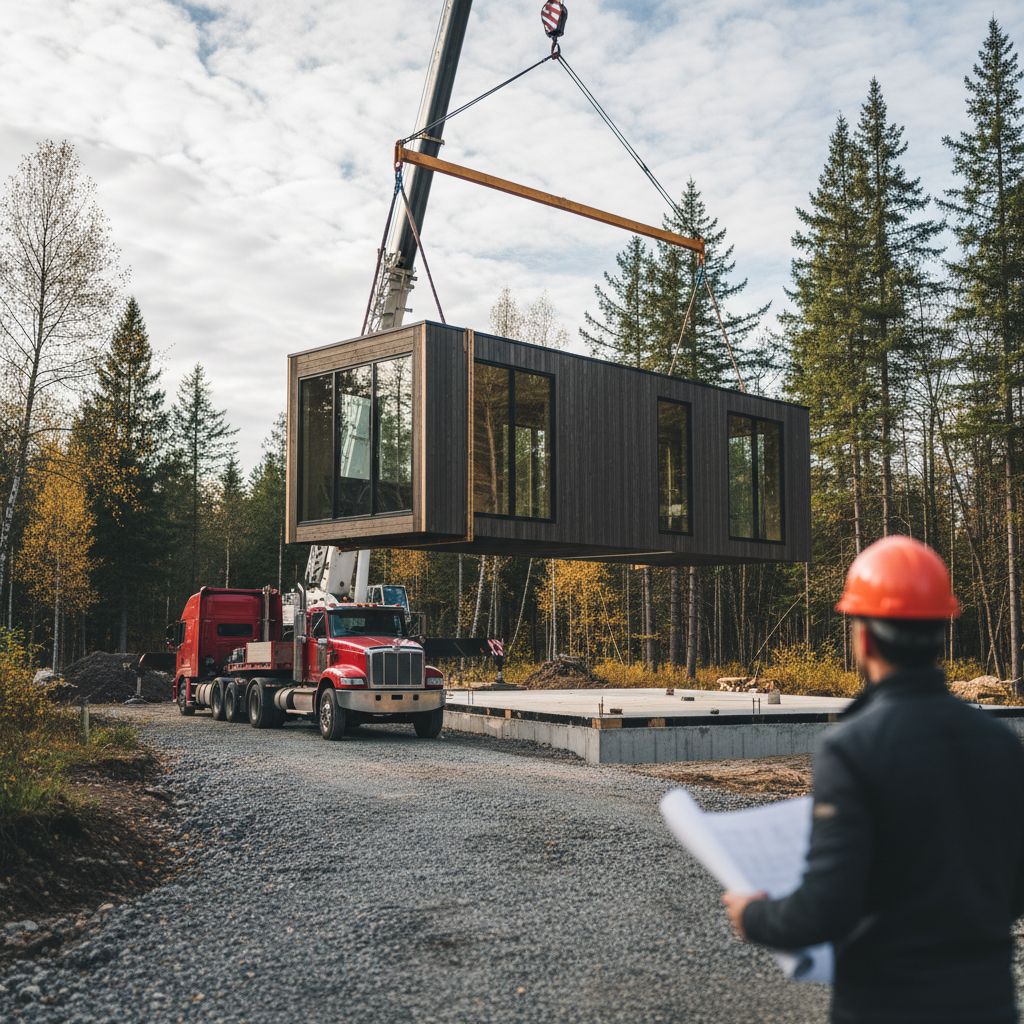
Modular homes are built in sections inside a factory, trucked to the site, and set on a permanent foundation with a crane. They are inspected at the factory by a third-party agency and carry a state modular insignia — meaning they meet the same state and local building codes (IRC or IBC) as a stick-built home.
Cost range. $80–$180 per square foot for the module itself. Land, site work, foundation, transportation, crane set, and finish-out push delivered cost to $120–$280 per square foot in most markets. A 1,800 sq ft modular landed and finished typically lands between $250K and $450K.
Code. State modular code, which mirrors IRC for single-family. Local building department reviews the site work and foundation, not the module — the module was already inspected at the factory.
Best-fit buyer. Someone who wants a real, financeable, appreciable house — but wants faster build time and tighter quality control than a stick-built. Builders to know in this category include Plant Prefab, Dvele, Method Homes, Connect Homes, and Champion Homes.
Manufactured Homes
Manufactured homes are built to the federal HUD Code, not state code. They are built on a permanent steel chassis (which stays with the home), transported on their own wheels, and set on piers, a slab, or a permanent foundation. They carry a red HUD certification tag.
Cost range. $50–$110 per square foot delivered. A new single-section (single-wide) typically runs $60K–$110K. A double-section (double-wide) runs $90K–$180K. A triple-section runs $150K–$280K.
Code. HUD federal preemption — the same code applies in every state. Local jurisdictions can regulate placement (zoning, setbacks, foundation type) but cannot reinspect the home itself.
Best-fit buyer. Someone who needs a financeable primary residence at the lowest dollar-per-square-foot in the category. Manufactured is the only path to a brand-new, code-compliant house under $100K in most US markets. Major builders include Clayton Homes, Champion Homes, Cavco Industries, and Skyline Homes.
Panelized Homes
Panelized homes ship as flat wall, floor, and roof panels — sometimes structurally insulated panels (SIPs), sometimes open-stud panels with sheathing. A general contractor assembles the panels on-site, then completes the home with traditional trades.
Cost range. $100–$220 per square foot for the panel package and on-site assembly, before site work and finish trades. Delivered cost ranges $180–$350 per square foot depending on finish level and climate zone.
Code. Site-built code (IRC). The panels themselves are not a regulated category — the finished home gets inspected by the local building department like any other stick-built house. The factory pre-build is a construction efficiency, not a regulatory category.
Best-fit buyer. Someone working with a custom architect or a regional GC who wants faster framing, tighter envelope performance, and better insulation than conventional stick-frame — without leaving site-built code. Common for high-performance, net-zero, and passive house projects.
Kit Homes
Kit homes ship as a labeled bundle of materials — framing, sheathing, hardware, sometimes windows and doors — with assembly instructions. The buyer (or a contractor the buyer hires) builds the home on-site. Kits range from rustic A-frames and barns to fully engineered packages from companies like Mighty Buildings on the higher end.
Cost range. $20K–$120K for the kit alone, depending on size and finish level. Delivered, finished cost typically lands $150–$280 per square foot once you add foundation, labor, plumbing, electrical, HVAC, and permits.
Code. Site-built code. The kit is a materials package — the local building department inspects it as a conventional construction project.
Best-fit buyer. Owner-builders, rural buyers with their own labor, or someone building an accessory structure on land they already own. Not a fit for anyone who needs a turnkey product or a financeable mortgage on day one.
Tiny Homes
Tiny homes are a small subcategory of prefab with their own confusing code path. A tiny home on wheels (THOW) is typically built to RV industry standards (RVIA) and registered as a recreational vehicle, not a house. A tiny home on a permanent foundation falls under IRC Appendix Q (Tiny Houses, 400 sq ft and under) and is treated as a small site-built or modular home.
Cost range. $40K–$120K for a finished THOW. $80K–$200K for a tiny home on a permanent foundation, depending on land prep.
Code. THOW = RVIA + state DMV. THOF (tiny home on foundation) = IRC Appendix Q + local building department.
Best-fit buyer. Highly site-specific. THOWs work for buyers with rural land or RV-zoned communities. THOFs work as ADUs in jurisdictions that allow them. Neither is a great primary-residence path in most cities — the financing market is thin and the resale market is thinner.
Side-by-Side Cost and Code Snapshot
| Category | Typical $/sq ft delivered | Code path | Financeable | Resale market |
|---|---|---|---|---|
| Modular | $120–$280 | State modular insignia + IRC | Yes — construction-to-perm | Strong |
| Manufactured (HUD) | $50–$110 | HUD federal preemption | Yes — chattel or real-property | Strong |
| Panelized | $180–$350 | Site-built (IRC) | Yes — construction loan | Strong |
| Kit | $150–$280 | Site-built (IRC) | Sometimes — depends on GC and lender | Mixed |
| Tiny (THOW) | $40K–$120K total | RVIA + DMV | Rare — RV loan or cash | Thin |
| Tiny (THOF) | $80K–$200K total | IRC Appendix Q | Yes — small modular/site-built | Limited |
The Honest Comparison Most Articles Skip
Online prefab content tends to lump all five of these together under one headline number — usually something like "prefab homes cost $100–$200 per square foot." That number is averaging a $60K HUD single-section with a $700K Plant Prefab build, which is meaningless. The honest version is that the category you pick determines the number, and the buyer-facing decision should start with code and financing, not with aesthetics.
A buyer who wants the cheapest financeable new home in America: manufactured (HUD). A buyer who wants the modern-architecture look at modular speed: modular by Plant Prefab, Method, Dvele, or Connect. A buyer building custom on rural land with a GC: panelized. A buyer with land, time, and labor: kit. A buyer with rural acreage or an RV-zoned park: tiny on wheels. A buyer adding a backyard rental unit: tiny on foundation as an ADU, or a small modular.
The wrong move is to pick the category by photos. The right move is to pick by code path and financing, then narrow by aesthetics inside that category.
What Drives Total Cost Beyond the Sticker
Across every prefab category, the structure itself is rarely more than 60–70% of the delivered cost. The rest is land, site work (clearing, grading, soil testing, septic if no sewer, well if no water, driveway), foundation, utility hookups, permit fees, transportation, crane set (for modular), and the finish trades the factory didn't include. Buyers who anchor on the module price and forget the rest are the same buyers who post angry reviews six months later.
A good rule of thumb: budget 1.5x to 2x the module/manufactured/kit sticker price as your total project cost on raw land, and 1.2x to 1.4x on a developed lot with utilities at the property line.
How Financing Differs by Category
Modular homes finance like site-built — construction-to-permanent loan from a regional bank or credit union, converts to a conventional mortgage at completion. Fannie Mae and Freddie Mac both buy modular mortgages on the secondary market.
Manufactured homes finance one of two ways: chattel loan (personal property, higher rate, shorter term) or real-property mortgage (when the home is permanently affixed to land the buyer owns, often through Fannie Mae's MH Advantage or Freddie Mac's CHOICEHome programs). Real-property is the lower-rate path; chattel is the only path if the home sits in a leased land community.
Panelized and kit homes finance through a construction loan that converts to a conventional mortgage — assuming the GC is licensed and the project is permitted.
Tiny homes are the hardest. THOWs are RV-loan or cash. THOFs sometimes qualify as small modulars, sometimes don't — lender by lender.
The PERCH View
PERCH is the honest marketplace for modular and manufactured homes — the two categories that actually function as financeable, code-compliant, appreciable houses for most buyers. We verify the builders, surface real specs, and let buyers declare their financing path up front so the matches that come back are real. If you've been trying to figure out what "prefab" even means before you start shopping, you've done the hardest part already.
Join the conversation
Comments
Reader questions get answered. Real names and a working email — that's it.