Guides
Modular vs. Manufactured Home: The 2026 Comparison
On this page
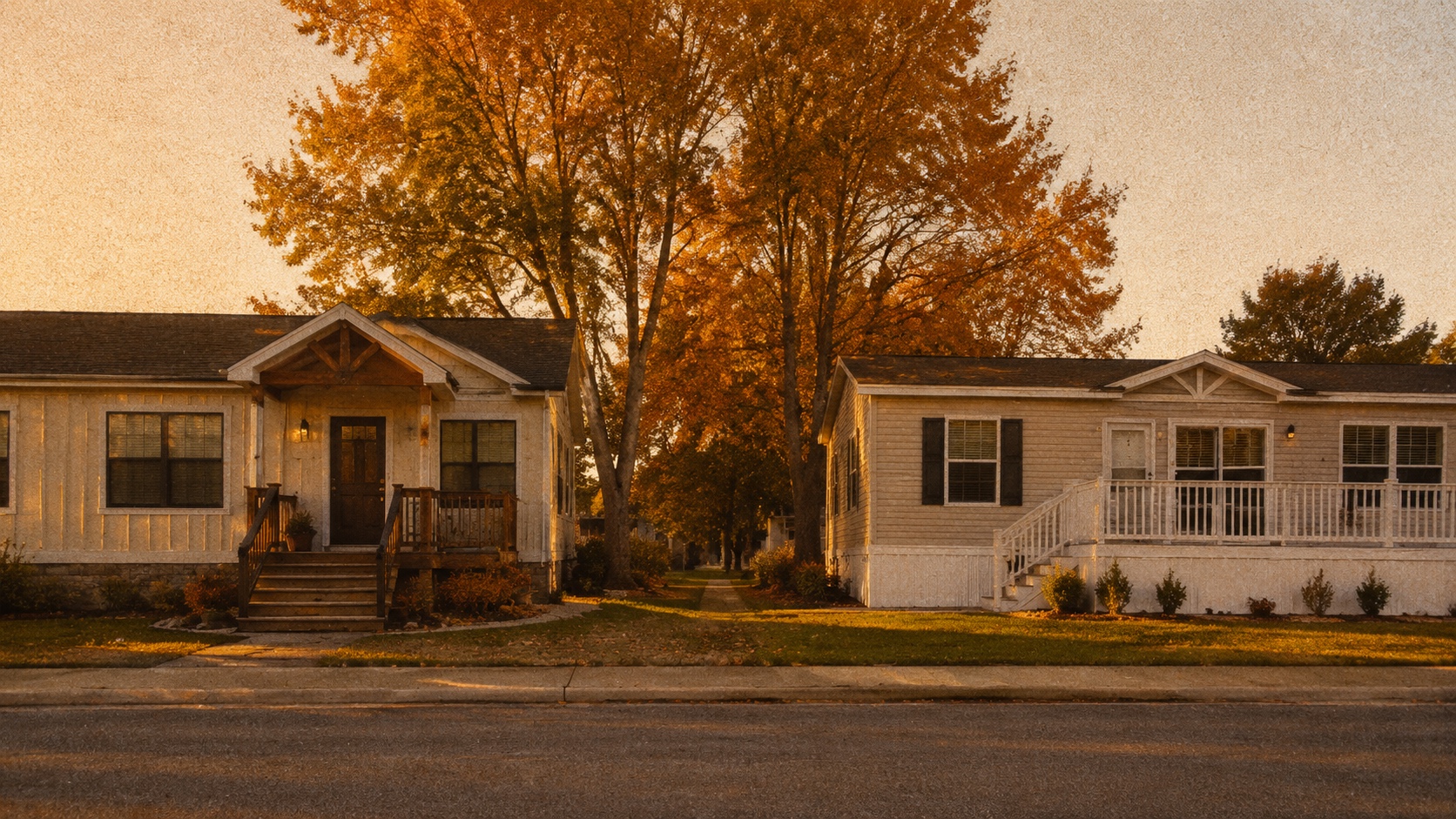
Same driveway, very different math.
The two words get used interchangeably. They shouldn't. Modular and manufactured homes are built in different factories, to different building codes, financed by different lenders, taxed by different rules, and — most importantly — appreciate or depreciate on entirely different curves. Pick wrong and you spend twenty years explaining to appraisers why the numbers don't work.
Why this makes sense right now
Modular home shipments rose 18% in 2024 per Modular Housing Institute, while manufactured home shipments rose 6% per Manufactured Housing Institute. Both categories are winning share from site-built — but for entirely different buyer profiles.
The financing gap is the deciding factor. Fannie Mae MH Advantage reported that in 2024, only 24% of manufactured homes were financed with conventional mortgages; 76% closed on chattel or land-home loans at 8-11% APR. Modular homes closed on conventional mortgages 91% of the time, at 6-7% APR. Same borrower, same downpayment, radically different monthly obligation.
Zoning cooperated for modular in most states. 38 states permit modular on any lot zoned residential, per ADU Marketplace zoning tracker. Manufactured homes remain restricted to land zoned for manufactured/mobile home use in ~60% of jurisdictions.
The layout — head-to-head on the 12 things that matter
Building code
- Modular: IRC + state amendments (identical to site-built)
- Manufactured: HUD Code (federal, preempts local code)
Foundation
- Modular: permanent (frost-depth footings, full basement or crawl)
- Manufactured: pier-and-beam or permanent (chassis stays under home)
Chassis
- Modular: none; sections are cranes onto foundation, chassis discarded
- Manufactured: steel chassis stays permanently, hidden by skirting
Cost per sq ft turnkey (2026)
- Modular: $180-$280
- Manufactured: $80-$140
Build time
- Modular: 4-9 months factory + 30-90 days on-site
- Manufactured: 60-120 days factory + 14-45 days on-site
Financing
- Modular: conventional Fannie/Freddie mortgages, VA, FHA, USDA — all standard programs
- Manufactured: chattel (personal property), land-home packages, FHA Title I, MH Advantage; limited conventional
Appreciation
- Modular: appreciates like site-built (typically 3-5% annually in most markets)
- Manufactured: depreciates like vehicles (typically 3-5% annually) UNLESS titled as real property on owned land with a permanent foundation
Property tax
- Modular: real property tax on land + structure
- Manufactured: real property if titled as such; otherwise personal property tax like a vehicle
Insurance
- Modular: standard homeowner's policy
- Manufactured: specialty MH policy or mobile-home insurance
Resale
- Modular: comparable to site-built in most markets
- Manufactured: 40-60% resale premium loss vs. modular over 10 years unless converted to real property
Zoning
- Modular: any residential lot (38 states by right)
- Manufactured: MH-designated lots primarily; some jurisdictions accept CrossMod/MH Advantage on standard residential
Warranty
- Modular: builder warranty + state homeowner warranty (typically 10 years structural)
- Manufactured: HUD Code warranty (typically 1 year full + limited structural)
Two builders in 2026 doing purpose-built modular: Clayton Homes Modular Division — 20+ factories, national footprint, $150-$220/sq ft. Cavco Industries — modular and CrossMod lines, $170-$260/sq ft. Two doing HUD-code manufactured that closes the gap: Champion Homes — 40+ plants, $85-$140/sq ft. Skyline Champion — largest US manufactured builder, $80-$130/sq ft.
Financing — the fork that actually determines the deal
If you have land already:
- Modular: land-in-lieu construction loan, converts to conventional mortgage at C.O.
- Manufactured: land-home package via 21st Mortgage, Triad, or Cascade at 8-10% APR
If you need land + home:
- Modular: two-step (land loan + construction loan) or one-step construction-to-perm
- Manufactured: land-home package from specialty lender (single close, 20-year term typical)
If you have strong credit but no land:
- Modular: standard mortgage on completed home, works with any Fannie/Freddie lender
- Manufactured: chattel loan at 9-11% APR (highest cost path), or Fannie MH Advantage if home + foundation qualify
If you're building on family/leased land:
- Modular: works with lender, requires real property title
- Manufactured: chattel loan is the primary path
Cash-flow math for a $250K modular vs. a $130K manufactured on the same lot: modular P+I at 6.5% for 30 years = $1,580/month; manufactured land-home at 9% for 20 years = $1,170/month. Modular is $410/month more expensive to carry — but appreciates while the manufactured typically doesn't. Over ten years the equity math flips in favor of modular in most metros.
The PERCH Financing Finder is the fastest way to see which loan structures are actually available for your specific credit + land + build combination. Eight questions, real lender routing.
Choose modular if...
- You want the home to appreciate like a site-built house
- Conventional mortgage rates are available to you (700+ FICO, standard downpayment)
- You have or are buying land that permits modular by right
- You plan to hold the home 10+ years
- Long-term equity growth matters more than initial cash outlay
- You want the resale market to be as broad as possible
Choose manufactured if...
- Upfront affordability is the deciding factor
- You can accept chattel or land-home financing at 8-11% APR
- The land is in a manufactured-home park or MH-zoned lot
- You plan to hold less than 5-7 years
- Depreciation is acceptable in exchange for a lower monthly payment
- You need the fastest possible closing (30-45 days is possible on manufactured; modular is typically 90+ days)
The quiet part.
Nobody tells you which decision is "right" because both work if you match them to the right life stage. The modular is the family home that shows up on the appraiser's spreadsheet as a real house. The manufactured is the affordable-housing solution that gets a family under a roof this year instead of next. The confusion — and the loss — happens when a family with a modular budget accidentally buys manufactured because a salesperson told them it was "the same thing but cheaper." It isn't. It is a different asset class.
Ten years from now the modular appraises 40-60% higher than the manufactured on the same square footage in the same metro. That gap is not the builder's fault. It is the code, the title, the financing, and the appraisal system doing what they do. Buy the one that fits your ten-year plan, not the one the salesperson wants to close this month.
Related guides
- Manufactured vs. Modular vs. Site-Built (2026) — the three-way with financing tables
- Modular vs. Site-Built Home Comparison (2026) — when the modular actually beats the stick-built
- Conventional Mortgage: Modular vs. Site-Built (2026) — the loan structure that opens the deal
Join the conversation
Comments
Reader questions get answered. Real names and a working email — that's it.