Guides
Modular Homes: Types, Costs, and the Honest Process from Factory to Foundation (2026)
On this page
A modular home is the most misunderstood product in the housing category. Buyers confuse it with manufactured. Builders confuse it with panelized. Lenders sometimes confuse it with both. The result is a market where a real, code-compliant, financeable, appreciable house gets dismissed as "a trailer" by people who haven't looked at one since 1985.
If you're researching modular seriously — for a primary residence, a vacation home, or an ADU — this is the honest version. PERCH is the marketplace where verified US modular and manufactured builders list real inventory. We don't manufacture, we don't sell units, and we don't push categories. What we do is talk to a lot of modular buyers and a lot of modular factories, and the gap between what most articles describe and what actually happens on a build is wider than it should be.
What a Modular Home Actually Is
A modular home is built in sections (modules, or "boxes") inside a climate-controlled factory, then trucked to the building site and set on a permanent foundation with a crane. Each module is roughly 12–16 feet wide and up to 60+ feet long, depending on the factory and the road permits along the route. A typical single-family modular is two to six modules. A 1,800 sq ft ranch might be two modules. A 2,800 sq ft two-story might be four to six.
The modules are inspected at the factory by a third-party agency under the supervision of a state's modular program. When they pass, they receive a state modular insignia — a metal tag affixed inside the home — which is the regulatory equivalent of a stick-built home passing local framing, plumbing, and electrical inspection. The local building department then inspects the foundation, the site work, and the final hookups. The module itself is not reinspected because it was already inspected at the factory.
This is what makes a modular a real house. It meets the same IRC code as a stick-built. It gets a real-property title attached to the land. It finances through a conventional construction-to-permanent loan. It appreciates with the land. It insures with a standard homeowner's policy.
Modular vs. Manufactured (Don't Mix These Up)
Manufactured homes are built to the federal HUD Code, not state code. They are built on a permanent steel chassis and carry a red HUD tag. They are legally a different product class — closer to a vehicle in some respects (they have a title from the state DMV until they're converted to real property).
Modular homes are built to state and local code. They have no chassis. They are set on a permanent foundation from day one. They are legally a house.
A buyer who mixes these up will end up with the wrong financing path and the wrong resale assumptions.
The Factory Build Process
A modular order typically goes like this. The buyer signs a contract with the builder (often a dealer or the factory direct), specs the floor plan and finishes, and puts down a deposit. The factory schedules a build slot — usually 4–12 weeks out. Once the slot opens, the build itself takes 2–6 weeks depending on size and complexity.
Inside the factory, the modules move down an indoor assembly line. Foundation walls go in. Floor systems get framed and decked. Wall panels go up. Plumbing and electrical rough-in. Insulation. Drywall. Cabinets, flooring, fixtures. Roof. Siding. Every stage gets inspected before it moves to the next. The modules are weather-sealed, wrapped, and loaded onto trucks.
This is the part that surprises buyers who haven't seen a factory: a modular built indoors is, on average, drier, straighter, and tighter than a stick-built that sat in the rain for four months waiting for trades. The materials are the same. The labor is the same trades doing the same work. The environment is the difference.
Transportation and Set
The modules ship by truck — usually a flatbed with the module strapped down and tarped. Depending on size, the route may need oversize permits and a pilot car. Costs and timing vary by distance: a 100-mile haul might run $2K–$5K per module; a 500-mile haul might run $8K–$15K per module.
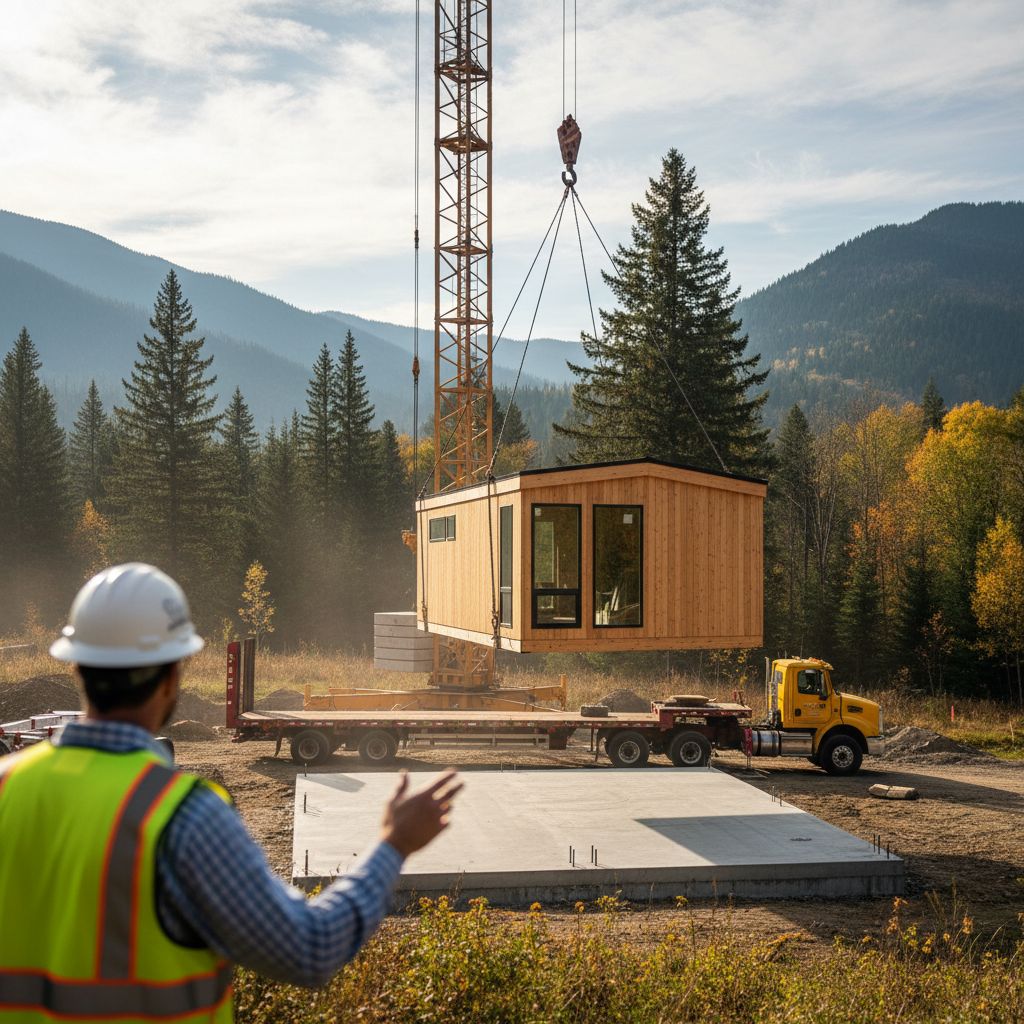
The set crew arrives the same day as the modules. A crane lifts each module onto the prepared foundation, the crew bolts the modules together ("marrying" them), and the home is "buttoned up" — meaning the roof seams are sealed, the siding gaps are closed, and the interior connection points (drywall, flooring transitions, plumbing crossovers) are finished by the set crew or a follow-on local trade.
A typical two-module ranch is craned, set, and dried-in within one to three days. A larger multi-module two-story might take a week.
Finish-Out On Site
After set, the local builder or general contractor completes the finish work. This usually includes the foundation tie-in, exterior porches and decks, garage construction (most factories don't ship garages — they're stick-built on site), final utility connections (water, sewer or septic, electric, gas), interior touch-ups at the marriage walls, final flooring transitions, HVAC commissioning, and the punch list.
Finish-out typically takes 4–10 weeks after set. The full timeline from contract to certificate of occupancy is usually 4–9 months — faster than stick-built (which often runs 9–18 months in current market conditions), and the timeline is more predictable because weather doesn't delay the factory portion.
Real Cost Ranges
Modular pricing is best understood in three layers: the module, the on-site work, and the land/site prep.
Module cost. $80–$180 per square foot, factory floor, depending on builder, finish level, and complexity. A production-grade ranch from a Midwest factory might come in at $95–$120 per square foot. A high-design modern modular from Plant Prefab, Dvele, Method Homes, or Connect Homes typically runs $200–$350+ per square foot at the factory level.
On-site work. Transportation, crane and set crew, foundation, marriage work, exterior finishes, garage, deck, utility connections, finish trades. Budget $40–$120 per square foot depending on region and scope.
Land and site prep. Wildly variable. A developed urban lot with utilities at the property line might add $50K–$300K+ for the land plus $15K–$40K for site prep. Rural raw land might be cheaper for the dirt but expensive for the site work (well, septic, long driveway, electric run, soil engineering).
A reasonable rule of thumb for a finished, on-foundation modular on a developed lot: $200–$350 per square foot all-in for mid-range builds, and $350–$600+ for high-design custom builds. A 1,800 sq ft modular landed, finished, and ready to move into is typically $360K–$630K depending on market and builder.
Major Builders Worth Knowing
The modular market has regional production builders, national premium brands, and specialist factories. A short list of names a buyer is likely to encounter:
Plant Prefab — premium modular and panelized, sustainability-focused, west coast-strong.
Dvele — high-performance net-zero modular, factory in California and Idaho.
Method Homes — Pacific Northwest premium modular, architect-collaborative.
Connect Homes — modern modular shipped flat-pack-style in container-sized modules, west coast and beyond.
Champion Homes — large national producer, broad modular and manufactured lineup, strong dealer network.
Cavco Industries — large national producer, multiple regional factories, modular and HUD product.
Skyline Homes — long-established national producer, strong in mid-market modular and HUD.
Clayton Homes — primarily HUD-code manufactured but with modular product lines through subsidiaries.
The right builder depends on geography. Modular is a freight-cost-sensitive business, and the factories closest to your site usually offer the best dollar-per-square-foot.
Financing Reality
Modular finances through a construction-to-permanent loan from a regional bank, credit union, or specialty lender. The bank funds the build in draws (deposit, factory build, transportation/set, finish-out, certificate of occupancy), then the loan converts to a conventional 30-year mortgage at completion. Both Fannie Mae and Freddie Mac buy modular mortgages on the secondary market under the same guidelines as site-built — no special program required.
The credit and income requirements are conventional. The appraisal at completion treats the home as site-built for comp purposes. The title is real-property.
The buyer needs land (or a contract for land) to start the loan process. Most lenders will not finance a modular as personal property — that's the HUD/manufactured chattel path, which is a different category.
When Modular Is the Right Call
A buyer who wants a real, financeable, code-compliant house with faster build time and tighter quality control than stick-built. A buyer who values factory precision and a predictable timeline. A buyer in a region where stick-built labor is expensive, weather-delayed, or simply unavailable. A buyer who wants modern architecture at production speed.
When It Isn't
A buyer who needs a sub-$100K finished home — that's manufactured (HUD), not modular. A buyer on a remote site without crane access or road width for module delivery. A buyer who wants extreme custom geometry (curved walls, vaulted spaces that don't fit module dimensions) — that's site-built or panelized. A buyer who doesn't yet have land and isn't ready to commit to a site.
The PERCH View
PERCH lists verified US modular and manufactured builders so buyers can compare real specs, real timelines, and real prices side by side instead of clicking through twelve builder websites with twelve different marketing flows. If you're shopping modular seriously — primary home, second home, or ADU — the right next step is to lock in your land or financing path first, then narrow to the two or three factories closest to your site.
Data Sources & Further Reading
The specifics in this guide reference the following authoritative sources — check them directly for the current numbers, program rules, and code text before finalizing a purchase or build decision:
- HUD manufactured-home construction standards (24 CFR Part 3280)
- Fannie Mae MH Advantage
- U.S. Census Bureau — Housing Vacancies and Homeownership
For federal manufactured-housing dispute and repair resources, see HUD's Manufactured Home Dispute Resolution Program. For financing standards on factory-built product, Fannie Mae MH Advantage and Freddie Mac CHOICEHome set the terms most lenders reference.
Join the conversation
Comments
Reader questions get answered. Real names and a working email — that's it.