Guides
Modular Box Homes: The 2026 Guide to the Architectural Style, the Best Builders, and the Real Cost
On this page
"Box homes" is one of those terms that means three different things to three different buyers. To one person, it's a shipping container conversion. To another, it's an under-$20,000 Amazon kit. To the buyer this guide is written for, it's the modernist architectural style — the clean, cube-volume, flat-roofed, big-window modular homes that look like they belong in a Dwell feature and increasingly do. That's the category we're going to unpack.
This is the version of the guide that doesn't pretend the price gap between modernist modular and a base-model HUD-tagged manufactured isn't real. It is real, and it's worth understanding why, what you're buying when you pay for it, and whether the math works for the way you actually want to live. PERCH is a marketplace where US builders list real homes. We don't manufacture and we have no preferred builder. What follows is the honest read.
What a Box Home Actually Is in the Modular World
Architecturally, a box home is a modular home whose volumes read as rectangular prisms. Flat or low-slope roofs, large glazed openings, minimal eaves, exterior cladding in long planes (often cedar, charred timber, fiber cement, or metal), and a deliberate suppression of the gabled, eaved, traditional residential vocabulary. The home is a series of clean rectangular boxes — sometimes one, sometimes stacked, sometimes arranged in an L or T.
The category is modernist by design intent. It draws on the same architectural vocabulary that runs from the Case Study Houses of mid-century California through Glenn Murcutt and contemporary Scandinavian residential work. When done well, a modular box home is genuine architecture delivered through a factory production process. When done poorly, it's a beige rectangle with a flat roof.
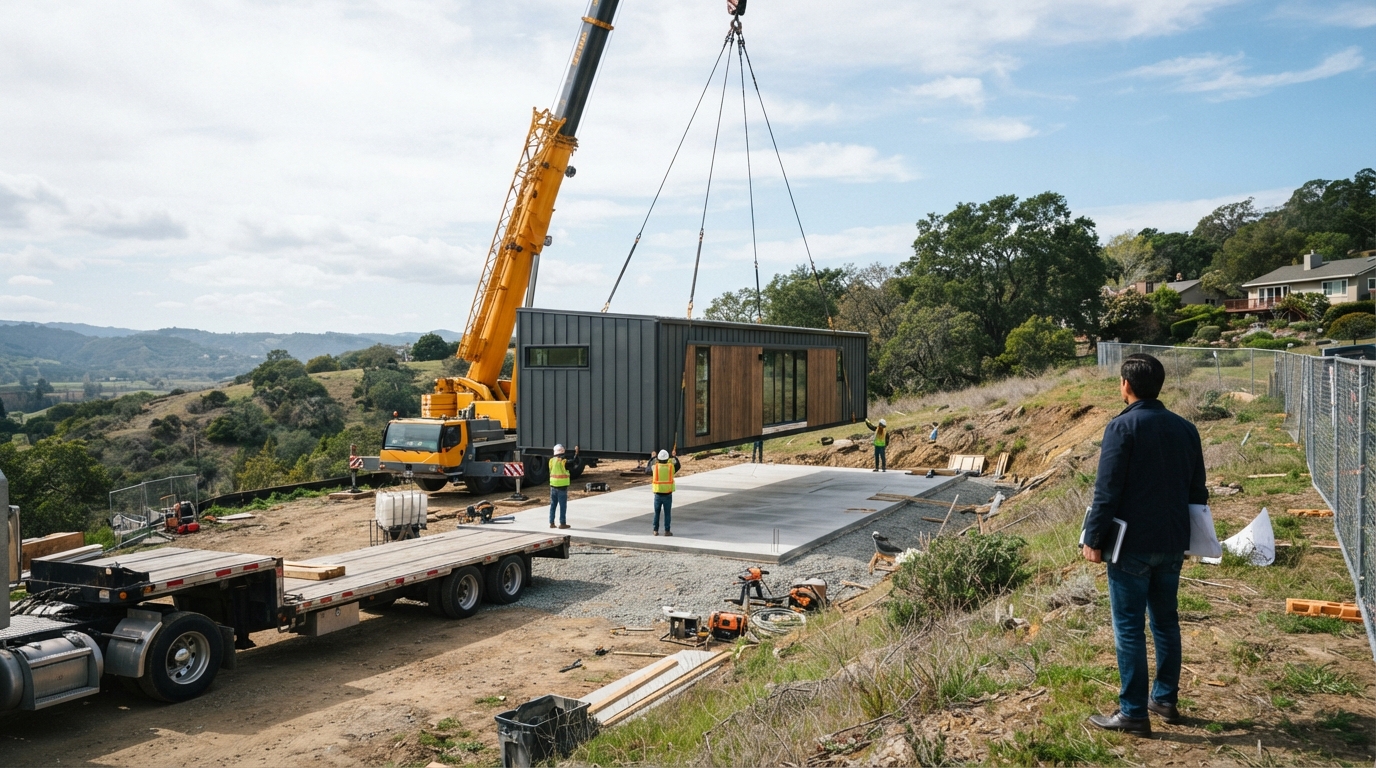
Importantly: a modular box home is not a container home. Container homes are conversions of ISO shipping containers. Modular box homes are purpose-built factory modules engineered for residential use, certified under state modular code, and delivered to site by truck. The two categories share an aesthetic. They do not share construction, code path, financing, or longevity.
The Builders Worth Knowing
This is a category where a handful of US builders have done most of the serious design and production work. The names that matter for any buyer researching the modernist end of modular:
Plant Prefab in California runs a multi-line factory with an explicit focus on architect-designed modular homes. Their LivingHomes platform includes work with name architects and the price point reflects it — typically $400 to $700 per square foot delivered, depending on configuration.
Method Homes in Washington has been one of the longest-running modernist modular factories in the Pacific Northwest. The Method catalog covers cabin-scale to multi-thousand-square-foot homes, with strong performance specs and a clear box-architecture vocabulary.
Dvele builds high-performance modernist homes with heavy emphasis on building science, air quality, and energy performance. Pricing is at the premium end of the category. Their modules read as clean, glazed boxes, and the technical specifications behind the cladding are unusually deep for the modular industry.
Connect Homes out of Los Angeles built their reputation on a steel-frame modular system that ships in container-sized modules and stacks or arranges on site. Architecturally, Connect homes are the cleanest box vocabulary in the US modular market.
Abodu focuses on backyard ADUs in California with a modernist sensibility. Smaller footprints, fixed catalog, but the aesthetic and the certification path are both clean.
Cover, also California-based, applied a software-and-design-first model to backyard studios and small homes with a strong modernist box aesthetic.
There are good builders we're leaving out for length. The pattern across all of them is consistent: real factories, real certifications, real architects, and pricing that reflects all three.
Why the Modernist Box Costs More Than the Base Modular
Modernist architecture is harder to build well than traditional residential. That's the unromantic version. Three specific costs drive the premium.
Glazing area is much higher. A box home's defining feature is its windows — large, often floor-to-ceiling, frequently corner-mounted, sometimes full-wall sliding doors. Premium glazing units run $80 to $250 per square foot installed, against $40 to $80 for conventional residential windows. A box home with 30% of its wall area in glazing is paying real money for that aesthetic.
Flat and low-slope roofs are unforgiving. A traditional pitched roof sheds water with gravity and survives mediocre flashing. A flat roof on a modernist box requires premium membrane (TPO, EPDM, or PVC), perfect drainage design, careful parapet detailing, and ongoing maintenance. The roof cost per square foot is often double a conventional pitched roof, and the consequences of cutting corners are more severe.
Long uninterrupted wall planes show every flaw. A board-and-batten cottage hides imperfection in its trim and articulation. A box home with a 40-foot cedar plane has nowhere to hide a misaligned panel or a sloppy reveal. Factory precision and on-site finishing both have to be tighter, and tighter costs more.
The result: a box home from a quality builder in the modernist category typically runs $350 to $700 per square foot delivered and finished, against $120 to $250 for a comparable size site-built traditional home and $80 to $180 for a HUD-tagged manufactured single-section.
The Code Path Is Straightforward — Which Matters
Almost every serious modular box builder in the US works under state modular code. That means the factory holds the third-party agency certification, the unit ships with the state modular insignia, and the home is legally a piece of real property attached to your land. This is the same certification framework that governs the broader US modular industry — well-developed, lender-recognized, insurer-recognized.
The practical effect: financing is conventional. A construction-to-permanent loan from a local credit union or community bank treats a state-modular box home essentially the same as a site-built home. Insurance is a standard homeowner's policy. Resale comps exist. The home appraises against neighboring real property, not against a chattel manufactured-home register.
This is the single largest distinction between modernist modular and the imported expandable category. The modernist box costs more, but the certification is real and the financial life of the home behaves like a real home.
Where Box Homes Make Sense
The architectural style suits some sites and some buyers better than others.
Sites with views or strong landscape context. The whole point of the glazing-forward box vocabulary is to dissolve the wall between interior and landscape. Put one on a wooded lot, a hillside, a waterfront, or open desert and the architecture earns its premium. Put one on a 40-foot suburban tract lot facing a neighbor's siding and the design fights its context.
Buyers who would otherwise hire an architect for a custom build. If you're already in the conversation about a $700,000 custom home on a designed lot, a modular box from Plant Prefab or Method comes in at a similar quality with shorter schedule and tighter cost certainty. That comparison is where the category really shines.
ADU and accessory builds in design-conscious markets. California ADUs, Pacific Northwest guest suites, Colorado mountain retreats — all natural homes for the box vocabulary from Abodu, Cover, or the smaller catalog lines of the bigger builders.
Where the Style Fights You
Tight urban infill where the architecture won't be visible. You're paying for an exterior aesthetic. If it's hidden behind a fence or a setback, the math gets harder.
Cold climates without serious building-science discipline. Big glazing is a thermal penalty in zone 5+. The premium builders engineer around it. Cheaper interpretations of the style don't.
Markets where the modernist aesthetic depresses resale. Most of urban California, the Pacific Northwest, parts of Colorado, Austin, and increasingly Atlanta and Nashville reward the style at resale. Many other markets do not, and the modernist box can sell at a discount in neighborhoods where buyers expected gables.
What the Right Builder Conversation Looks Like
Ask any modular box builder these questions and the answers will sort the serious factories from the mediocre ones:
- Which state modular agency certifies your units, and can you provide the insignia number?
- What's the glazing spec — U-value, SHGC, frame material?
- What's the roof assembly, the membrane manufacturer, and the warranty?
- What's your site-prep and foundation guidance, and do you provide stamped drawings?
- What's the lead time from contract signing to delivery?
- Can I walk a completed unit within driving distance?
The answers will be specific or they will be evasive. There's no middle.
The Honest Comparison Table
| Factor | Modernist modular box | Traditional modular | HUD manufactured | Container conversion |
|---|---|---|---|---|
| Typical delivered cost | $350-$700/sqft | $150-$300/sqft | $80-$180/sqft | $200-$500/sqft |
| Certification | State modular | State modular | HUD tag | Case-by-case |
| Financing | Conventional | Conventional | Chattel or real | Often cash |
| Insurance | Standard dwelling | Standard dwelling | Standard dwelling | Limited |
| Resale | Real property comps | Real property comps | Manufactured register | Limited market |
| Architecture grade | High | Standard residential | Standard residential | Variable |
The PERCH Take
A modular box from Plant Prefab, Method, Dvele, Connect, Abodu, or Cover is genuine architecture delivered through a factory. If your site, your taste, and your budget all point that direction, it's an honest answer to the question of how to build a beautiful small home without a 14-month custom timeline. PERCH lists US-built modular and manufactured homes from verified builders across the price spectrum. Worth a look before you commit to any single factory.
Data Sources & Further Reading
The specifics in this guide reference the following authoritative sources — check them directly for the current numbers, program rules, and code text before finalizing a purchase or build decision:
- HUD manufactured-home construction standards (24 CFR Part 3280)
- International Code Council (IRC/IBC)
- Fannie Mae MH Advantage
For federal manufactured-housing dispute and repair resources, see HUD's Manufactured Home Dispute Resolution Program. For financing standards on factory-built product, Fannie Mae MH Advantage and Freddie Mac CHOICEHome set the terms most lenders reference.
Join the conversation
Comments
Reader questions get answered. Real names and a working email — that's it.