Guides
How Many Tiny Homes Fit on an Acre?
On this page
Math you can walk around, if the zoning cooperates.
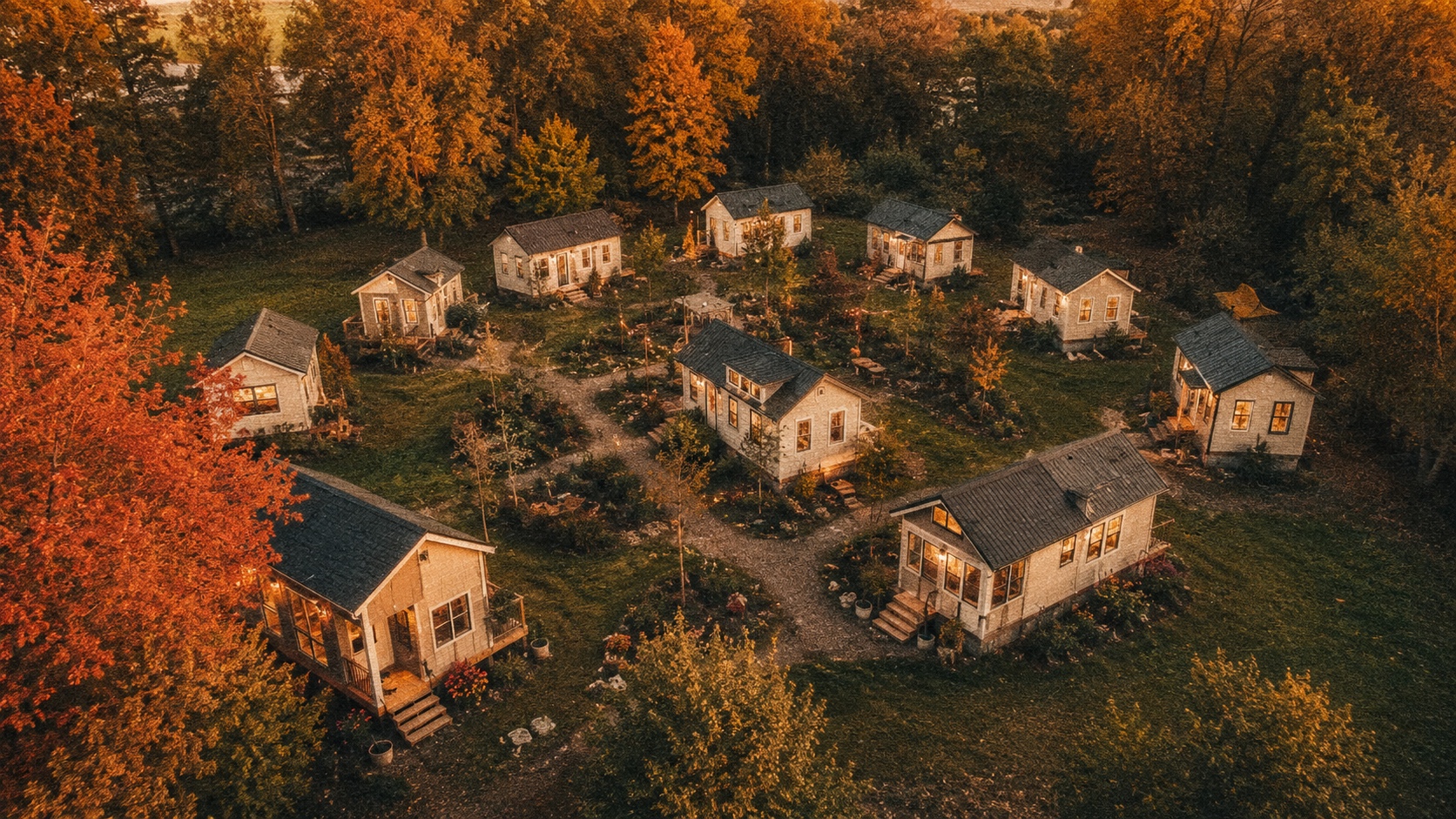
An acre is 43,560 square feet. A well-designed tiny home village fits a lot more houses than most buyers guess. The constraint is almost never the geometry. It's the local ordinance.
Why this matters right now
Tiny home village development grew 34% in 2024 per American Tiny House Association, driven by cities like Austin, Portland, and Nashville explicitly rewriting code to allow higher-density tiny living. ICMA (International City/County Management Association) tracked 42 US cities that adopted tiny-home-specific density rules between 2020 and 2024 — most raising the allowable count from 1-2 per acre to 6-12 per acre.
The layout — geometry vs. zoning
Pure geometry (unrestricted acre, 400 sq ft tiny homes):
- 43,560 sq ft ÷ 400 sq ft = 108 homes if buildings only
- After 12-ft-wide driveways, 6-ft setbacks per home, utility corridors: ~25-30 homes
- After 20% common space (paths, garden, mailbox area): ~20-25 homes
Typical US zoning restrictions:
- Standard single-family zone: 1 primary + 1 ADU = 2 tiny homes per acre
- ADU-permissive residential: 1 primary + 2 ADUs = 3 tiny homes per acre (California SB 9)
- Manufactured home park: 6-12 tiny homes per acre (per park density rules)
- Tiny-home-village overlay zone (Austin, Portland, etc.): 8-15 tiny homes per acre
Working reality by lot size:
- 5,000 sq ft lot: 1 tiny home + garage typically
- 10,000 sq ft lot: 1-2 tiny homes
- ¼ acre (10,890 sq ft): 2-3 tiny homes typically
- ½ acre (21,780 sq ft): 4-6 tiny homes
- 1 acre: 8-12 tiny homes in permissive jurisdictions
Zoning — the constraints that matter more than math
Minimum lot size per dwelling. Standard residential zones require 5,000-8,000 sq ft per home. That caps 1 acre at 5-8 dwellings before setbacks.
Setbacks. Typical requirements: 20 ft front, 5 ft side, 10 ft rear. On a small tiny home footprint, setbacks eat 30-50% of usable land.
Off-street parking. Most jurisdictions require 1-2 parking spaces per dwelling. At 200 sq ft per parking space, this cuts density meaningfully.
Density caps. Some jurisdictions cap total dwellings per acre regardless of lot size math.
Utility hookup requirements. Cities require permanent water, sewer, electric per unit. Site infrastructure cost per unit averages $8K-$18K in urban tiny home villages.
Two operational US tiny home villages in 2026: Village Farm Austin — 200 units on ~20 acres in Austin TX, purpose-built tiny home community. Tiny Estates — ~60 units on 12 acres in Elizabethtown PA, first tiny house village in Pennsylvania.
Financing math for a tiny home village developer
$3M land purchase for 10 acres in a tiny-home-permitted jurisdiction. 80 tiny homes at 8/acre density. Per-unit cost: $85K (structure + site infrastructure + permitting). Total build cost: $6.8M. Total project: $9.8M. Rental income at $1,400/month per unit × 80 = $112K/month = $1.34M/year gross. Cap rate ~11-13% before operating costs.
Choose to develop a village if...
- Your jurisdiction has a tiny-home-village overlay zone
- Land under $150K/acre available in permitted areas
- Capital available for site infrastructure ($8K-$18K per unit)
- Long-term rental hold expected (7+ years)
Choose single-lot ADU if...
- You already own a residential lot
- One or two additional tiny homes as ADUs is the play
- HELOC or HomeStyle Renovation available for financing
- Family use or single-tenant rental preferred
The quiet part.
Tiny home villages are the answer to America's housing affordability crisis nobody wants to zone for. The math works. The financing works. The buyer demand is proven. What doesn't work is city councils that hear "tiny home village" and picture 1970s trailer parks.
The cities that have said yes (Austin, Portland, Nashville) are seeing 8-15% cap rates on village developments and 95%+ occupancy at $1,200-$1,800/month rents. That's institutional-real-estate territory hidden inside residential zoning.
If your city permits it, an acre can hold 8-15 tiny homes and cash-flow like an apartment building. If your city doesn't, an acre holds 1-3 tiny homes and works like an ADU + primary.
Related guides
- Tiny Home Affordable Housing Solution — the macro affordability angle
- Tiny Home vs. Park Model Comparison (2026) — village-friendly categories
- ADU vs. Tiny Home Comparison (2026) — single-lot alternative
Join the conversation
Comments
Reader questions get answered. Real names and a working email — that's it.