Guides
Pros and Cons of Modular Homes in 2026 — The Honest Decision List
Twelve pros and ten cons of modular homes, calibrated for a buyer or owner deciding whether the category actually fits. The neutral decision framework.
On this page
The neutral side-by-side of what modular homes get right and what they get wrong, calibrated for a buyer or owner deciding whether the category actually fits.
Modular homes have quiet advantages the marketing rarely leads with — factory build quality, faster total project timelines, and appreciation behavior comparable to site-built — and specific disadvantages that catch first-time buyers if they are not surfaced early. This is the honest list. Twelve pros, ten cons, and the framework for deciding which category the reader in front of the question actually belongs in.
The short version
- Modular homes are built to residential code — same as site-built, unlike manufactured homes which follow HUD Code
- Factory build cuts weeks off the total project timeline — typically 3-6 months total vs 8-12 months for comparable site-built
- Cost is 10-20% less than site-built for a comparable finished home, though the gap has narrowed since 2020
- Appreciation on owned land with a permanent foundation typically matches site-built in the same market
- The two most common surprises — the true all-in cost including site work, and the buyer pool is local (moving a modular home is expensive)
The pros of modular homes
1. Factory build quality
Modular homes are built indoors in a controlled factory environment. Weather delays do not affect the build. Framing, insulation, plumbing, and electrical work happen with the sections upright but protected. Quality control is often better than site-built because the work is done in a repeatable factory environment with dedicated inspectors on the floor.
2. Speed of total project timeline
Factory build runs 4-12 weeks. Foundation and site prep happen in parallel with the factory build. Delivery, set, and finishing add 4-8 weeks after delivery. Total project time is typically 3-6 months.
Comparable site-built construction runs 8-12 months in most U.S. markets, primarily because weather, subcontractor scheduling, and material delivery all add sequential delays that modular avoids.
3. Cost advantage over site-built
Modular homes typically cost 10-20% less than comparable site-built homes when accounting for total all-in cost. On a $300,000 site-built home, that is $30,000-$60,000 in savings.
The gap has narrowed since 2020 as construction costs rose across all categories. It remains real for standard-configuration builds.
4. Same building code as site-built
Modular homes are built to the state and local residential building code that applies at the delivery location — the exact same code as site-built. This drives two consequences: modular homes appraise like site-built and are permitted through the same building department.
5. Conventional mortgage financing
Modular homes on permanent foundations on owned land qualify for conventional mortgages, FHA, VA, and USDA loans. Same lender pool as site-built. Rates match site-built rates.
6. Appreciation comparable to site-built
On owned land with a permanent foundation, modular homes typically appreciate at rates comparable to site-built homes in the same market. Fifteen years in, a modular home in a healthy market is often worth 30%-60% more than the original all-in cost.
7. Predictable total cost
Because most of the build happens in a factory with fixed pricing, modular home budgets are more predictable than site-built. Site work, foundation, and utility connections remain variable, but the structure cost is set at contract signing.
8. Energy efficiency at reasonable cost
Modular homes ship with insulation packages installed by the factory. Upgrading to high-R insulation, tight air sealing, and energy-efficient windows adds less to the total cost than the equivalent upgrade on a site-built home.
9. Foundation flexibility
Modular homes can be installed on slab, crawl space, or full basement foundations. This is more flexible than manufactured homes and matches site-built.
10. Design flexibility within the modular grid
Modern modular manufacturers offer custom layouts within the constraints of the factory's transportation dimensions. Cathedral ceilings, upgraded finishes, and complex multi-section floor plans are all possible.
11. Faster path to occupancy
Total project time of 3-6 months means the buyer can move in faster and stop paying rent or a construction loan payment sooner. On a 12-month timeline difference vs site-built, that is 6-9 months of avoided housing costs.
12. Resale market maturity
The modular home resale market has matured. Real estate agents in modular-active markets understand the category. Local MLS listings for used modular homes clear at prices comparable to site-built comparables when the home is on a permanent foundation on owned land. See the used modular homes for sale guide for pricing detail.
The cons of modular homes
1. Higher all-in cost than manufactured homes
Modular is cheaper than site-built but 50%-80% more expensive than manufactured. A comparable 1,600 sqft modular home all-in runs $200,000-$320,000 vs $95,000-$180,000 for manufactured. For buyers priced out of modular, manufactured may be the answer.
2. Delivery logistics
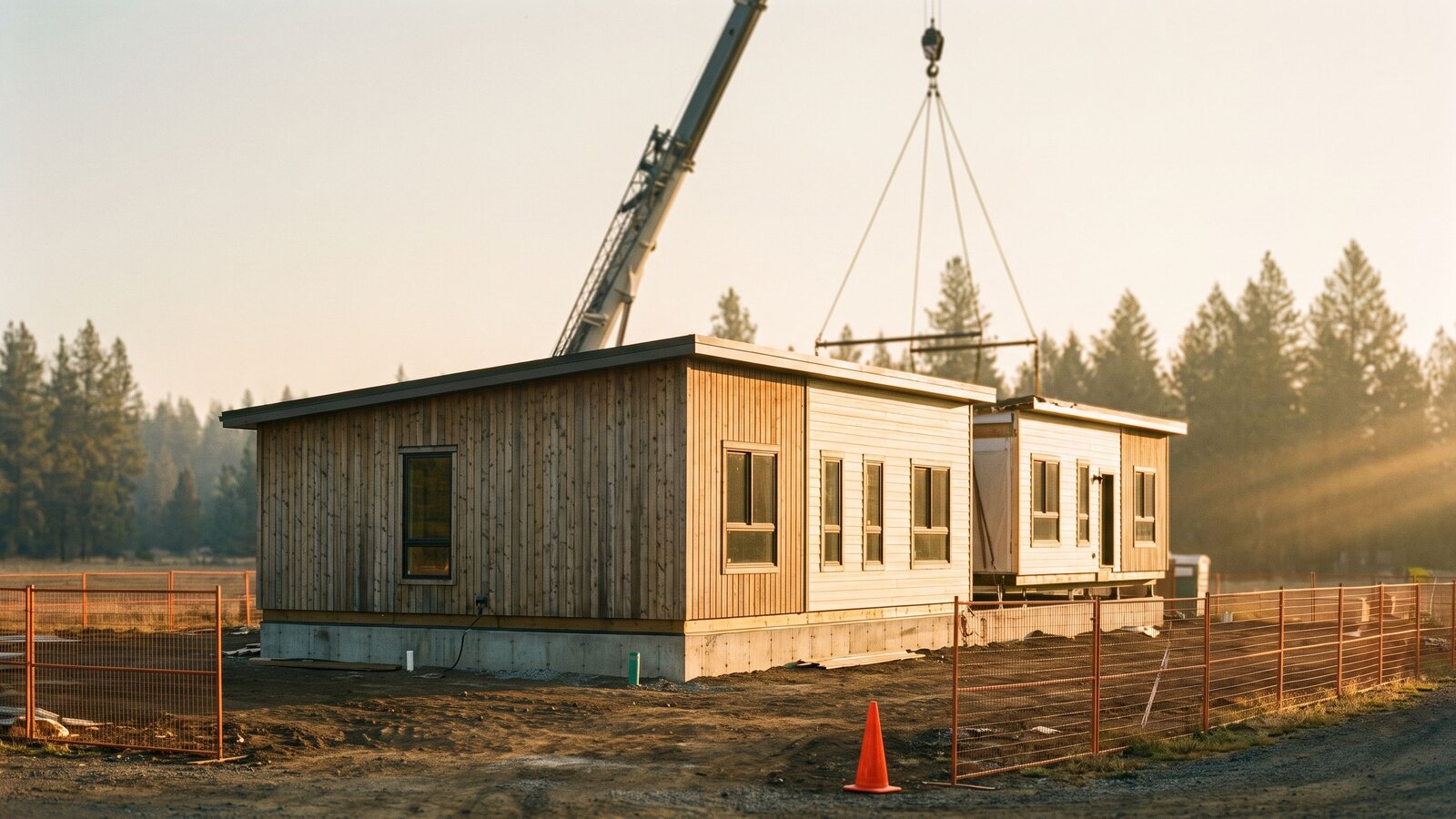
Delivering multi-section modular homes requires clear road access, adequate turning radius, and often crane placement. Rural lots with narrow drives, dense tree cover, or long distances from the road can add $5,000-$20,000 to delivery costs or require pre-delivery site improvements.
3. Foundation cost is not included in the base price
The base structure price is delivered but not sited. The foundation adds $18,000-$80,000+ depending on type. Buyers who see the base price and assume that is the total cost get an unpleasant surprise.
4. Site work is variable and often underestimated
Utility connections, site prep, driveway, permits, and impact fees typically add $30,000-$80,000 on top of the base structure. Rural sites with long utility runs run at the high end.
5. Design constrained to transportation dimensions
Modular home sections must fit on a delivery truck. Section widths are typically 14-16 feet maximum. Complex multi-section layouts are possible but constrained. Truly custom architectural forms — curves, unusual roof lines, cantilevered structures — are difficult or impossible.
6. Local buyer pool for resale
Modular homes are effectively immovable once installed. Disassembly and relocation costs $15,000-$40,000+ and destination lots require re-permitting. The resale buyer pool is local (typically within a two-county radius). This is different from manufactured homes on single-wide chassis, which reach a national buyer pool.
7. Limited manufacturer choice in some regions
The Northeast and West Coast have fewer modular manufacturers than the Southeast and Midwest. Buyers in those regions have narrower product selection and often longer delivery distances.
8. Permit variance by county
Modular homes are legal in every U.S. county, but permit timelines and requirements vary. Some counties process modular permits routinely. Others require additional plan review that adds weeks to the timeline. Confirm before ordering.
9. Common lender misconceptions
Some conventional mortgage lenders still confuse modular with manufactured. Buyers occasionally have to educate their loan officer or shop for a lender familiar with modular. Once past the initial confusion, the loan process runs the same as site-built.
10. Not always cheaper than expected
The 10%-20% cost advantage over site-built is real, but it applies to standard configurations. Premium modular builds with high-end finishes and complex layouts can approach site-built pricing.
The decision framework
Three questions to determine whether modular fits:
1. Is the buyer pre-approved for conventional mortgage financing on the total all-in cost?
Yes → modular is a natural fit No → manufactured may be the better path
2. Is the destination lot on owned land with clear road access and utility availability?
Yes → modular installs smoothly No (rural, off-grid, narrow access) → confirm delivery and setup costs before committing
3. Is the intended hold period 5+ years, with a plan to eventually sell in the local market?
Yes → modular's appreciation behavior favors this No (shorter hold, potential relocation) → manufactured with its more portable configurations may fit better
Modular vs manufactured — the honest choice
For buyers between the two categories, the modular vs manufactured comparison guide covers the specific differences in code, financing, appraisal, and appreciation. The short summary: modular is closer to site-built in every dimension except price. Manufactured is more affordable, more portable, and follows different rules.
The right pick depends on total budget, financing, land status, and long-term hold intent.
What buyers routinely miss about modular homes
Three items that catch first-time modular buyers:
Total all-in cost. The base structure is often 55%-65% of the total all-in. Buyers who budget only the structure get surprised at foundation, utility, and permit costs.
Foundation is the biggest add-on variable. Slab is cheapest, full basement is most expensive. Cold-climate states with deep frost lines run to the upper end.
Impact fees vary widely by county. Some jurisdictions charge $10,000+ for a new residential unit as a school and infrastructure fee. Confirm with the county before signing.
The Consumer Financial Protection Bureau publishes guidance on financing factory-built homes including modular.
What PERCH does for modular home buyers and sellers
PERCH is the marketplace for modular, manufactured, container, tiny, and small-format homes — the ones the industry stopped counting. Buyers see verified modular listings routed by category, size, price, and region. Sellers get their listing routed to pre-qualified local buyers, licensed escrow settlement in all fifty states, and a notarizable bill of sale and purchase agreement template calibrated to the seller's state.
Listing is free right now.
Or get the Seller's Field Guide — free PDF, twenty pages, everything you need to price and list. Send me the guide →
Sources
- U.S. Department of Housing and Urban Development, Manufactured Housing Programs
- Consumer Financial Protection Bureau — Manufactured Home Loans guidance
- Manufactured Housing Institute — market data and state fact sheets
- Rocket Mortgage — Modular Home Financing overview
- National Association of Home Builders — factory-built housing standards
Related on PERCH
- Modular Home Prices in 2026
- Modular Homes vs Manufactured Homes
- Used Modular Homes for Sale
- Prefab Homes in 2026
- Sell a Manufactured Home Without Losing 20-40% to a Cash Buyer
Join the conversation
Comments
Reader questions get answered. Real names and a working email — that's it.