Guides
Modular Homes vs Manufactured Homes 2026 — The Decision Framework Every Buyer and Seller Needs
The honest side-by-side comparison of modular and manufactured homes — code, financing, appraisal, cost, appreciation, and how to pick the right category.
On this page
The honest side-by-side comparison. What actually differs, what does not, and how to pick the right category for your budget, financing, and long-term hold intent.
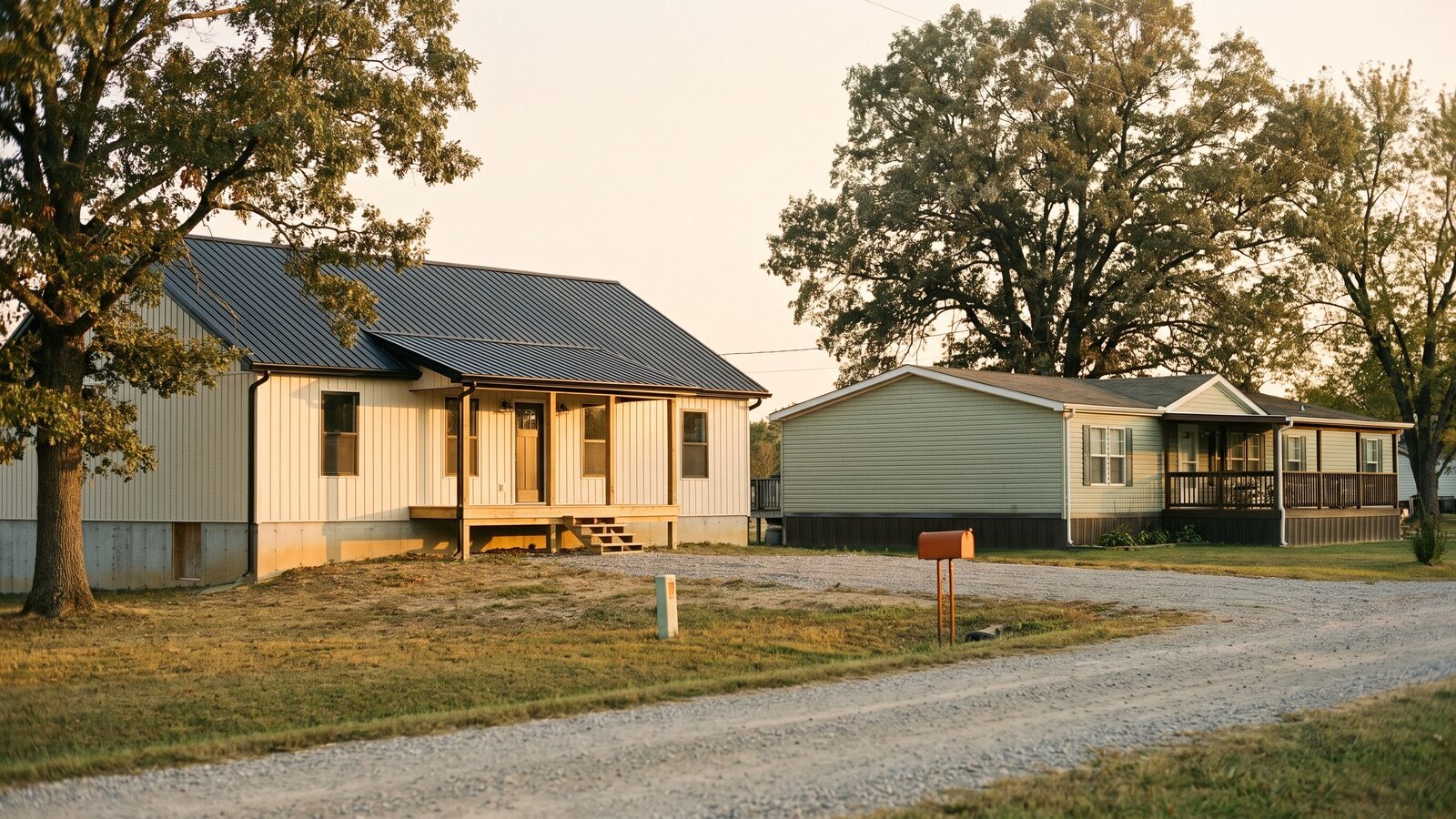
Modular homes and manufactured homes are both factory-built, but they are built to different codes, financed through different lenders, appraised through different methods, and typically appreciate at different rates. Modular homes are built to state and local residential building codes — the same codes as site-built homes — and permanently affixed to a foundation. Manufactured homes are built to HUD Code, a federal standard, and delivered on a permanent steel chassis. The two categories look similar from the outside and behave very differently on paper.
This is the neutral side-by-side view. What is the same. What is different. And which category actually fits the buyer or seller in front of the question.
The short version
- Modular homes are built to state residential code, permanently affixed to a foundation, and appraise like site-built homes.
- Manufactured homes are built to HUD Code (federal), delivered on a permanent chassis, and appraise separately using manufactured-housing methodology.
- Modular is more expensive — typically $50-$160 per square foot base — but qualifies for conventional mortgages and appreciates like site-built.
- Manufactured is more affordable — typically $40-$80 per square foot base — but usually finances through specialty lenders and depreciates in book value.
- The right pick depends on financing, land status, appraisal goals, and long-term hold intent.
The building code difference
The single most important distinction between the two categories:
Modular homes are built to the state and local residential building code that applies at the delivery location. A modular home delivered to Vermont is built to Vermont's residential code. A modular home delivered to Texas is built to Texas's residential code. The factory builds the home in sections and delivers it — but the code compliance is identical to a site-built home at the same location.
Manufactured homes are built to HUD Code — the federal Manufactured Home Construction and Safety Standards adopted in 1976. HUD Code is a single national standard. A manufactured home built in Alabama and delivered to Oregon meets the same HUD Code as one delivered to Alabama. The U.S. Department of Housing and Urban Development's manufactured housing program publishes and maintains the code.
Why this matters: local jurisdictions treat the two categories differently because the codes are different. A modular home is treated as a residential structure and permitted through the local building department the same as a site-built home. A manufactured home is treated as a HUD-certified factory-built structure and often permitted through a separate state manufactured housing office.
Delivery and foundation
Modular homes are delivered in one to five sections without a permanent chassis. The sections are lifted from the delivery truck by crane, placed on a permanent foundation (slab, crawl space, or full basement), and joined together at the site. A finished modular home is indistinguishable from a site-built home from the outside once the modular joint seams and roof cap are finished.
Manufactured homes are delivered on a permanent steel chassis with axles. The chassis remains with the home permanently — it does not get removed after placement. Manufactured homes can be installed on piers, a slab, or a permanent foundation with skirting or block enclosure below.
Foundation types drive meaningful cost differences:
- Slab (either category): $8,000-$18,000
- Crawl space (either category): $15,000-$30,000
- Full basement (modular typically, rare for manufactured): $30,000-$80,000+
The modular home almost always has a permanent full-perimeter foundation. The manufactured home has more foundation flexibility, with piers-and-skirting the most common installation on private land.
Financing — where the two categories diverge sharply
Modular homes on a permanent foundation on owned land, titled as real property:
- Conventional mortgage (30-year fixed)
- FHA, VA, USDA loans all apply
- Construction-to-permanent loans available from most regional banks
- Rates match site-built home financing
Manufactured homes on a permanent foundation on owned land, titled as real property:
- Conventional mortgage available but not guaranteed by every lender
- FHA Title II applies (permanent foundation required)
- Specialty lenders — 21st Mortgage, Triad, Cascade, Vanderbilt — are the more common financing route
Manufactured homes on leased land in a park:
- Specialty lenders only
- FHA Title I loans available (personal property financing)
- Rates typically 100-300 basis points above conventional mortgage rates
The Consumer Financial Protection Bureau's manufactured home loan guidance walks through the specific loan types and applicable protections for each category.
Appraisal — the appreciation reality
The single most misunderstood difference between the two categories:
Modular homes on owned land with a permanent foundation appraise at parity with comparable site-built homes in the same market. The appraiser uses the same methodology — comparable sales, replacement cost, income approach — that would apply to a site-built home. In healthy markets, a modular home built in 2020 for $250,000 is often worth $300,000-$350,000 in 2026.
Manufactured homes appraise using a separate methodology, primarily the NADA Manufactured Housing Appraisal Guide. NADA calculates a base retail value from make, model, year, size, and regional multipliers, then adjusts for condition and add-ons. The book value depreciates over time, similar to (but slower than) a vehicle. A manufactured home built in 2020 for $110,000 often has a NADA book value of $85,000-$95,000 in 2026 — before local market adjustments.
The land changes the arithmetic. A manufactured home on owned land in an appreciating real-estate market often gains total-value even as the structure book value depreciates, because the land carries the appreciation. On a leased lot, there is no land appreciation to offset the structure depreciation.
For long-term hold and resale, the modular home is closer to a site-built home in appreciation behavior. The manufactured home is more like a durable goods purchase with land as the appreciating component (when the land is owned).
Cost — the honest comparison
Base structure cost, delivered but not sited, for a standard 1,600-1,800 square foot home in 2026:
| Cost element | Modular | Manufactured |
|---|---|---|
| Base structure | $80,000-$200,000 | $60,000-$140,000 |
| Delivery and set | $15,000-$25,000 | $6,000-$18,000 |
| Foundation | $18,000-$80,000+ | $10,000-$40,000 |
| Utility connections | $10,000-$40,000 | $8,000-$30,000 |
| Permits and impact fees | $3,000-$15,000 | $2,000-$12,000 |
| Site preparation | $5,000-$25,000 | $4,000-$18,000 |
| Total all-in (typical) | $200,000-$320,000 | $95,000-$200,000 |
The gap is meaningful — the modular home typically costs 50-80% more all-in for a comparable square footage. What the buyer gains in return: conventional mortgage financing, site-built appraisal parity, and appreciation behavior closer to a traditional home.
The Rocket Mortgage overview of modular home financing walks through the cost and loan-side implications.
The decision framework
The pick between modular and manufactured usually falls out cleanly when the buyer answers three questions:
1. What is the total budget including land and site work?
Under $150,000 all-in → manufactured on leased or owned rural land, or an entry-level manufactured on a permanent foundation $150,000-$220,000 all-in → mid-range manufactured on a permanent foundation on owned land, or an entry-level modular $220,000+ all-in → modular home on owned land
2. What financing is available?
Conventional mortgage pre-approval → both categories work; modular is easier Specialty lender pre-approval → both categories work; manufactured is the historically stronger fit Cash → both categories work; the buyer optimizes for total dollars
3. What is the long-term hold intent?
Live in it for the next 5-30 years, sell as real estate → modular Live in it, replace or upgrade in 10-15 years → manufactured works well Rent it as an investment property → depends on the local market; modular has broader tenant appeal in some markets
Portable vs stationary — the same rule applies to both
The same strategic reality that shapes the tiny home and container home categories applies here:
Transportable versions — single-wide manufactured homes, small park models — attract nationwide buyer pools. Delivery moves them from any factory to any destination. Sellers list nationally.
Foundation-affixed versions — modular homes, multi-section manufactured homes on permanent foundations — attract local buyer pools. Moving them costs $15,000-$40,000+ and most buyers do not do that math. Sellers list locally.
For a modular home, the buyer pool is almost always local. Pricing is set by local comps. See modular home prices for state-by-state ranges.
For a manufactured home, the buyer pool depends on transportability. Single-wides on leased lots or on wheels reach national buyers. Foundation-affixed doubles and triples sell locally. See selling a mobile home in a trailer park for the community-lot exit paths and the FSBO playbook for private-party sale mechanics.
Selling either category — the paperwork sequence
For modular homes titled as real property: standard residential real estate transaction. MLS listing, real estate agent (optional), buyer inspection, title company closing.
For modular homes titled as personal property or manufactured homes: the manufactured home sale path — bill of sale, purchase agreement, title transfer through the state manufactured housing office, licensed escrow settlement.
For any category on leased land: park approval process applies to in-place sales.
What PERCH does with both categories
PERCH is the marketplace for modular, manufactured, container, tiny, and small-format homes — the ones the industry stopped counting. Buyers see verified listings across both modular and manufactured categories, filtered by title status, land inclusion, and price. Sellers get their listing routed to pre-qualified buyers appropriate to the category and title status, licensed escrow settlement in all fifty states, and a notarizable bill of sale and purchase agreement template calibrated to the seller's state.
Listing is free right now.
Or get the Seller's Field Guide — free PDF, twenty pages, everything you need to price and list. Send me the guide →
Sources
- U.S. Department of Housing and Urban Development, Manufactured Housing Programs
- Consumer Financial Protection Bureau — Manufactured Home Loans guidance
- Manufactured Housing Institute — market data and state fact sheets
- J.D. Power NADA Manufactured Housing Appraisal Guide
- Rocket Mortgage — Modular Home Financing overview
Related on PERCH
- Modular Home Prices in 2026
- Prefab Homes in 2026
- NADA Mobile Home Value
- Sell a Manufactured Home Without Losing 20-40% to a Cash Buyer
- Bill of Sale for a Manufactured Home
Join the conversation
Comments
Reader questions get answered. Real names and a working email — that's it.