The 22M Wedge
BlackRock vs. Main Street: Why Modular Is the Category Wall Street Can't Buy
The real number is 3 to 5 percent, not 40. And the buyers are not BlackRock. Here is what Wall Street actually owns, what they could not, and why modular homes on owned land are the housing category that structurally resists consolidation.

On this page
The story that Wall Street is swallowing American housing is half true, half myth, and almost entirely missing the part that actually matters.
This article walks through what the real numbers say, names the actual buyers (it is not BlackRock), and explains the structural reasons why one specific housing category has resisted institutional consolidation almost completely — and why that resistance is itself an opportunity for the 22 million American households that live in it.
The Number Everyone Gets Wrong
If you spend any time on housing Twitter, you have seen the chart. BlackRock is buying every house in America. Forty percent of single-family homes are owned by hedge funds. Normal families cannot compete with infinite balance sheets.
The frustration is real. The number is wrong.
The Urban Institute, which tracks this carefully, places institutional ownership of single-family rentals at roughly 3 to 5 percent nationally, with large institutional owners (those holding more than 1,000 homes) representing about 2 percent of the single-family rental stock. The Joint Center for Housing Studies at Harvard pegs the same figure in a similar band. The Federal Reserve has noted that even in the metros where institutional buyers are most active, they remain a minority of total transactions.
Mom-and-pop landlords — people who own one to ten homes — still control the overwhelming majority of US single-family rentals. The picture is not "Wall Street vs. everyone." It is "everyone vs. everyone, with Wall Street getting a disproportionate amount of headline space."
This matters for two reasons. First, if you are going to fight a problem, you have to name it correctly. Second, the real story is more interesting than the viral one, because the real story tells you exactly where the wedge is.
Who Is Actually Buying
Let us name the players, because the headlines almost always pick the wrong one.
BlackRock, the asset manager most often blamed in viral posts, does not run a meaningful single-family rental portfolio. BlackRock manages funds; it does not directly own neighborhoods of houses. The conflation with Blackstone — a different firm — is one of the most durable mistakes in housing discourse.
Blackstone is the firm that mattered. It founded Invitation Homes in 2012, scooped up tens of thousands of foreclosed homes after the 2008 crash, took the company public, and has since exited the position. Invitation Homes is now publicly traded and operates independently.
The current institutional landlords, the ones still actively buying, are:
- Pretium Partners (parent of Progress Residential), the largest single-family rental operator in the US
- Tricon Residential, taken private in a recent deal that brought scrutiny back to the category
- AMH, formerly American Homes 4 Rent
- Invitation Homes, the original at-scale player
- A handful of smaller institutional buyers and build-to-rent developers
Together, these operators own somewhere between 350,000 and 450,000 homes nationally, against a total US single-family rental stock of roughly 14 to 16 million units. That is the 3 percent figure, give or take.
The concentration story is different and more troubling. In specific Sun Belt metros — Atlanta, Phoenix, Charlotte, Jacksonville, Tampa, parts of Dallas — institutional share of single-family rentals can reach 10 to 15 percent. In specific zip codes within those metros, particularly working-class subdivisions priced between $200K and $350K, the share can climb higher. That is where the local frustration is real and grounded. Nationally, the institutional footprint is narrower than headlines imply.
Why They Target What They Target
Institutional capital has a profile. It wants yield, scale, automation, title cleanliness, and underwriting fit. Stick-built single-family rentals in Sun Belt metros tick every box. The homes are fungible, the rents are growing, the title work is clean, the financing market is mature, and you can buy 500 houses in one zip code without anyone noticing until you already own them.
That is the institutional sweet spot. It is also the boundary of what institutional capital can efficiently absorb.
What Wall Street Did Buy in Factory-Built Housing
To be honest about the category, we have to be honest about where institutions did move in. They bought manufactured-home land-lease communities — also known as mobile-home parks.
Firms like Sun Communities, Equity Lifestyle Properties, and a handful of private-equity-backed roll-ups have spent the last decade consolidating park ownership. The model is structurally similar to the SFR thesis: own the land, collect monthly lot rent from residents who own their homes but cannot easily move them, raise rents annually, and benefit from a structural shortage of new parks because of zoning resistance.
The Manufactured Housing Institute tracks this segment. The National Council of State Housing Agencies has flagged it. Federal regulators, including HUD and the FTC, have opened inquiries into lot-rent practices at large park operators. The consolidation is real, the rent escalation is documented, and the residents — many of them on fixed incomes — have limited recourse because they own the home but rent the land.
This is the institutional play that worked. It worked precisely because it fits the criteria: scale, yield, automation, clean title to the land, captive tenant base.
Now look at what they could not buy.
The Category That Resists the Model
Manufactured and modular homes on owned land — meaning the homeowner owns both the home and the dirt underneath it — do not fit the institutional profile. There are roughly 22 million Americans living in factory-built housing. A meaningful share of those homes sit on land the homeowner controls. That subset is the 22M wedge.
Four structural features make it resistant to consolidation.
1. It is fragmented. The owned-land manufactured and modular market is millions of individual transactions across tens of thousands of zip codes. There is no concentrated geography where an institution can buy 500 units in one quarter. The acquisition cost per home of building that pipeline is prohibitive relative to the ticket size.
2. The ticket size is wrong. A typical manufactured or modular home on owned land trades for somewhere between $80,000 and $250,000 depending on region, age, and land value. Institutional underwriting models are built for $300,000+ assets where fixed costs of acquisition and management amortize cleanly. Below that band, the math gets ugly fast.
3. It is regulated state-by-state. Manufactured-home titling, financing, and conveyance vary by state. Some states treat the home as personal property (titled like a vehicle), some as real property (titled like a house), and the conversion process between the two is its own administrative thicket. An institutional buyer who wants a national portfolio has to staff up to handle fifty different regulatory regimes. That is friction.
4. Personal-property regime breaks securitization. Most manufactured homes are still titled as personal property, often called "chattel." Chattel loans are not easily packaged into the standard mortgage-backed-security pipeline that powers institutional SFR financing. The financing market exists — 21st Mortgage, Vanderbilt, and Triad Financial dominate the chattel space — but it is a different market with different terms, and it does not slot into existing institutional plumbing.
Add it up: too small, too fragmented, too regulated, too unconventional in title. Wall Street looked at this market and walked away from the owned-land segment. They went where the model worked: stick-built SFR in Sun Belt metros, and land-lease parks where they could own the dirt instead of the home.
The wedge is what they left behind.
The wedge is what they left behind. It is also where 22 million Americans already live. The question is not how to fight Wall Street for the houses they want. It is how to build the marketplace for the houses they do not.
What This Means for Individual Buyers and Sellers
If you are watching the housing affordability crisis from the sidelines and wondering where a normal family can still buy a home with land for under $200,000, the answer is sitting in plain sight. It is the modular and manufactured market on owned land. It always has been.
The catch — and there has always been a catch — is that the market is opaque. There is no Zillow for it. There is no Autotrader for it. Listings live on Craigslist, Facebook Marketplace, regional dealer sites, and a long tail of broker classifieds. Financing options are unfamiliar to most consumers. Title work varies by state. Transport logistics for moving a home from a factory or from one lot to another are handled by a balkanized network of regional haulers. The buyer experience is closer to buying a used boat than to buying a house.
That opacity is the second reason institutional capital has not consolidated the category. It is also the reason individual sellers struggle to find buyers at fair prices, and individual buyers struggle to find homes without driving four states to inspect them.
The market is structurally protected from institutional consolidation. It is also structurally underserved.
PERCH · Home made for your land.
Be early to the marketplace built for the category Wall Street walked away from.
Join the PERCH waitlistWhere PERCH Fits
PERCH is the Autotrader × Zillow for modular and manufactured homes. We are a marketplace layer — not a hedge fund, not a homebuilder, not a lender, not a title company, not a trucking company.
What we actually do: marketplace listings (sellers, including individual owners and small builders, list homes in one place with consistent fields, photography standards, and a national audience); TourReady 3D walk-through tours so a buyer in Ohio can evaluate a home in Tennessee without a road trip; financing-options walkthrough (educational, not origination — we explain chattel and real-property financing, the major lenders in the space, and what a buyer should expect); transport and title coordination through vetted partners on close (we do not own trucks, we do not run a title office, we coordinate the people who do); concierge support walking each transaction through the parts of the process most buyers and sellers have never seen before.
The market is fragmented because the asset class is fragmented. That fragmentation is exactly what protects it from institutional roll-up. Our job is to make the fragmented market navigable without consolidating it.
If we do that well, the wedge gets wider. More homes change hands at fair prices. More families build equity in a home they actually own, on land they actually own, in a category Wall Street structurally cannot buy at scale.
That is the bet.
The Honest Caveats
Two things to be honest about, because the category deserves honesty.
The land-lease park segment is real and the consolidation there is a genuine concern. If you live in a park, you are exposed to lot-rent increases that institutional owners have used aggressively. The owned-land wedge is the protected category. Park residency is not. Policy work at the state level on lot-rent caps, right-to-purchase laws, and resident-ownership cooperatives matters.
The modular and manufactured market has historically been underserved by financing, undervalued by appraisers, and stigmatized by zoning codes. The opacity that protects it from Wall Street also imposes a tax on the families who live in it. Building a better marketplace does not erase those frictions. It surfaces them so they can be solved one transaction at a time.
PERCH is not a fix-everything platform. It is a marketplace layer for a category that has needed one for forty years.
Related guides
The weekly brief for modern modular living.
Design concepts, zoning workarounds, and market strategies — the specific ones the 22 million families in the missing middle actually need.
Under 3 minutes. Every Friday afternoon. Unsubscribe with one click.
Frequently asked questions
Does BlackRock actually buy single-family homes?
What percentage of US single-family homes do institutions actually own?
Who are the actual institutional single-family landlords?
Have institutions consolidated manufactured-home parks?
Why have institutions not bought manufactured and modular homes on owned land?
Can a normal family still buy a home with land for under $200,000?
Is PERCH a lender or a builder?
How can I sell a modular or manufactured home through PERCH?
Join the conversation.
Share your take on this guide.
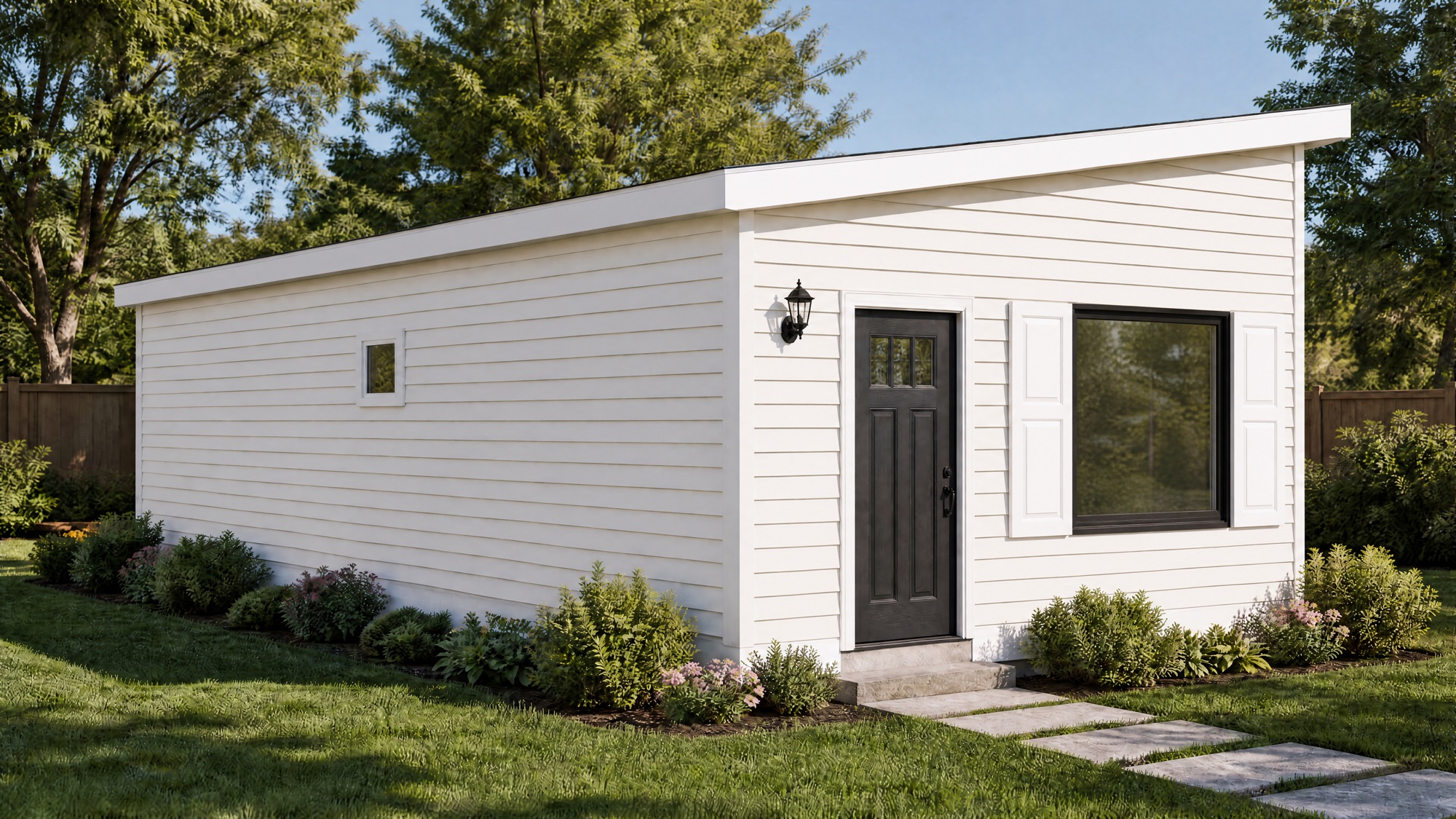 Available now
The Nest
Delivered to your parcel · 60–75 days
- PERCH-designed
- Escrow with proof
Refundable within 7 days.