Guides
ADU Rental Income to Offset Mortgage Payments
On this page
When the mortgage math finally makes sense.
There are two ways to look at the mortgage on the family house. One: the largest recurring expense in your monthly life, quietly grinding down your retirement account for the next 22 years. Two: an asset paired with an underused piece of land where you can build a rental unit that covers most or all of the debt service. The second way requires a construction loan and a decision. It changes the entire math.
Why this makes sense right now
The average American homeowner in 2026 pays $2,180/month in mortgage principal and interest, per Federal Reserve tracked data. Property tax and insurance add another $580/month on average. Total monthly housing cost: about $2,760.
Meanwhile, the median one-bedroom rent in the top 40 metros hit $1,900/month in Q3 2026 per Zillow Observed Rent Index. In the top 15 metros, above $2,400. A well-designed 500-650 sq ft backyard ADU commands roughly the same rent as a one-bedroom apartment in the same metro. On a typical primary mortgage, the ADU rental covers 60-90% of the monthly housing cost.
The construction financing environment supports the play. Fannie Mae HomeStyle Renovation loans and standard HELOC products now explicitly cover ADU construction on single-family lots. 38 states permit ADUs by right as of 2026. The friction that killed this play in 2015 has been legislated out of the way.
The layout — the ADU that produces the highest offset
The ADU designed specifically for mortgage-offset rental has five design decisions:
One bedroom, not a studio. A true one-bedroom rents $180-$340/month higher than a studio of the same square footage. Always build the one-bedroom.
Full kitchen, not a kitchenette. 24" range, dishwasher, full-height fridge. Renters look at the kitchen first. This is $6K-$12K in additional build cost that recovers in 18-30 months of rent.
In-unit laundry. Stacked washer/dryer costs $1,800 installed. Adds $75-$150/month in rent. Recovered in year one.
A private outdoor space. A fenced or hedged 100 sq ft patio is the difference between "backyard ADU" and "detached small home." Adds $100-$200/month in rent.
Separate metered utilities. Bumps build cost by $3,500-$6,000. Saves you an ongoing landlord headache and lets you rent at "utilities separate" (the standard in most markets).
Sweet spot on square footage: 550-680 sq ft. Below 500, rent per dollar starts to shrink. Above 800, marginal rent per additional square foot drops fast.
Two builders in 2026 doing rental-optimized ADUs well: Connect Homes — California, Washington, Colorado, Utah, 500 to 900 sq ft rental-optimized ADUs, $220K-$340K turnkey. Villa — California-focused, 500 to 800 sq ft rental-optimized floorplans, $190K-$310K turnkey.
Financing — the paths that make the offset math work
HELOC on the primary. Most common structure. Q3 2026 rates 8.25%-9.75%. Interest-only during 10-year draw. On a $250K HELOC at 8.75%, monthly interest is roughly $1,820. If the ADU rents at $2,000/month, the net after debt service is $180/month positive. Rent bumps compound; break-even to full offset lands in year 2-3.
Fixed HELOAN on the primary. Q3 2026 rates 7.5%-8.75%. Fully amortizing over 10-20 years. Higher monthly, rate is locked. Best when you want the offset math to hold through rate shocks.
Fannie Mae HomeStyle Renovation loan. Rate ~0.25-0.5% above conventional. Rolls the ADU cost into a single mortgage on the primary. Simplifies life dramatically. Best when you can also lower your primary rate in the process.
Cash from a taxable brokerage. For higher-net-worth families. Every dollar of rent flows to you directly. Payback becomes an opportunity-cost calculation rather than a cash-flow one.
Cash-flow math for a typical $250K rental-optimized ADU, HELOC-financed at 8.75%: interest cost year one ~$21,900. Rental income year one at $2,000/month ~$24,000. Property tax lift on the ADU ~$2,800. Insurance ~$600. Maintenance reserve ~$1,200. Net year one: about -$2,500 (near-breakeven). Year three, with modest rent bumps: positive $2K-$4K/year. Compound over the 25-year useful life: 9-14% annualized total return.
The quiet part.
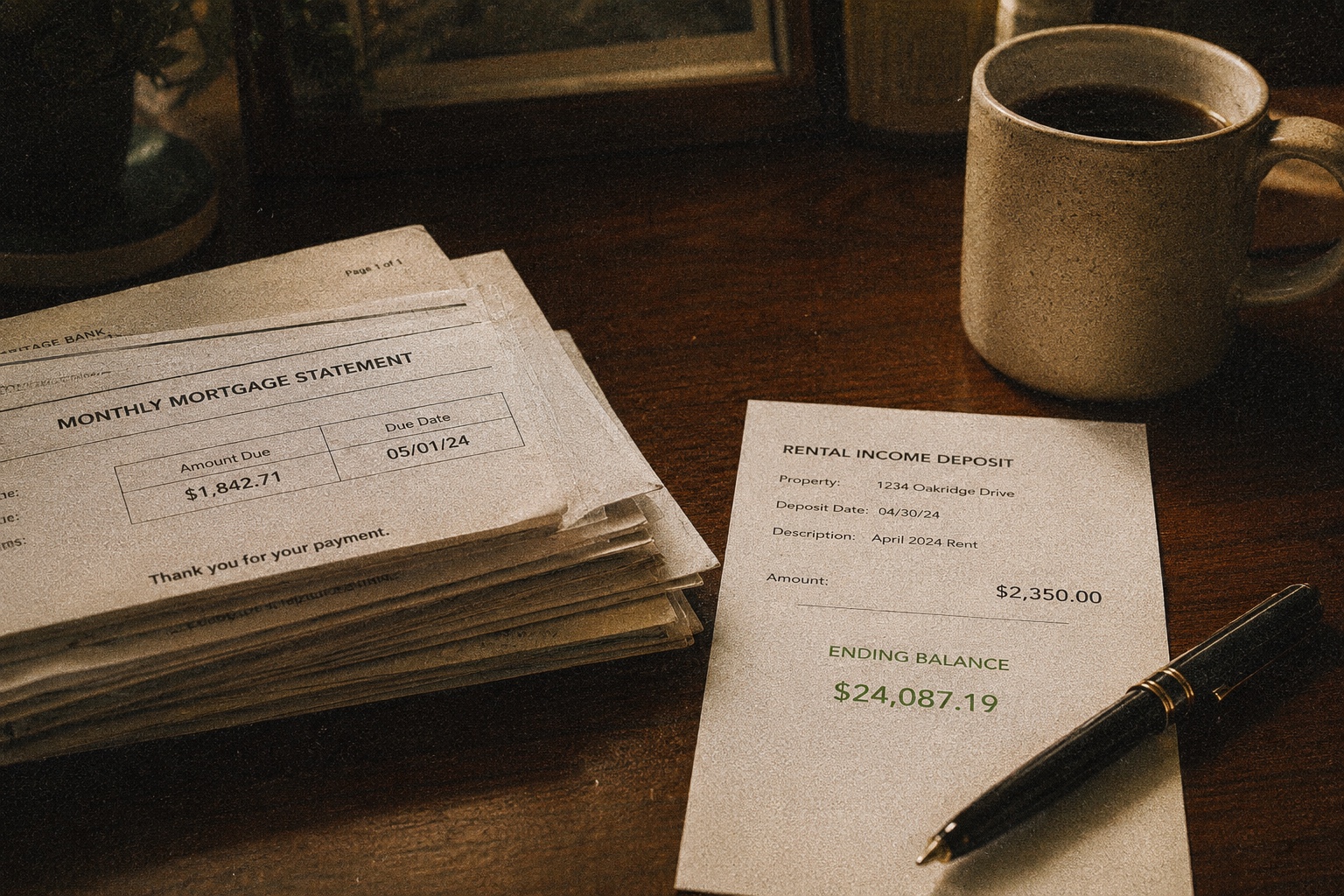
The mortgage payment on the family house feels different when it's paired with rent from the ADU behind it. Not because the number on the bill is smaller — the bill is the bill. It's because the mental accounting shifts.
The primary mortgage stops being "the drag on the retirement account." It becomes "the debt on the property that produces net income after the ADU tenant pays rent." That's a different sentence, and it changes what you feel every month when the deposit and the debit happen in the same week.
The couple that builds the ADU sleeps differently. Not because they'll be rich in twenty years (though they might be). Because the monthly panic gets smaller. That's worth more than most families will admit out loud.
Related guides
- ADU Rental Income: Financing & Return Guide — The ADU that pays for itself. And the marriage.
- ADU for Passive Income: 2026 Guide — House-hacking, for people who don't like the word "hacking."
- ADU Cost, Financing & Return Analysis — The backyard cottage. The forever loan payment. Discuss.
Join the conversation
Comments
Reader questions get answered. Real names and a working email — that's it.