Guides
Tiny Homes in Marietta, GA: The 2026 Cobb County Buyer's Guide
Marietta and the broader Cobb County tiny home market split sharply between city, incorporated cities, and unincorporated rural acreage. Here's the 2026 buyer's guide — what each jurisdiction permits, what placement actually costs, and the three buyer profiles that drive the market.
On this page
Marietta is one of metro Atlanta's most search-active submarkets for sub-1,000-square-foot homes, and it is also one of the most regulatorily misunderstood. Cobb County's zoning posture is restrictive on standalone tiny homes but accommodating on accessory dwelling units, the City of Marietta has its own ordinance overlay that further refines what is allowed, and the practical permit landscape splits sharply between unincorporated Cobb and the incorporated cities of Marietta, Smyrna, Kennesaw, and Powder Springs. Most search results for "tiny homes Marietta GA" lump the entire county together and miss the jurisdictional split that determines what will actually get built.
If you are looking for a tiny home in Marietta in 2026, the question is not "is this legal?" but "in the City of Marietta, in unincorporated Cobb, or in one of the adjacent incorporated cities — and as what classification of dwelling?"
The Marietta Jurisdictional Map
Marietta sits at the geographic center of Cobb County. The relevant jurisdictions for a tiny home buyer:
The City of Marietta proper covers roughly 23 square miles. Inside city limits, the residential zoning code requires a minimum primary residence square footage that varies by zone — typically 1,200 to 1,800 square feet depending on the specific district. Tiny homes under that threshold cannot be primary residences in most city zones, but are permitted as ADUs on parcels with a compliant primary residence and adequate lot area.
Unincorporated Cobb County wraps the City of Marietta and most other Cobb cities. The unincorporated areas, particularly in the northern county, have more permissive setbacks and minimum dwelling size requirements, and routinely permit modular and manufactured homes on rural and semi-rural acreage.
The adjacent cities — Smyrna to the southeast, Kennesaw to the north, and Powder Springs to the southwest — each have their own ordinances. Smyrna and Kennesaw are restrictive in the Marietta-pattern; Powder Springs has historically been somewhat more accommodating for manufactured housing.
Why the ADU Path Dominates in Marietta
For buyers focused on the City of Marietta and inner Cobb generally, the accessory dwelling unit path is the workable one. Cobb County and the City of Marietta both adopted ADU frameworks that permit a secondary dwelling on parcels with sufficient lot area and a compliant primary residence. The ADU framework requires the primary residence to remain owner-occupied in most cases, sets a maximum ADU size between 800 and 1,000 square feet depending on parcel, and imposes setback and parking requirements that vary by zone.
For a buyer who already owns a Marietta-area home with a sizable lot, ADU placement is the most predictable path. For a buyer who wants to purchase land specifically for a standalone tiny home, the path runs through unincorporated Cobb rural acreage or through one of the smaller adjacent municipalities with more permissive zoning.
What a Marietta Tiny Home Actually Costs in 2026
For a 400 to 800 square foot factory-built unit placed as an ADU or small primary residence in the Marietta area:
| Cost component | Typical 2026 range |
|---|---|
| Factory-built unit (400 to 800 sq ft) | $54,000 to $128,000 |
| Delivery and crane placement | $4,800 to $9,500 |
| Permanent foundation and anchors | $14,500 to $28,000 |
| Utility connections (water, sewer, electric) | $9,000 to $22,000 |
| Site prep, grading, driveway | $7,500 to $16,000 |
| Permits, inspections, certificate of occupancy | $2,200 to $5,500 |
| Cobb County tree replacement (where applicable) | $0 to $5,500 |
Delivered and permitted, the all-in total for a Marietta-area placement typically falls between $92,000 and $214,500 in 2026. Cobb County's tree-protection ordinance applies to most parcels with significant canopy and can add meaningful cost to placements on heavily-treed lots; placements on previously-cleared lots avoid most of that cost.
The Three Marietta Buyer Profiles
Three buyer profiles drive most of the Marietta tiny home market.
Profile 1 — Multi-Generational Family ADU Placement
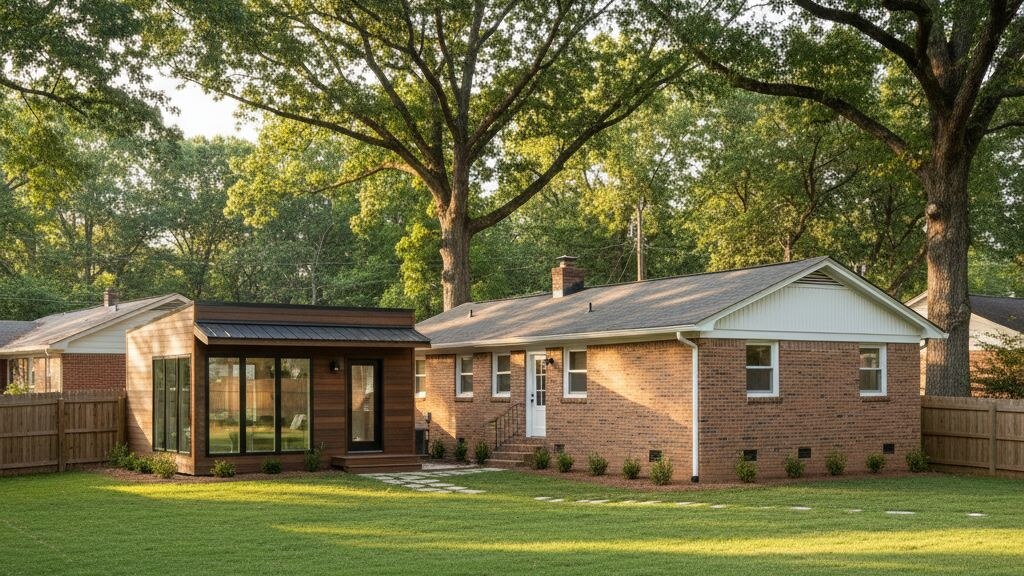
This is the most common Marietta buyer. A family owns a primary residence on a half-acre or larger lot inside the City of Marietta or in inner Cobb, and wants to place an ADU behind the main house for an aging parent, adult child, or returning college graduate. The path is well-trodden — Cobb County's ADU framework supports this configuration directly — and the cost is well below the cost of separate housing for the family member.
The limiting factor for this profile is typically not the home or the regulatory framework, but the parcel's existing conditions: utility connection points, tree canopy, slope, and the location of the primary residence relative to setbacks for the new structure. A Marietta-experienced site evaluator can usually identify the workable ADU footprint in a single visit.
Profile 2 — First-Time Homebuyer Seeking the Smallest Legal Primary Residence
This buyer wants the smallest legal primary residence the local jurisdiction will permit, on the most affordable parcel they can find. In the Marietta area, that path almost always runs through unincorporated Cobb County rural acreage rather than through the City of Marietta itself. Northern Cobb, particularly the rural portions near the Cherokee County line, has historically permitted smaller primary-residence footprints on adequate acreage.
The financing path for this profile is typically a manufacturer's in-house lender, a specialty manufactured-home lender like 21st Mortgage or Triad Financial Services, or a conventional mortgage after permanent foundation conversion and title cancellation.
Profile 3 — Investment Configuration for Long-Term Rental
A smaller cohort. Some Marietta-area buyers configure an ADU behind a primary residence as a long-term rental rather than a multi-generational family residence. Cobb County permits this configuration with the same ADU framework as Profile 1, with rental compliance handled at the county level. Short-term rental (Airbnb-style) is restricted across most Cobb jurisdictions and is not a workable configuration for an ADU in most parts of the Marietta area.
The Specific Marietta Sub-Submarkets
East Cobb (north of Marietta proper)
The most expensive land in Cobb County. East Cobb's large-lot residential character makes ADU placement viable on many parcels, but the high underlying land cost makes the financial calculus different from other parts of the county. Buyers here are typically multi-generational families rather than first-time homebuyers.
West Cobb (Powder Springs, Hiram, parts of unincorporated Cobb)
The most permissive Cobb sub-market for both standalone manufactured and modular placements on private acreage. The land cost runs significantly below East Cobb. The trade-off is the longer commute to the I-285 inner perimeter and the more rural character of the area.
North Cobb (Kennesaw, Acworth, near the Bartow line)
A middle path. Kennesaw and Acworth are restrictive on standalone tiny placements but adopt the broader Cobb ADU framework. The unincorporated portions near the Bartow County line are more permissive. Land costs run between East and West Cobb.
South Cobb (Smyrna, Mableton)
Closer to the airport and central Atlanta. Smyrna's ADU framework is conservative; Mableton was incorporated in 2022 and is still developing its specific ordinance posture. South Cobb buyers tend to focus on existing-residence ADU placements rather than land-acquisition standalones.
The Cobb-Specific Considerations
Cobb County's tree-protection ordinance is one of the most actively enforced in the Atlanta metro. Removal of protected trees on a parcel triggers either a replacement requirement or an in-lieu fee. For an ADU placement that requires significant tree removal, the cost can add several thousand dollars to the project. For a standalone tiny home placement on previously-cleared rural acreage, the ordinance has minimal impact.
Stormwater management requirements in the City of Marietta apply to new impervious surface above a defined threshold. A 400 to 800 square foot ADU with associated driveway and hardscape typically falls within the threshold for a simplified stormwater approach, but the requirement should be confirmed parcel-by-parcel before site work begins.
Septic versus municipal sewer is the largest single utility decision in the rural Cobb portions. Properties on municipal sewer require a tap fee and connection; properties on septic require either a new system installation or a confirmation that the existing system has capacity for the additional unit. A failed septic perc test is one of the most common deal-killers for rural Cobb tiny home projects.
How to Get Started in the Marietta Market
The realistic path for most 2026 Marietta tiny home buyers:
Step one is identifying which jurisdiction and which sub-submarket fits the household. East Cobb for multi-generational ADU, West Cobb for rural standalone, City of Marietta for inner-suburban ADU on an existing parcel. The jurisdiction selection drives every subsequent decision.
Step two is parcel-level evaluation. Whether the buyer already owns the parcel or is searching for one, the same evaluation applies: utility connection points, tree canopy, slope, septic versus sewer, setbacks, and the location of the existing primary residence (for ADU placements). A site visit with a Cobb-experienced builder or verified ADU builder in Georgia is the single highest-leverage hour in the process.
Step three is ordering the right factory-built unit from a Southeast-certified manufacturer. The wind and snow ratings for Cobb County are less demanding than Texas Gulf Coast spec but still require local-code compliance.
Step four is parallel-tracking site prep and permit application — the two longest portions of the timeline — so they finish near the same time rather than sequentially.
PERCH was built to make each of these four steps concrete and verified for Atlanta-metro buyers. Honest jurisdictional information, verified factories, real Cobb-specific timelines.
Ready to find your Marietta tiny home placement? Join the PERCH waitlist → for early access to verified inventory and Cobb-specific operator support.
Join the conversation
Comments
Reader questions get answered. Real names and a working email — that's it.