Guides
The Modular Home Buying Process: The 2026 Seven-Step Reference
Buying a modular home in 2026 follows seven distinct phases — and most failed projects fail because the buyer treated it as a single step. Here's the operator's reference for each phase, what it should cost, and what most often goes wrong.
On this page
Buying a modular home in 2026 is a seven-step process. The order matters, the dependencies between steps matter, and the buyers who treat the project as a single contract-and-delivery transaction lose months and tens of thousands of dollars to avoidable friction. The buyers who treat it as seven distinct phases — each with its own decisions, its own deliverables, and its own pitfalls — finish on schedule and on budget. This is the operator's reference for each phase.
The Seven Phases
Phase 1 — Parcel Evaluation and Acquisition
The first decision is whether the buyer already owns suitable land or needs to acquire it. If acquiring, the parcel evaluation precedes purchase: utility availability, soil conditions, slope, setbacks, deed restrictions, zoning, access for delivery equipment.
This phase typically takes 30 to 120 days when land acquisition is required, or one day when the buyer already owns the parcel. Skipping serious evaluation here causes most of the worst-outcome surprises later.
Phase 2 — Jurisdiction Selection and Feasibility
The buyer confirms which permitting jurisdiction the parcel falls under (city, county, or unincorporated county), reviews the applicable building code and zoning ordinance, and confirms that the planned configuration is workable on the specific parcel.
This phase typically takes 14 to 30 days. A conversation with the local building department or a parcel-level feasibility check by a verified operator is the most efficient way to complete it.
Phase 3 — Financing Pre-Approval
The buyer secures pre-approval for the financing pathway that fits the configuration: conventional mortgage with construction-to-permanent financing, FHA Title II, manufactured-home specialty lending, or a hybrid path.
This phase typically takes 21 to 45 days. The pre-approval should be specific to the modular configuration and foundation type — generic mortgage pre-approval is not sufficient for modular projects.
Phase 4 — Manufacturer and Operator Selection
The buyer selects the factory that will produce the unit and the contractor or operator that will handle site preparation, foundation, delivery, set, and finishing. Some operators handle both factory and site work; others specialize in one side.
This phase typically takes 30 to 90 days for serious evaluation. Selecting on price alone is the most common failure mode; selecting on documented installation history in the buyer's specific jurisdiction is the most reliable approach.
Phase 5 — Design and Contract
The buyer works with the manufacturer and operator to finalize the unit specification, the foundation specification, the utility connection plan, and the construction contract. Customization decisions, finish package selection, and option pricing all happen in this phase.
This phase typically takes 30 to 90 days. The contract should include line-item pricing across the seven components of total cost (unit, delivery, foundation, utilities, site prep, permits, finish).
Phase 6 — Permits and Construction
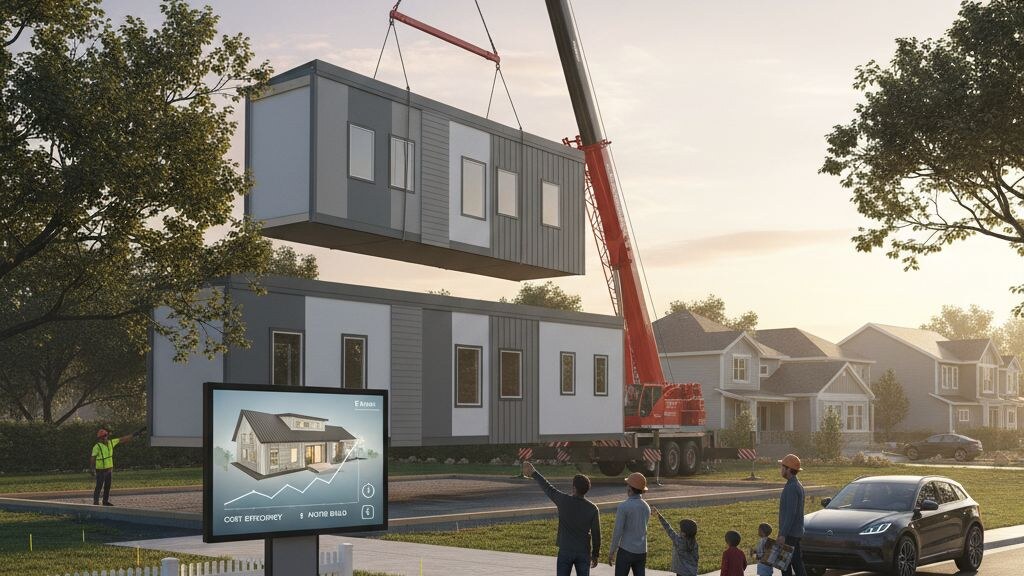
Permit application, site preparation, foundation pour, factory production, delivery, set, mechanical hookup, and finishing all happen in this phase. Modular's timeline advantage versus site-built is realized here — factory production runs in parallel with site preparation, compressing the total elapsed time.
This phase typically takes 90 to 240 days depending on jurisdiction permit cycles and operator scheduling. Parallel-tracking permits and site prep is essential to realizing the compressed timeline.
Phase 7 — Final Inspection and Occupancy
The final building inspection, certificate of occupancy issuance, utility activation, and buyer move-in. Any punch-list items from the construction phase are completed in this phase.
This phase typically takes 7 to 30 days after construction completion. Most failed move-in dates result from one of the construction-phase inspections being missed or failing, requiring rework before final occupancy.
What Typically Goes Wrong
Three patterns account for most failed modular projects.
The first is parcel-related: the buyer commits to a parcel before confirming feasibility for the planned configuration, then discovers post-purchase that the parcel cannot accommodate what they wanted to build.
The second is financing-related: the buyer secures generic mortgage pre-approval that does not specifically support modular construction, then discovers at draw-schedule setup that the lender's actual modular underwriting is stricter than the pre-approval suggested.
The third is operator-related: the buyer selects an operator on price without verifying installation history in the specific jurisdiction, then discovers during construction that the operator's first modular project in that jurisdiction is the buyer's project.
PERCH was built precisely to compress this seven-phase process. The verified operator directory covers every US region, with documented installation history and jurisdiction-specific expertise.
Where PERCH Fits
PERCH was built specifically to compress the operator-and-process work this guide describes. The verified ADU and small-home builder directory covers operators in each US region with documented installation history, real references, and traceable post-sale support. The marketplace surfaces verified inventory for buyers comparing options across configurations.
Ready to apply this to your specific project? Join the PERCH waitlist → for early access to verified operator inventory and concierge buyer support.
Join the conversation
Comments
Reader questions get answered. Real names and a working email — that's it.