Guides
Inspections at Every Stage of a Modular Project: The 2026 Operator's Reference
A modular project passes through approximately eight inspection points from foundation to occupancy. Missing any one of them creates documentation gaps that surface at refinance, at insurance renewal, or at resale.
On this page
A modular home project passes through approximately eight inspection points between foundation pour and certificate of occupancy. Each inspection verifies a specific aspect of the project against the applicable building code, manufacturer specification, or jurisdiction requirement. Missing any one of them creates a documentation gap that surfaces later at refinance, at insurance renewal, at resale, or at the next code-compliance event. Most failed inspection sequences fail not because the work was bad but because the inspection coordination dropped between buyer, builder, and jurisdiction. This is the 2026 operator's reference.
The Eight Inspection Points
Inspection 1 — Foundation Pre-Pour (Footing or Slab Forms)
Verifies that the foundation forms are placed correctly, reinforcement is in place per spec, and the prepared site matches the approved foundation plan. Performed before concrete pour. Failed inspection means the pour cannot proceed until the form work is corrected.
Inspection 2 — Foundation Post-Pour (After Cure)
Verifies that the cured foundation matches the dimensional and structural specification. Performed after the concrete has cured to inspection-ready strength. Failed inspection means remediation work before unit set can proceed.
Inspection 3 — Underground Utility Rough-In (Pre-Backfill)
Verifies that water, sewer, and underground electrical lines are placed correctly, joints are sealed, and connections meet code. Performed before trench backfill. Critical because underground inspection failures are dramatically more expensive to remediate after backfill.
Inspection 4 — Unit Set and Anchorage
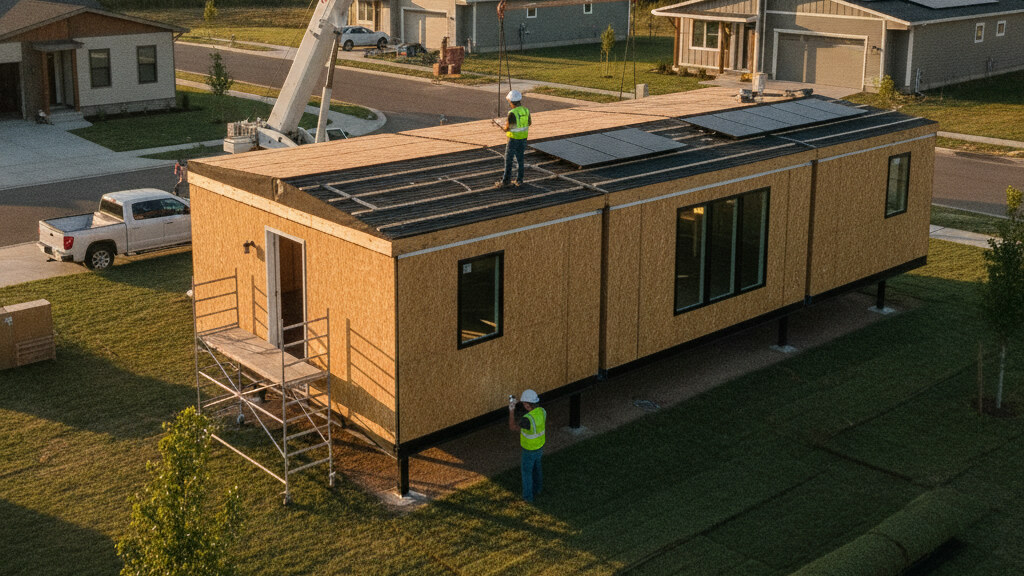
Verifies that the factory-built unit is correctly positioned on the foundation, anchored per manufacturer specification, and structurally tied to the foundation. Performed after unit set, before site-side work begins.
Inspection 5 — Mechanical Connection Rough-In
Verifies water and gas connections from utility laterals to the unit, electrical service connection from meter to unit panel, and HVAC connection if applicable. Performed before final mechanical cover-up.
Inspection 6 — Interior Mechanical and Electrical (Where Site-Completed)
For units shipped with partial-finish interior, verifies that site-completed mechanical and electrical work meets code. For units shipped move-in ready with all mechanical factory-completed, this inspection may be combined with Inspection 5.
Inspection 7 — Exterior Finish (Siding, Roofing, Skirting Where Site-Completed)
For units shipped with partial exterior finish, verifies that site-completed exterior work meets code. For units shipped with all exterior factory-completed, this inspection may be limited to verifying connection points and seal integrity.
Inspection 8 — Final and Certificate of Occupancy
The final building inspection that verifies all prior inspection items are complete, the unit meets occupancy code, and the certificate of occupancy can be issued. The buyer cannot legally occupy the unit until this inspection passes and the certificate is issued.
What Each Inspection Verifies
Each inspection has a specific scope and a specific code reference. The inspector's job is to verify the scope items against the code reference and either pass, fail, or require correction-and-reinspection.
A passed inspection is documented in the jurisdiction's permit record and (typically) in the buyer's project file. The documentation becomes part of the unit's permanent record and is referenced at refinance, at insurance renewal, and at resale.
A failed inspection requires remediation of the noted deficiencies, scheduling a reinspection, and passing the reinspection before subsequent work can proceed. Failed inspections add time and (sometimes) cost to the project.
How Inspection Coordination Typically Fails
Three patterns account for most inspection coordination friction.
The first is calendar misalignment. The contractor is ready for inspection but the inspector is not available within the contractor's working window; the contractor moves to other work while waiting; the inspection happens but subsequent work is delayed.
The second is documentation misalignment. The inspector arrives expecting one configuration based on the permit application; the as-built differs; the inspection cannot be completed until the discrepancy is resolved.
The third is responsibility misalignment. The buyer assumes the builder is coordinating inspections; the builder assumes the buyer is coordinating; the inspection is not scheduled and the project stalls.
How to Manage Inspection Coordination
The realistic 2026 approach:
Identify in advance who is responsible for inspection coordination — typically the general contractor or operator, but confirmed in writing at contract signing. The PERCH verified operator directory covers operators with documented inspection-coordination track records.
Build inspection scheduling into the project timeline with realistic windows. Inspections typically require 5 to 10 business days lead time in busy jurisdictions; planning for that lead time in the project schedule prevents stalls.
Verify that each inspection is documented in the jurisdiction's permit record after completion. Inspection documentation gaps surface later; addressing them in real time is dramatically cheaper than reconstructing the documentation years later.
Address failed inspections immediately. The cost of a failed-inspection remediation typically increases with the time elapsed since the failure; addressing the issue while the original conditions are still in place is most efficient.
The buyer's role in inspection coordination is typically minimal during the active phase — the operator handles the scheduling and the technical work. The buyer's role is most important in the documentation phase post-construction, where the buyer's records archive provides the long-term reference.
Where PERCH Fits
PERCH was built specifically to compress the operator-and-process work this guide describes. The verified ADU and small-home builder directory covers operators in each US region with documented installation history, real references, and traceable post-sale support. The marketplace surfaces verified inventory for buyers comparing options across configurations.
Ready to apply this to your specific project? Join the PERCH waitlist → for early access to verified operator inventory and concierge buyer support.
Join the conversation
Comments
Reader questions get answered. Real names and a working email — that's it.