Guides
Container Homes for Sale in 2026 — Prices, Sizes, Delivery, and the Buyer-Pool Reality
Container home prices, delivery cost, permits, and the strategic reality that portability opens a nationwide buyer pool. The neutral marketplace view.
On this page
The neutral marketplace view of the container home category. Prices, models, sizes, delivery cost, permits, and the strategic reality that portability changes who the buyer is.
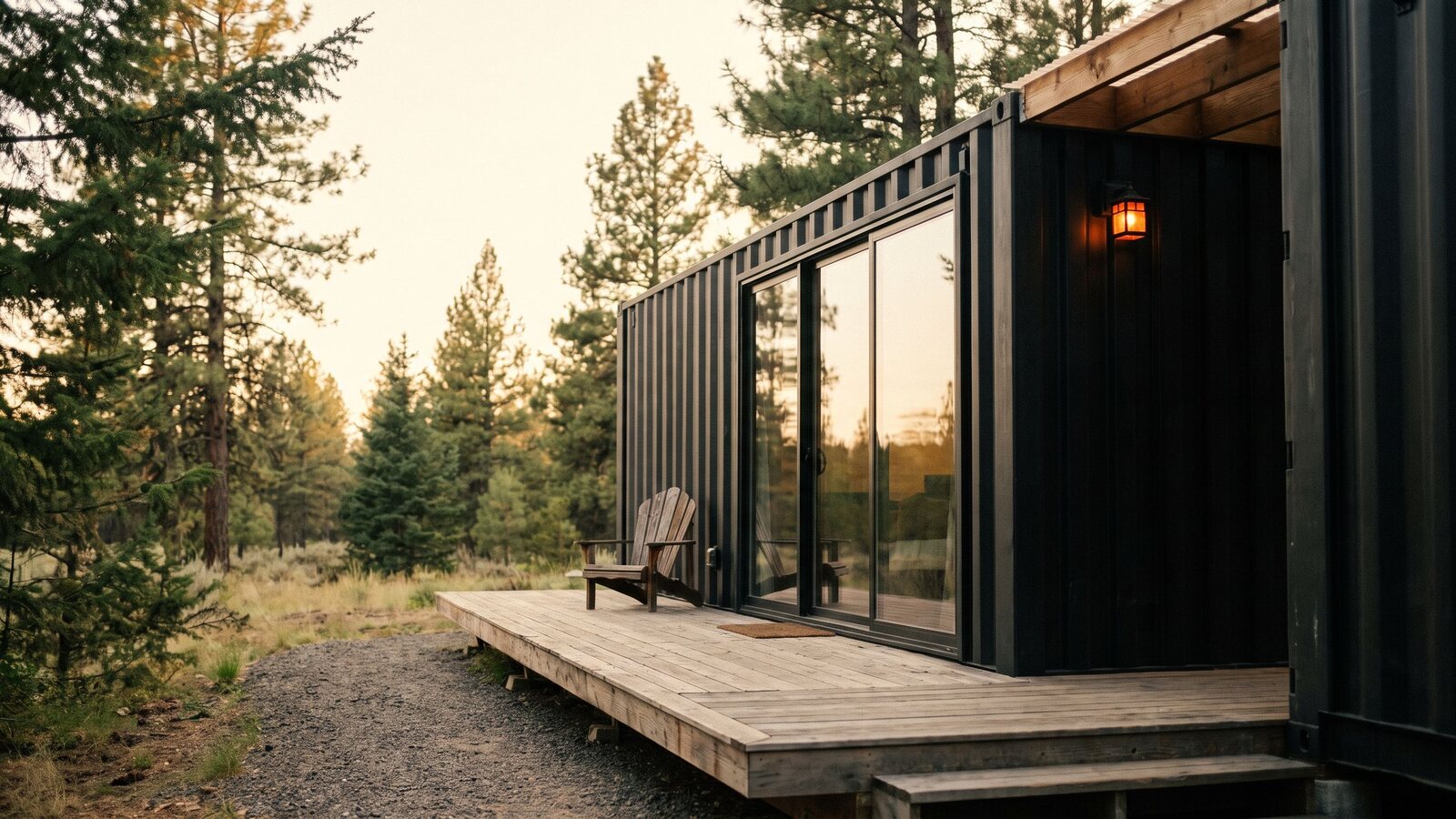
Container homes for sale in 2026 typically range from about $30,000 for a small single-container studio through $200,000+ for a fully-outfitted multi-container residence. The category has matured — manufacturers are shipping standard models with warranties, off-grid options are common, and expandable and pop-out models have brought interior square footage well above what a raw shipping container implies. Buyers can order factory-built, dealer-supplied, or resale, and the home can be delivered anywhere in the country.
This is the neutral view of the market — models, prices, delivery realities, permits, and who is actually buying and selling container homes right now.
The short version
- Small studio container homes start around $30,000-$45,000 for a single 20-foot conversion, delivered but not sited.
- Standard one-bedroom container homes run $55,000-$95,000 for a 40-foot single-container build with full kitchen, bath, and HVAC.
- Multi-container and two-story models run $95,000-$200,000+, comparable to a small site-built home but delivered in weeks not months.
- Delivery adds roughly $1.50-$3.00 per loaded mile plus $3,000-$8,000 for setup at the destination.
- Permits vary widely by county. The most container-home-friendly regions are Texas, Arizona, New Mexico, Tennessee, and the Carolinas. Some coastal California counties still require a variance.
What a container home actually is in 2026
The term "container home" now covers three distinct product categories:
True shipping container conversions. A used or new 20-foot or 40-foot ISO shipping container is cut, insulated, wired, plumbed, and finished as a habitable structure. Doors and windows are added. Wall insulation is critical because steel conducts. These homes preserve the raw-container aesthetic and typically start at the lowest price point.
Container-inspired factory-built homes. Structurally similar to shipping containers but built specifically as homes from the beginning, often with better insulation, higher ceilings, and more window area. Manufacturers like Custom Container Living and Backcountry Containers occupy this middle tier.
Multi-container and expandable homes. Two, three, or more containers joined together, or single containers with hydraulic pop-out sections. These deliver 500-1,500 square feet of interior space and are competitive with modular home pricing. The upper end includes off-grid solar packages, high-end kitchens, and full three-bedroom layouts.
The category buyer needs to know which of the three they are actually shopping for, because the prices and the finish quality vary dramatically across them.
Container home price ranges in 2026 — the honest breakdown
Price ranges below reflect current 2026 asking prices from active manufacturers and marketplaces. All prices are for the home itself, delivered but not sited (no foundation, hookups, or permits).
Single 20-foot container home (studio)
- Range: $28,000-$48,000
- Interior: 130-160 square feet
- Configuration: studio with kitchenette, bathroom, sleeping area
- Best for: guest houses, ADUs, off-grid cabins, short-term rentals
Single 40-foot container home (1-bed)
- Range: $55,000-$95,000
- Interior: 280-320 square feet
- Configuration: bedroom, full bathroom, kitchen, living area
- Best for: primary residence for a couple, rural retreat, ADU
Expandable pop-out container home
- Range: $45,000-$85,000
- Interior: 400-700 square feet (expanded)
- Configuration: expandable living area, bedroom, kitchen, bathroom
- Best for: buyers who want more interior space without a multi-container setup
Multi-container homes (2 containers, 1-2 bed)
- Range: $95,000-$160,000
- Interior: 640-900 square feet
- Configuration: 1-2 bedrooms, kitchen, bathroom, living
- Best for: full-time residence for small households
Multi-container homes (3+ containers, 2-3 bed)
- Range: $140,000-$220,000+
- Interior: 900-1,400 square feet
- Configuration: 2-3 bedrooms, 1-2 bathrooms
- Best for: primary family home, permanent residence
The gap in each range reflects finish quality. The low end is basic insulation, standard fixtures, and vinyl or laminate finishes. The high end includes upgraded insulation, quartz counters, hardwood flooring, tile bathrooms, and appliance packages.
What buyers routinely miss when pricing
The listed price is the home. It is not the total cost. Three add-ons that catch first-time buyers:
Site preparation. Level the lot, pour a pier foundation or concrete pad, run utility lines to the site. Typically $5,000-$25,000 depending on lot condition and utility distance.
Delivery. $1.50-$3.00 per loaded mile from the factory to the destination. Setup at the destination adds $3,000-$8,000 for crane placement, connection to utilities, and inspection sign-off.
Permits. Highly variable. Some rural counties charge $500 for a basic building permit. Others require full engineered plans, impact fees, and setback variances totaling $5,000+.
Total cost for a $60,000 single-container home delivered and sited is typically $75,000-$95,000, depending on site condition, distance from the factory, and county permit costs. Owners who budget only the container price get an unpleasant surprise at permitting.
The U.S. Department of Housing and Urban Development publishes guidance on manufactured and factory-built home standards that generally applies to container homes when they are certified for permanent residence.
Delivery — the reality of shipping a container home
A container home is a large, heavy object. Delivery is a real logistics operation.
Distance pricing: $1.50-$3.00 per loaded mile. A single-container home delivered from Texas to Colorado (roughly 850 miles) runs $1,275-$2,550 in transport alone.
Multi-container homes typically deliver in sections. Each container ships separately and is joined on-site by a crew and a crane. Multi-container delivery of a 3-container home in the same distance range would run $3,825-$7,650.
Crane and setup at the destination is a separate cost — $3,000-$8,000 depending on lot access and container placement complexity.
Permits for the delivery route may be required if the load exceeds standard truck dimensions. The transport company usually handles this, but the cost is passed to the buyer.
Total delivery + setup on a single-container home from a mid-country manufacturer to any U.S. destination usually runs $6,000-$14,000.
Permits and zoning — where container homes are welcome
Container homes occupy a strange zoning space. They are factory-built, but not always HUD-certified. They are habitable, but not always inspected under standard residential codes. The result: county-by-county variation.
Container-friendly regions in 2026:
- Texas (particularly rural counties and unincorporated areas)
- Arizona (Mohave, Cochise, Yavapai counties known for permissive rules)
- New Mexico (most of the state permits container homes as accessory or primary dwellings)
- Tennessee (rural counties, minimal restriction)
- North Carolina and South Carolina (varies by county)
- Rural Colorado (particularly at higher elevations)
- Rural Oregon and Washington
Where container homes face resistance:
- Coastal California counties (often require variance or full engineered plans)
- Most urban and suburban jurisdictions in the Northeast
- HOA-controlled communities (regardless of state)
Before ordering, buyers should contact the county building department in the destination location and ask two specific questions: is a container home permitted as a primary or accessory dwelling, and what are the plan review and inspection requirements. Both answers vary. The Manufactured Housing Institute tracks state-level regulatory frameworks that indicate which states are most receptive.
Portable is the point — nationwide buyer pool
The strategic reality that shapes both pricing and marketability: a container home can be moved.
That means the buyer pool is national. A container home built at a Texas factory can be delivered to a buyer in Michigan, Colorado, Georgia, or Florida. Delivery is a cost line, not a barrier. This is the single largest difference between the container home category and traditional site-built or foundation-affixed manufactured homes.
For buyers, that means the sourcing decision is not "what does the local dealer have" — it is "what is the best home I can buy in the country, delivered." The full inventory of every U.S. container home manufacturer is effectively accessible.
For sellers of used container homes, that means the buyer pool is not the county or the state — it is anyone in the country who wants a delivered container home. The clearing price on a used container home listed to a national buyer pool is often 20-40% higher than one listed only locally.
That is the reason PERCH exists as a national marketplace. Container homes should be sold to the widest possible pool. Local classifieds under-price them.
Selling a container home — the seller-side reality
If the article above describes buying, this section is for the reader who owns a container home and wants to sell it.
The used container home market is thin locally in most parts of the country. There simply are not enough local buyers in a specific county for a container home to clear at retail on a local marketplace. The correct move is to list nationally.
Real 2026 pricing for used container homes:
- Single 20-foot studio, 3-5 years old, good condition: $22,000-$38,000
- Single 40-foot 1-bed, 3-5 years old, good condition: $42,000-$78,000
- Multi-container, 3-5 years old, good condition: $75,000-$150,000
Add-ons increase the resale price: solar packages, upgraded insulation, permanent decks, and any permits already secured at the current location.
The paperwork for a used container home sale is generally simpler than a manufactured home sale, because container homes are usually not HUD-titled. A purchase agreement and a bill of sale cover the transfer. Escrow settlement through a licensed service like a licensed escrow service protects both sides on wire-transfer risk.
Selling with delivery included is the norm for used container homes. Buyer pays delivery separately or negotiates it into the sale price.
What PERCH does for container home buyers and sellers
PERCH is the marketplace for modular, manufactured, container, tiny, and small-format homes — the ones the industry stopped counting. Buyers see verified container home listings routed by size, price, and delivery region. Sellers get their listing routed to pre-qualified national buyers, escrow settlement through licensed escrow settlement in all fifty states, and a notarizable bill of sale and purchase agreement template — provided at the point of listing.
Listing is free right now.
Or get the Seller's Field Guide — free PDF, twenty pages, everything you need to price and list. Send me the guide →
Sources
- U.S. Department of Housing and Urban Development, Manufactured Housing Programs
- Manufactured Housing Institute — state fact sheets and regulatory framework
- Consumer Financial Protection Bureau — Manufactured Home Loans guidance
- Licensed escrow settlement — money-transmitter framework, all 50 states
- Custom Container Living — active manufacturer pricing data
Related on PERCH
- Bill of Sale for a Manufactured Home
- Sell a Manufactured Home Without Losing 20–40% to a Cash Buyer
- Mobile Home Purchase Agreement Template
Join the conversation
Comments
Reader questions get answered. Real names and a working email — that's it.