Guides
Construction-to-Permanent Loans for Prefab Construction: The 2026 Buyer's Reference
A construction-to-permanent loan finances the prefab build phase and converts to a long-term mortgage at completion in a single closing. For most modular and many manufactured projects, it is the cleanest financing path — but only when the buyer understands the draw schedule.
On this page
A construction-to-permanent loan is a single-closing financing product that funds the prefab or modular build phase and converts to a long-term mortgage at project completion. For most modular projects and many manufactured-home permanent-foundation projects, it is the cleanest financing path in 2026 — eliminating the need for separate construction and mortgage closings and locking the long-term rate at the start of the project. The product is straightforward when it works. It fails when the buyer or the lender misunderstands the draw schedule. This is the 2026 reference.
How the One-Time-Close Structure Works
A traditional separate-construction-and-mortgage structure requires the buyer to close two distinct loans: a short-term construction loan that funds the build phase, and a separate long-term mortgage that pays off the construction loan at completion. Each closing has its own underwriting, its own closing costs, and its own rate-setting.
A construction-to-permanent loan combines both functions into a single closing. The loan funds the build phase through scheduled disbursements (draws), and at completion converts automatically to the long-term mortgage at the rate set at initial closing.
The advantages: one closing instead of two, one underwriting cycle instead of two, and rate certainty for the long-term portion locked at the start of the project. The trade-offs: more complex initial underwriting, and the draw schedule complexity inherited from the construction loan side of the structure.
The Draw Schedule
The draw schedule defines when the lender disburses funds during construction and what milestones trigger each disbursement. Typical milestones for a modular project:
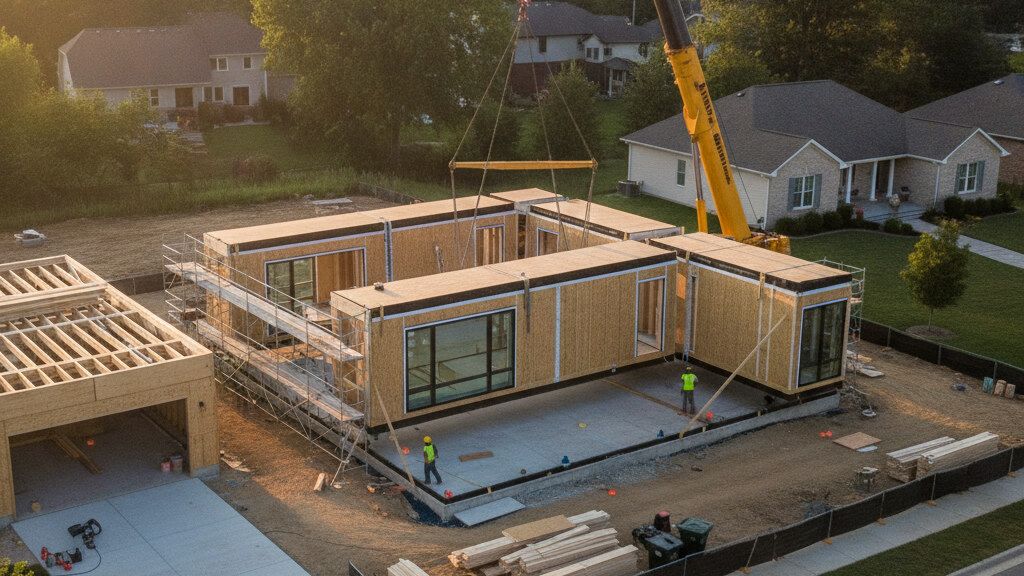
Initial draw at foundation pour. Draw at factory production start. Draw at unit delivery to site. Draw at unit set on foundation. Draw at utility connection completion. Final draw at certificate of occupancy.
Each draw requires inspection-confirmation that the milestone has been reached. The inspection is typically performed by the lender's inspector, the buyer's general contractor, or a third-party inspector depending on the lender's process.
Misalignment on the draw schedule is the single most common cause of construction-loan stalls. The builder needs funds to continue work; the lender needs inspection confirmation to disburse. If the inspection coordination is loose, the builder waits, the project slows, and the buyer's project timeline extends.
Qualification Requirements
Construction-to-permanent loan qualification is typically stricter than standard mortgage qualification because the lender is committing to fund both the construction phase and the permanent loan based on the buyer's profile and the project's plan.
Typical requirements:
Credit score typically 680+ for most lenders' construction-to-permanent products. Debt-to-income ratio within standard guidelines, calculated against the long-term mortgage payment (not the construction-phase interest-only payment). Detailed project plan with line-item budget, manufacturer specification, and operator selection documented. Down payment typically 20%+ for most lenders, though some lenders accept lower for specific configurations. Verified land ownership or land acquisition included in the loan.
The qualification process typically takes 30 to 60 days from application to loan approval.
How to Avoid the Common Construction-Loan Failures
Three failures account for most construction-loan stalls.
The first is draw-schedule miscoordination. The remediation is detailed upfront agreement among buyer, builder, and lender on exactly what inspection confirmation is required at each draw and who is responsible for scheduling it.
The second is unexpected change orders during construction. Construction-loan budgets are typically locked at initial closing; significant changes during construction may require loan modification or buyer-funded additional cost. The remediation is detailed pre-construction design and specification to minimize mid-project changes.
The third is jurisdiction permit delays. If permits are not in place at the scheduled construction start, the construction loan funds are typically held until permits issue. The remediation is filing permits before initial loan closing, or aligning the construction-loan timeline with realistic permit cycles.
Lender Availability
Construction-to-permanent loans for modular construction are available from a smaller subset of lenders than standard mortgages. Local and regional banks with construction lending desks are typically more receptive than large national mortgage lenders. Modular-specific lender networks accessible through manufacturer or operator referral can also be productive starting points.
Buyers should specifically confirm the lender's modular construction experience and recent draw-schedule track record before committing. The PERCH verified ADU and small-home builder directory includes operators who have worked successfully with specific construction-to-permanent lenders in each major US region.
Where PERCH Fits
PERCH was built specifically to compress the operator-and-process work this guide describes. The verified ADU and small-home builder directory covers operators in each US region with documented installation history, real references, and traceable post-sale support. The marketplace surfaces verified inventory for buyers comparing options across configurations.
Ready to apply this to your specific project? Join the PERCH waitlist → for early access to verified operator inventory and concierge buyer support.
Join the conversation
Comments
Reader questions get answered. Real names and a working email — that's it.