Guides
Ready-to-Move Tiny Homes vs Build on Site: The 2026 Decision Guide
The buyer choosing between a ready-to-move tiny home and a build-on-site small dwelling is making one of the more consequential decisions in alternative housing. Here's the 2026 guide — five comparison dimensions, three configuration-specific recommendations, and the decision process.
On this page
The buyer choosing between a ready-to-move tiny home and a build-on-site small dwelling is making one of the more consequential decisions in the alternative housing market in 2026. The two paths produce structurally different end products, follow different regulatory pathways, finance through different lenders, appraise on different comp curves, and resell into different markets. Most of the published comparisons treat the decision as a simple cost calculation; the actual decision involves cost, timeline, customization, regulatory pathway, financing access, resale market, and the buyer's tolerance for the operational complexity of site-built construction. This guide walks through what each path actually delivers, where each wins, and how to make the decision for your specific configuration.
If you are choosing between a ready-to-move tiny home and a build-on-site option in 2026, the question is not "which is cheaper?" but "which path's full-cycle outcome — cost, timeline, customization, financing, resale — best matches your specific configuration and tolerance for complexity?"
What Each Path Actually Delivers
The Ready-to-Move Path
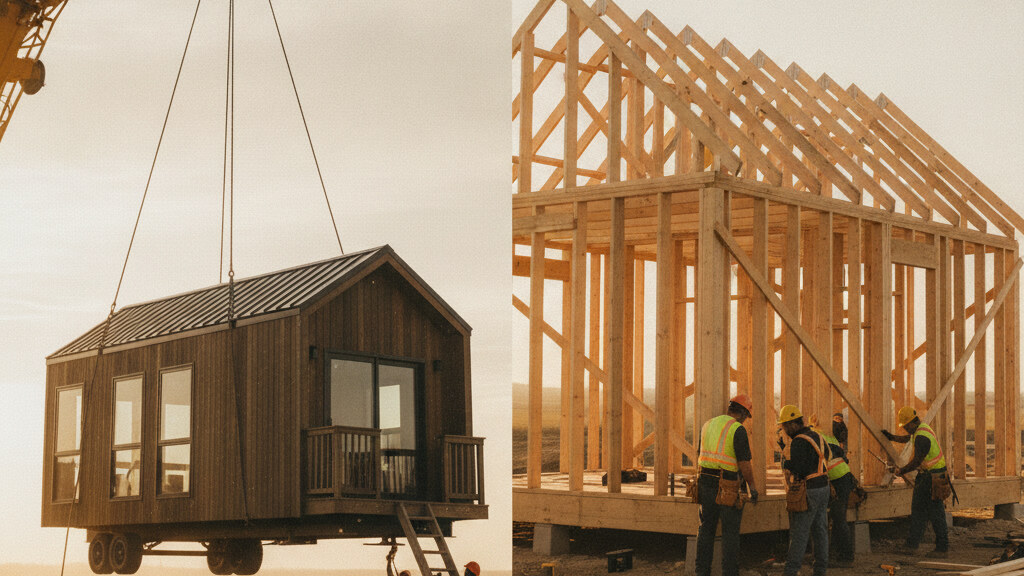
The buyer purchases a factory-built unit from a manufacturer or dealer, arranges delivery to the site, prepares foundation and utility connections, sets the unit on the foundation, completes utility hookup, secures permits and inspections, and occupies. The unit's construction itself is done at the factory before delivery; the buyer's site responsibilities focus on the foundation-and-utility layer.
The end product is a factory-built dwelling, classified for legal and regulatory purposes as either HUD-Code manufactured, state-spec modular, or RVIA-certified depending on the unit's construction standard. The unit can be installed on a permanent foundation (typical for primary residences and most ADU placements) or on a temporary foundation (typical for movable configurations).
The operators in this category include the full prefab tiny home builder set: Plant Prefab, Dvele, Connect Homes, Stillwater Dwellings, Method Homes, Abodu, Cover, Neo Smart Living, and the regional manufactured-housing operators like Clayton Homes.
The Build-on-Site Path
The buyer engages an architect or designer for plans, an engineer for structural and systems engineering, a general contractor for the build, and the appropriate subcontractor trades (framing, plumbing, electrical, HVAC, finishing, roofing). The construction happens at the site, starting from foundation pour and continuing through framing, dry-in, mechanical rough-in, finish, and final completion.
The end product is a site-built dwelling, classified for legal and regulatory purposes as conventional residential construction. The unit follows the same building code requirements as a full-size single-family home and is treated identically to surrounding site-built construction for appraisal, insurance, and resale purposes.
The operators in this category include general residential contractors with small-dwelling experience and the architect/designer/contractor teams that typically serve custom-build small-dwelling projects.
The Five Comparison Dimensions That Matter
Timeline
Ready-to-move tiny homes typically complete from contract signature to certificate of occupancy in 4 to 8 months. The factory production runs in parallel with site preparation; the on-site portion is compressed to foundation, set, utility hookup, and inspection.
Build-on-site small dwellings typically complete in 8 to 18 months from architect engagement to certificate of occupancy. The work is sequential — design, permit, foundation, framing, dry-in, mechanical rough-in, finish — and each phase depends on completion of the prior phase.
For timeline-constrained buyers, ready-to-move wins decisively. For buyers with timeline flexibility, the timeline difference matters less.
Cost
Ready-to-move tiny homes in the 600 to 900 square foot range typically deliver all-in for $115,000 to $325,000 depending on finish tier and parcel conditions. The cost is largely fixed at contract signature, with limited variability from factory pricing.
Build-on-site small dwellings in the same square footage range typically run $185,000 to $485,000 all-in. The cost variability is higher — open-bid finish work, change orders during construction, and material cost variability during the longer timeline all contribute to cost overrun risk.
For most US small-dwelling buyers in 2026, ready-to-move runs lower on both expected cost and cost variability. For some specific configurations, particularly highly-custom or design-priority builds, the cost difference compresses or inverts.
Customization
Build-on-site wins decisively on customization. The unit is designed specifically for the parcel, the buyer's preferences, and the local context. Every dimension, finish, and detail is chosen during the design phase.
Ready-to-move provides customization within the manufacturer's option set, which varies by operator. The premium-prefab operators (Plant Prefab, Dvele, Connect Homes, Stillwater Dwellings, Method Homes) offer substantial customization within their architectural language. The affordability-focused and regional manufactured-housing operators offer more limited customization typically focused on finish options and floor plan selection.
For buyers prioritizing design distinctiveness or parcel-specific configuration, build-on-site is the natural path. For buyers willing to work within an established product family, ready-to-move accommodates substantial preference variation.
Regulatory Pathway
Ready-to-move tiny homes follow the regulatory pathway determined by their legal classification — manufactured, modular, or RV-classified. The path is generally simpler than full residential construction because the unit's structural and systems compliance is documented at the factory.
Build-on-site small dwellings follow conventional residential construction regulatory pathways — full plan review, multiple-stage inspections, and the same permitting cycle as a full-size single-family home. The path is more involved but is also better-understood by most permitting offices because it matches the standard residential construction model.
The two paths typically take comparable total permitting time, with the ready-to-move path more compressed in the active inspection portion but requiring more upfront documentation of the factory-built unit's classification.
Financing
Build-on-site typically has the most established financing pathway. Conventional mortgage products treat site-built construction identically to existing-home purchases. Construction-to-permanent loans are well-developed and widely available for site-built work.
Ready-to-move financing varies by unit classification. Modular units on permanent foundations qualify for conventional mortgage products comparable to site-built. Manufactured units on permanent foundations after title cancellation also qualify. RV-classified units require RV financing with different terms. The financing pathway is more fragmented than site-built but is generally workable for permanent-foundation installations.
For buyers with strong conventional credit and standard underwriting profiles, both paths are typically financeable. For buyers with non-standard profiles, the build-on-site path tends to have more options.
Resale Market and Appraisal
Build-on-site small dwellings appraise on the same comp curve as surrounding site-built construction. The unit is treated identically for appraisal, insurance, and resale purposes.
Ready-to-move appraisal depends on classification. Modular units on permanent foundations typically appraise comparable to site-built construction; manufactured units on permanent foundations typically appraise on the manufactured-housing comp curve, which can run at a discount to site-built in some markets. RV-classified units depreciate on the vehicle comp curve and do not appreciate on the housing comp curve.
For long-term value retention and resale market access, the build-on-site path generally wins. For shorter-term ownership or use-case-focused buyers, the appraisal difference matters less.
The Configuration-Specific Recommendation
The right path depends on the configuration. Three configurations cover most US buyers.
Configuration 1 — ADU Placement
For an ADU placement on an existing residential parcel, ready-to-move typically wins. The timeline compression, the cost predictability, and the factory-built quality control all favor the ready-to-move path. Build-on-site for ADUs makes sense primarily for buyers with strong design preferences or parcel-specific constraints that the factory-built option cannot accommodate.
Configuration 2 — Small Primary Residence on Rural Acreage
For a 600 to 900 square foot primary residence on rural or exurban acreage, ready-to-move often wins on cost and timeline. Build-on-site can be competitive when the parcel has specific design constraints or when the buyer wants substantial customization. Long-term appraisal and resale market access tends to favor build-on-site for permanent-residence configurations the buyer intends to occupy long-term.
Configuration 3 — Premium Design-Priority Build
For a buyer prioritizing architectural design distinctiveness, custom finishes, and parcel-specific integration, build-on-site is the natural path. The premium ready-to-move operators (Plant Prefab, Dvele, Connect Homes, Stillwater Dwellings, Method Homes) compete in this segment with strong architectural products, but the maximum customization available through factory production is less than the maximum available through site-built design.
How to Decide for Your Configuration
The realistic 2026 decision process:
Step one is timeline. If you need occupancy in less than 9 months, ready-to-move is typically the only viable path. If your timeline is flexible to 12 to 18 months, both paths remain in consideration.
Step two is budget. If your total budget is below $250,000 for a 600 to 900 square foot unit on a typical parcel, ready-to-move tends to be the workable path. If your budget supports $300,000 to $500,000, both paths are accessible.
Step three is customization priority. If your design preferences fit within the option set of a premium prefab operator, ready-to-move accommodates. If your preferences require parcel-specific architectural response or substantial deviation from any operator's standard, build-on-site is the natural path.
Step four is long-term ownership and resale plan. If you plan to occupy long-term and care about appraisal and resale comp comparability with surrounding site-built, build-on-site has long-term advantages.
Step five is comparing actual quotes. Request a ready-to-move quote from at least one operator and a build-on-site quote from at least one local residential contractor for a comparable end configuration. The line-item comparison typically reveals which path fits your specific configuration better than the general comparison can.
PERCH was built to make the ready-to-move side of this comparison concrete for buyers. The PERCH marketplace surfaces verified operators with documented configurations, transparent pricing, and verifiable delivery track records. The verified ADU and small-home builder directory covers each major US region.
Ready to compare ready-to-move tiny homes against build-on-site for your configuration? Join the PERCH waitlist → for early access to verified operator quotes.
Join the conversation
Comments
Reader questions get answered. Real names and a working email — that's it.