Guides
How Big Is an Average Backyard in Feet? The 2026 Reference
The average American backyard in 2026 isn't a single number — it's a range from 2,000 to 7,500 square feet that varies by subdivision era, region, and lot orientation. Here's the reference, with the ADU planning math underneath.
On this page
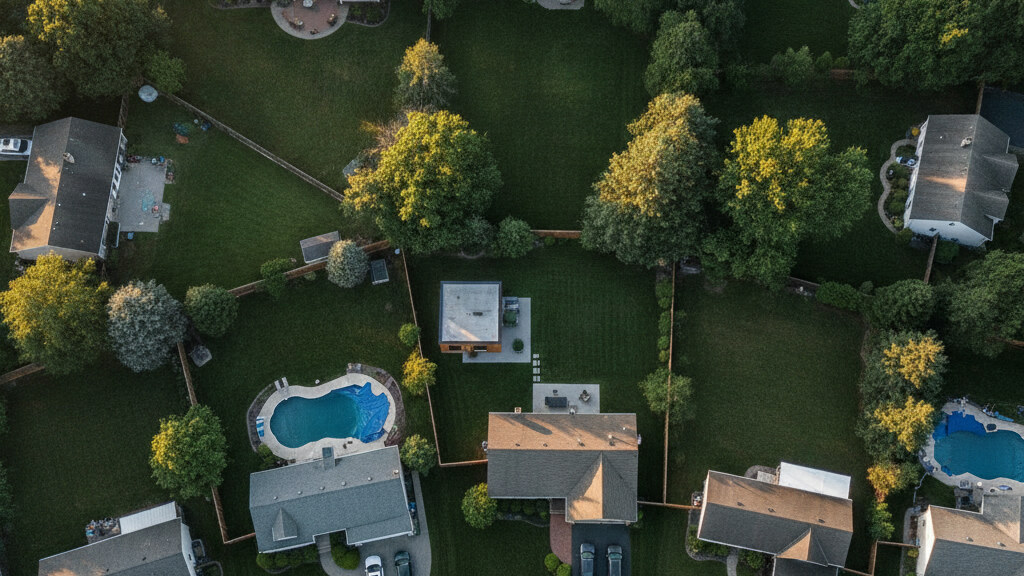
The average American backyard is meaningfully smaller in 2026 than it was a generation ago, but the headline averages most often cited obscure dramatic differences by region, by metro density, by age of subdivision, and by lot orientation. The same phrase — "average backyard" — describes a 600-square-foot patio rectangle behind a townhouse in inner Atlanta, a 4,800-square-foot lawn behind a 1990s suburban single-family in Phoenix, and a 28,000-square-foot pasture behind a rural acreage parcel in Tennessee. The 2026 numbers worth knowing are not a single average but a set of ranges that map to what the buyer is actually trying to plan around.
If you are asking how big the average backyard is in feet, the question almost always sits underneath another question — can I fit a pool, an ADU, a workshop, a play area, or some combination — and the right answer is the range that matches your actual planning goal.
What "Average" Actually Means Here
The phrase "average backyard size" is used three different ways depending on the source. Each gives a different number.
The first usage is the average lot size minus the average building footprint. This is the methodology behind most published statistics from real estate analytics firms and from US Census Bureau housing data. It produces a figure for the average residual yard area on a typical single-family residential lot — the area not occupied by the house itself, the driveway, or other structures.
The second usage is the average usable rear yard area specifically — the portion of the residual yard area that sits behind the house, excluding front yard, side yards, and any rear-yard area occupied by garages, sheds, or driveway runs. This is the figure most useful for planning ADU placements, pool construction, or workshop builds.
The third usage is the average outdoor living area as designed — patio plus lawn plus landscaped area in the rear yard treated as a unified outdoor space. This figure is most useful for landscape and outdoor-living design.
When you encounter a number cited as "average backyard size," the methodology behind it matters. A 4,200 square foot residual-yard figure and a 2,100 square foot usable-rear-yard figure both describe the same typical American single-family lot — just measured differently.
The 2026 Ranges, By Property Type
Detached Single-Family in a Newer Subdivision (2010s and later)
Newer single-family subdivisions in most US metros are designed for higher residential density than their 1970s and 1980s counterparts. Lot sizes typically fall in the 4,000 to 7,000 square foot range, with house footprints occupying 1,500 to 2,800 square feet of that, and the remaining yard area split between front, side, and rear.
The typical rear yard in this configuration runs approximately 1,200 to 3,000 square feet — usable for a small patio, modest lawn, and a single structural addition like a small ADU or a workshop, but not multiple major elements. Pool construction in this configuration typically requires using most of the available rear yard area.
Detached Single-Family in a Mid-Century Subdivision (1950s–1980s)
The classic American suburban backyard. Lots are larger, often 8,000 to 18,000 square feet. House footprints are smaller relative to lot size, often 1,400 to 2,200 square feet. The result is a rear yard frequently in the 5,000 to 12,000 square foot range — enough for a pool, an ADU, a workshop, a play area, and meaningful lawn simultaneously.
This is the configuration most Americans of a certain age remember as "a backyard." It is also the configuration most actively being subdivided as in-fill development converts these lots into multiple smaller ones.
Detached Single-Family on Rural or Exurban Acreage
A different category entirely. Acreage parcels run from approximately 0.5 acres (about 21,780 square feet total lot area) up to multi-acre rural configurations. Backyard area is more meaningfully measured as a fraction of an acre rather than as a fixed square footage. A typical 1-acre rural lot might have 30,000 to 35,000 square feet of rear yard area after the house footprint, driveway, and any outbuildings.
Townhouse and Patio Home
A much smaller configuration. Townhouses and patio homes typically have rear yard areas in the 300 to 1,200 square foot range — a courtyard, a small patio, or a narrow rear strip rather than what most buyers picture as a backyard. The configuration trades yard area for the financial accessibility of attached-housing construction.
The Average Backyard By Region
Regional patterns matter as much as property type. Three regional patterns dominate.
The Sunbelt expansion-era subdivisions of Phoenix, Las Vegas, Dallas-Fort Worth, Houston, Atlanta, and Orlando trend toward larger lot sizes than the equivalent-era subdivisions in the Northeast and Mid-Atlantic. A 1990s Phoenix single-family typically has a meaningfully larger backyard than a 1990s Boston-area single-family on a similar-priced lot.
The Mid-Atlantic and Northeast traditional suburbs (much of New Jersey, Connecticut, eastern Pennsylvania, suburban New York) trend toward smaller lot sizes overall but with proportionally more of the lot allocated to rear yard than front yard. The result is rear yards comparable to or slightly larger than Sunbelt rear yards on smaller overall lots.
The dense urban metros — San Francisco, central Los Angeles, central Chicago, Boston proper, Washington DC, central New York — have meaningfully smaller backyards across the board, with much of the housing stock townhouse or patio-home format rather than detached single-family.
What This Means For ADU Planning
The single most common reason buyers search for "average backyard size in feet" is ADU planning. The 2026 reality:
A detached ADU under 750 square feet — the typical maximum permitted in most US metros' ADU frameworks — requires a usable rear yard area of approximately 1,200 to 2,000 square feet at minimum, after setbacks, primary-residence-distance requirements, and required path-and-access clearances.
A 2,000 square foot rear yard accommodates a small ADU with limited remaining yard area. A 4,500 square foot rear yard accommodates an ADU plus meaningful remaining outdoor space. A 12,000 square foot rear yard accommodates an ADU, a pool, and a workshop simultaneously with room left over for landscaping.
The relevant question is not "what is the average backyard size?" but "what is the usable rear yard area on this specific parcel, and what configuration of additions does it support?" A parcel-level evaluation is essential before any meaningful planning. PERCH's verified ADU builder directory connects buyers with operators who can perform that parcel-level evaluation.
How to Measure Your Actual Backyard
Three methods produce a usable estimate.
The first is pulling the parcel record from your county assessor's office. The recorded lot dimensions and the house footprint together give a calculable residual-yard area. Most county assessors publish parcel maps online; the dimensions are typically accessible without a fee.
The second is using a satellite-imagery tool like Google Earth or Bing Maps to trace the actual outline of your rear yard area. The measurement tool in these applications gives a calculable square footage for any traced polygon.
The third is a physical measurement on the ground with a long tape or a wheel measure, particularly useful for irregular lot shapes that satellite imagery does not capture accurately.
For ADU planning, the satellite measurement plus a confirmed setback verification from the local jurisdiction is typically sufficient for initial feasibility. The final design and permit work requires a surveyor's stamped plat.
What Affects Usable Backyard Area
Beyond the raw rear-yard dimension, four factors meaningfully affect usable area.
Setbacks from the rear property line, the side property lines, and the primary residence reduce the buildable footprint within the gross rear yard area. Setbacks are jurisdiction-specific and parcel-specific; the recorded subdivision restrictions and the local zoning ordinance together define the actual buildable area.
Tree canopy and protected-tree status — particularly meaningful in Atlanta, Austin, Portland, Seattle, and several other metros with active tree ordinances — can effectively remove portions of the gross rear yard area from the buildable footprint.
Easements, particularly utility easements, can prevent construction over portions of the rear yard regardless of other constraints.
Slope and drainage characteristics can convert technically-buildable rear yard area into impractical or expensive-to-develop area. A steeply-sloped rear yard often has substantially less usable footprint than its gross square footage suggests.
Why the Backyard Question Matters for Housing Policy
The shift toward smaller backyards in newer subdivisions is one of the most-visible changes in American single-family housing over the last two decades. The reasons are several: rising land cost, increasing residential density in metropolitan growth areas, changing buyer preferences toward less-maintenance outdoor space, and changing builder economics favoring smaller-yard configurations.
For the buyer planning an ADU, a workshop, a pool, or any other meaningful rear-yard addition, the trend matters. Newer subdivisions often do not have the residual yard area to support major additions. Older subdivisions typically do.
For the buyer specifically planning around tiny home or modular home placement, the PERCH ADU builder directory and the related understanding ADUs guide cover the parcel-level evaluation and configuration planning the backyard-area question is usually trying to answer.
Ready to evaluate what your specific backyard supports? Join the PERCH waitlist → for early access to verified ADU planning support.
Join the conversation
Comments
Reader questions get answered. Real names and a working email — that's it.