Guides
Expandable Modular House Cost: The 2026 Real Numbers
Most published expandable modular house cost figures are ex-factory shell prices that omit the bulk of the buyer's actual spend. Here's the 2026 line-item breakdown — what each component actually costs, the realistic total at three price tiers, and the two factors that drive variance within each tier.
On this page
The expandable modular house has become the most-searched cost-question category in alternative housing in 2026, and most of the published cost figures are either ex-factory shell prices that omit the bulk of the buyer's actual spend, or aspirational price tags from listings that have never delivered to a US address. The realistic delivered, permitted, and habitable cost for an expandable modular house in the US in 2026 sits in a band roughly two-to-four times the ex-factory shell price, depending on parcel conditions, regional code requirements, and the level of factory finish. This guide breaks down where each dollar of the actual cost goes and shows what realistic 2026 quotes look like at the entry, mid, and premium ends of the category.
If you are pricing an expandable modular house in 2026, the question is not "what does the unit cost?" but "what does the unit plus delivery plus foundation plus utilities plus permits plus interior completion total — and which of those costs scale with the parcel rather than with the unit?"
The Cost Stack — Why the Ex-Factory Price Is Only Part of the Story
The most common mistake an expandable modular buyer makes is anchoring on the ex-factory shell price as the project budget. The shell price is one of seven cost components that combine to produce the actual buyer spend.
Component 1 — Factory Unit Ex-Factory
The price the manufacturer charges for the unit at the factory door. For a legitimate US-market expandable modular house in 2026, this runs approximately $32,000 to $85,000 for a 20- to 40-foot expandable unit, with the higher end reflecting better-quality construction, higher-spec interior finish, and US-spec compliance documentation.
Sub-$20,000 ex-factory listings on consumer marketplaces typically represent either shell-only units without interior systems, uncertified import units that cannot be permitted in US jurisdictions, or both.
Component 2 — Logistics and Inland Freight
For US-distributed prefab from US factories, delivery cost typically runs $4,800 to $9,500. For US-distributed prefab from international factories — which describes a meaningful share of the expandable container house market — import logistics, ocean freight, port handling, and inland freight to the buyer's site combine to typically $6,500 to $14,500.
Component 3 — Permanent Foundation
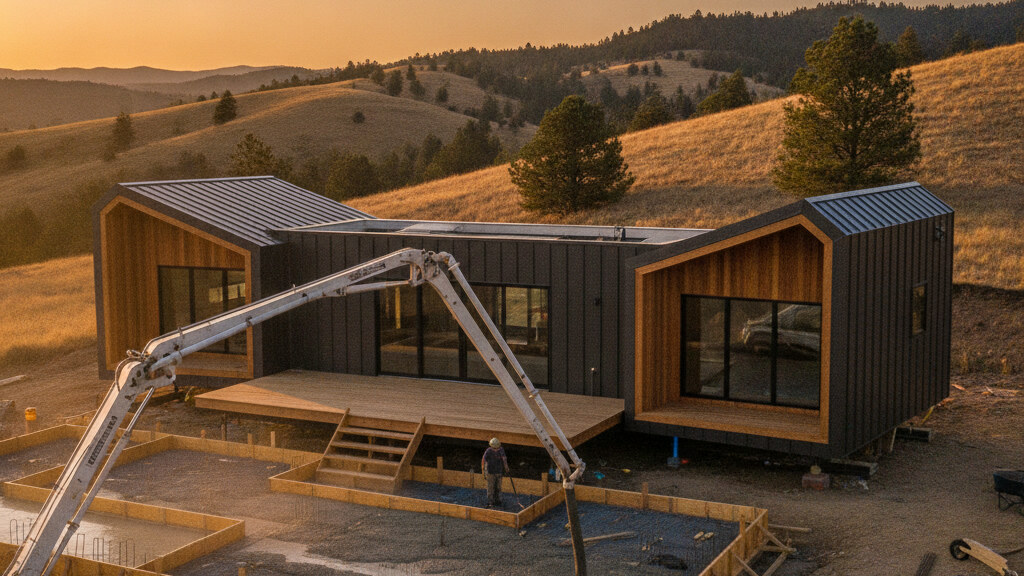
The single most consistently-underestimated cost in the category. A permanent foundation for an expandable modular house — concrete pad with anchor systems, or pier-and-beam with anchor systems depending on jurisdiction — typically runs $14,500 to $28,000. The cost varies with site conditions: a flat, accessible parcel with stable soil runs at the low end; a sloped parcel, a parcel with challenging soil, or a parcel requiring extended access for equipment runs at the high end.
For coastal placements requiring elevated foundations to FEMA Special Flood Hazard Area standards, the foundation cost can run substantially higher.
Component 4 — Utility Connections
Water, sewer (or septic), electric, and (where applicable) gas connections to the unit on site. The cost varies dramatically with parcel conditions. A parcel with municipal water and sewer at the lot line runs at the low end ($9,500 to $14,000). A parcel requiring new septic installation, well drilling, or extended electrical service runs at the high end ($18,000 to $32,000).
Component 5 — Site Preparation
Grading, driveway, access path for the delivery and crane equipment, hardscape, and any required tree removal or vegetation clearing. Typically $7,500 to $16,000. The cost varies with parcel slope, existing access infrastructure, and the local tree-protection or stormwater ordinance.
Component 6 — Permits, Inspections, and Certificate of Occupancy
Building permit, plan review, inspections at foundation, framing-equivalent (for the expansion mechanism), utility connections, and final occupancy. Typically $1,800 to $5,500 depending on jurisdiction and the unit's classification under the local building code.
Component 7 — Regional Code Upgrades and Interior Completion
For coastal-county placements requiring elevated wind ratings (Texas Gulf Coast, Florida, the Carolinas), seismic-zone placements requiring earthquake-rated installation (California, the Pacific Northwest), or cold-climate placements requiring upgraded insulation and snow-load construction (Mountain West, Northeast), the regional code premium typically adds $2,200 to $9,500.
For units shipped as shell-only or partial-finish, the interior completion scope — kitchen, bath, finished flooring, fixtures — typically adds $12,000 to $24,000.
The Realistic Quote at Three Price Points
Entry-Level — Approximately $78,000 to $108,000 All-In
A 20-foot expandable unit from an affordability-focused operator like Alternative Living Spaces or a comparable distributor. Standard interior finish, basic appliance package, conventional code spec without coastal or seismic upgrades. Placed on a flat, accessible rural parcel with municipal water and septic, in a non-coastal non-seismic jurisdiction. The configuration that fits a budget-priority first-time buyer or a rural-acreage primary residence.
Mid-Tier — Approximately $115,000 to $165,000 All-In
A 20- to 40-foot expandable unit from a US-distributed prefab operator like Neo Smart Living or a comparable manufacturer. Mid-tier interior finish, full appliance package, regional code compliance for the specific jurisdiction, full utility infrastructure including stormwater and tree-protection compliance where applicable. The configuration that fits most multi-generational ADU placements and most accommodating suburban primary residences.
Premium — Approximately $165,000 to $206,500 All-In
A 40-foot expandable or larger unit from a premium prefab operator like Honomobo, Plant Prefab, or a comparable high-end manufacturer. Premium interior finish, full smart-home integration, premium appliance package, full code compliance for the most-demanding US jurisdictions, full site work including landscaping, hardscape, and integrated outdoor systems. The configuration that fits premium-buyer ADU placements and design-priority primary residences.
What Drives the Variance Within Each Tier
Two factors drive most of the variance within each pricing tier.
The first is parcel condition. The same expandable modular house placed on a flat, accessible, municipally-serviced parcel and on a sloped, remote, off-grid parcel can differ by $35,000 to $75,000 in foundation, utility, and site-work cost. The parcel often drives more cost variance than the unit specification.
The second is jurisdiction. Code requirements, permit fees, and inspection costs vary materially across US jurisdictions. A San Francisco Bay Area placement carries significantly higher permit and code-compliance cost than an unincorporated-rural-Texas placement, even for the same physical unit.
For buyers comparing quotes across operators, the most useful comparison is line-itemized cost by component rather than total project cost. Two operators quoting the same total can have very different cost structures, with implications for what is included, what is the buyer's responsibility, and what is the realistic risk of cost overrun.
How to Get a Real Quote in 2026
The realistic process for getting an accurate expandable modular house quote:
Step one is parcel evaluation. Soil, slope, utility availability, access dimensions, jurisdiction code requirements, deed-restriction status. Without this, no quote is accurate.
Step two is configuration specification. Unit size, finish level, appliance package, regional code upgrades, foundation type. Different operators specify in different ways; consistent specification across quotes is essential for apples-to-apples comparison.
Step three is line-itemized quote request from at least three operators. Total-only quotes are not useful; the line-item breakdown is what reveals which operator has realistic cost expectations and which is anchoring on a low headline number.
Step four is contractor reference verification. The operator's most-recent three permitted-and-occupied installations in jurisdictions comparable to the buyer's. Without this, the quote is theoretical.
PERCH was built precisely to compress this four-step process. The PERCH marketplace surfaces verified operators with documented line-item pricing, real installation track records, and concierge support for the parcel-evaluation step that determines whether any quote is realistic for a specific site.
Ready to get a real quote on an expandable modular house? Join the PERCH waitlist → for early access to verified operator quotes and parcel-evaluation support.
Join the conversation
Comments
Reader questions get answered. Real names and a working email — that's it.