Guides
ADU vs Guest House vs Accessory Structure: The 2026 Definitions
The phrases ADU, guest house, casita, in-law unit, accessory structure, and detached unit describe overlapping but legally distinct configurations. The right phrase for the right configuration unlocks the right regulatory pathway.
On this page
The phrases accessory dwelling unit, guest house, casita, in-law unit, granny flat, accessory structure, and detached secondary unit all describe overlapping but legally distinct configurations. The regulatory pathway that applies to your project depends on which phrase actually describes what you are building, in which jurisdiction, on what parcel. The wrong phrase routes a project through the wrong permit office, applies the wrong building code, and triggers the wrong inspection sequence. This is the 2026 definitions guide.
The Definitions That Matter for Permitting
Accessory Dwelling Unit (ADU)
A self-contained dwelling unit on a parcel that already has a primary residence. ADUs have full kitchen facilities, full bath facilities, and dedicated sleeping area. They are permitted as legal residential units and can be occupied as primary or secondary residence for long-term occupants.
ADUs follow the local jurisdiction's ADU ordinance, which typically specifies maximum square footage, setback requirements, parking requirements, owner-occupancy requirements (in some jurisdictions), and rental restrictions (in some jurisdictions).
Detached ADU
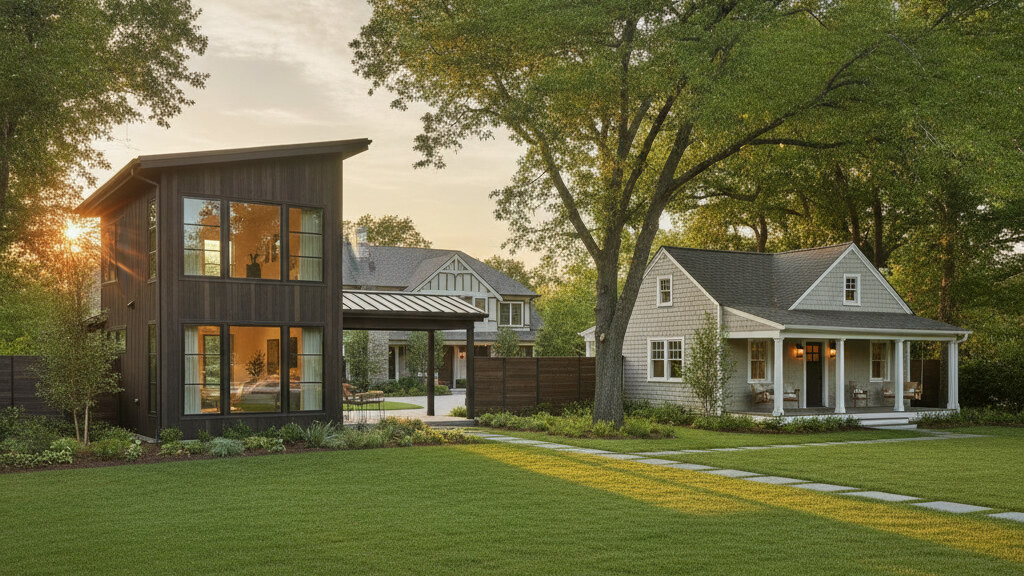
An ADU constructed as a separate structure on the parcel, distinct from the primary residence. The dominant configuration in most US ADU frameworks. Permits as a detached residential structure with its own foundation, utility connections, and address.
Attached ADU
An ADU constructed as an addition to the primary residence, with its own entrance and self-contained facilities but sharing one or more walls with the primary structure. Permits as an addition to the primary residence with the ADU portion meeting all ADU ordinance requirements.
Junior ADU (JADU)
A specific California category for very small ADUs (typically under 500 square feet) created within the existing footprint of the primary residence. Has separate permitting requirements that are typically simpler than full ADU permitting.
Conversion ADU
An ADU created by converting existing space — a basement, a garage, an attic — to a self-contained dwelling unit. The configuration uses the existing structural shell and adds the kitchen, bath, and entrance required for ADU classification.
Guest House
A secondary residential structure that does not have full kitchen facilities and therefore does not qualify as a dwelling unit under most local zoning frameworks. Used for short-term guest accommodation rather than long-term occupancy. Permits as an accessory structure rather than a dwelling unit. Cannot be rented as a residence in most jurisdictions.
Casita
A regional term (primarily Southwest US, with Spanish-language origin) for what is functionally either an ADU or a guest house depending on the specific unit's facilities. The term has no specific regulatory meaning; the actual permitting follows the unit's actual facilities.
In-Law Unit
A regional informal term, primarily Northeast and Midwest US, for an ADU used by family members. The term describes the use (housing an extended family member) rather than the construction type or regulatory classification. The actual permitting follows the unit's actual facilities and the local ADU framework.
Granny Flat
A regional informal term, primarily Australian and British origin but adopted in some US markets, for an ADU. Same as "in-law unit" — describes the use, not the regulatory classification.
Accessory Structure
The broader zoning category that includes ADUs, guest houses, workshops, storage buildings, detached garages, and other secondary structures on a residential parcel. Accessory structures may or may not be dwelling units depending on their specific facilities and permitting.
Why the Distinction Matters
The phrase used in the application drives the permitting pathway, and the permitting pathway determines:
Whether the unit can be occupied as a residence at all. Guest houses and most accessory structures cannot be primary residences.
Whether the unit can be rented. ADUs can typically be rented under the local ADU framework; guest houses typically cannot.
What kitchen and bath facilities must be installed. Full ADU facilities versus the limited facilities permitted in a guest house.
What parking and setback requirements apply. ADU requirements typically differ from accessory-structure requirements.
What permits and inspections are required. ADUs follow residential permit pathways; accessory structures follow accessory-structure permit pathways with different inspection sequences.
For a buyer planning a secondary unit, the right framing is the one that matches what the unit will actually do. If the unit will be a long-term residence, the phrase is ADU. If the unit will be a short-stay guest space, the phrase is guest house. Mis-categorizing creates the most expensive type of permit-stage friction.
The PERCH verified ADU builder directory covers operators experienced in the specific ADU framework of each US jurisdiction.
Where PERCH Fits
PERCH was built specifically to compress the operator-and-process work this guide describes. The verified ADU and small-home builder directory covers operators in each US region with documented installation history, real references, and traceable post-sale support. The marketplace surfaces verified inventory for buyers comparing options across configurations.
Ready to apply this to your specific project? Join the PERCH waitlist → for early access to verified operator inventory and concierge buyer support.
Join the conversation
Comments
Reader questions get answered. Real names and a working email — that's it.